Just as the potential benefits of sports for students have been questioned by Kappan authors, so, too, have the potential benefits of sports for schools.
The school extracurriculum is vast, comprising arts activities, social clubs, service organizations, and more. However, sports hold a particularly exalted place in American education. Team sports in particular are said to have value not just for the students who participate but also for the students, parents, and others who rally around the team.
But do the potential benefits of school sports make up for the costs? School athletics often require a significant investment of funds, time, and energy. Might students be better off if those investments were directed instead toward academics, or toward activities that focus not on competition among an exclusive few but on broader engagement and participation? These are some of the questions that Kappan authors have debated as they’ve considered what place sports should have in U.S. schools.
Athletics, academics, and attitudes
Much of the discussion about the role of sports in school has focused on whether participation in extracurricular competitive sports affects students’ grades. The debate goes back at least as far as 1940, when Benjamin Culley (“Athletes and grades,” April 1940) pointed out that many claims and counterclaims had been made about the academic performance of high school student athletes, but little actual data had been collected and analyzed. To address this data deficit, he studied the performance of students at the Los Angeles high school where he was a math teacher and coach.
Culley divided the boys at his school into three groups, based on their level of involvement in school sports, and he analyzed not just their grades but also their performance on a variety of other metrics, such as responsibility, curiosity, social concern, and work habits. His conclusion? Although the differences between athletes and non-athletes on these measures were small, athletes tended to perform slightly better.
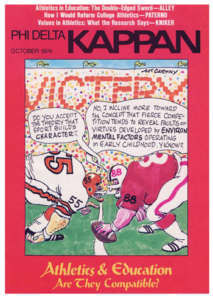
Of course, this small study was not enough to settle the matter. In October 1974, Kappan published an issue titled “Athletics and education: Are they compatible?” In that issue, Charles Kniker (“The values of athletics in schools: A continuing debate”) reviewed the existing research on the effects of athletics on participants and found it largely inconclusive. Yes, some studies showed a positive correlation between participation in school sports and student self-discipline, sportsmanship, social status, and grades, but, Kniker added, “even the researchers whose studies appear to support athletics urge caution in affirming that athletics cause changes in behavior” (p. 117).
Four decades later, in the May 2016 issue on “Schools and sports,” Daniel Bower and Collin Hitt put a more positive spin on athletics. School sports have always benefited students, they asserted, noting that “arguments made against preserving school-sponsored sports typically rely on anecdotal evidence or stereotypes that are often intuitively appealing but rarely backed by sound empirical evidence” (“History and evidence show school sports help students win,” p. 9). But after giving an overview of the research in this area, they, too, acknowledged that “it can be difficult to disentangle the extent to which participation produces academic benefits versus the possibility that student-athletes are just naturally higher-achieving students” (p. 10). Despite the research limitations, however, Bower and Hitt ultimately came out in favor of school sports:
We do not contend that school-sponsored athletics are perfect and should be preserved exactly as they are, even in the face of financial constraints. In tough financial times, everything should be scrutinized. Sports are no exception. But when we look at the larger body of evidence, we find that sports are a tradition in U.S. education that has genuinely benefitted students and their school communities. (p. 12)
Sports and the school
Just as the potential benefits of sports for students have been questioned by Kappan authors, so, too, have the potential benefits of sports for schools. In April 1961, Douglas Ward (“A proposal to put interscholastic athletics in their proper place”) complained that, despite being popular in many communities, high school sports, especially boys’ football and basketball:
give a lot of school people and parents headaches, a troublesome condition which appears to be endemic for seven or eight months of every year. The excitement and difficulties of high-school athletics are with us from the first day of “fall football practice” (in August or even late July) through the bright October days and on into winter when, mercifully, the locale of contests is transferred inside. It continues right up until summer sweeps northward. The group that suffers most acutely from “athletic headache” consists of conscientious teachers who must good-naturedly permit the teaching for which they are ostensibly employed to be set aside with disturbing frequency for pep assemblies; afternoon, evening, and Saturday practices; and student excursions to nearby and distant contests. (p. 276)
Although questioning the value of athletics was, Ward said, “about as popular as castigating motherhood” (p. 277), he wondered if it might be best to remove sports from schools and instead have them be managed by outside community youth programs:
By separating athletic programs from educational programs, their values may be enjoyed by players and public alike without detracting from the purposes for which schools were established. Much as we dislike admitting it, too many schools produce athletic teams to the neglect of their total educational programs. (p. 278)

The November 1982 Kappan (“School athletics: Out of bounds?”) took up the question of how schools should manage their sports programs. In an article titled “High school athletics: A Colorado story,” Elaine Yaffe discussed the high profile of sports programs in schools in the Colorado Springs area. Competition was getting more intense, students were specializing in more sports at younger ages to get a competitive edge, and schools were increasingly expected to provide better uniforms and more lavish facilities.
Defenders of the sports programs argued that games were good for not just the players, but also the cheerleaders, the band, and the community members who attended. But some in the community were frustrated that sports programs were receiving too much funding, to the detriment of other programs. Most of the money went to a few high-profile boys’ sports, and the drive to build those programs was, some argued, causing schools to prioritize hiring good coaches over hiring good teachers. Yaffe urged school leaders not to eliminate sports, but to be thoughtful about how they set their priorities:
This need for a balanced view of athletics is a moral as well as a financial necessity. Students ought to be learning to discriminate between what is and is not important. They should be helped to see that press boxes, whirlpool baths, matching sweatsuits and shoelaces and suspenders are not the point of athletics. Surely it would help them now, and our society later, if they learned that school districts, just like people, must live within reasonable limits. As a 17-year-old football player in District 2 put it, “It didn’t matter one bit that we couldn’t have black jerseys last year. It’s the attitude that counts.” (p. 181)
Coaches and sports culture
Some Kappan authors have questioned not the presence of sports in schools but the attitudes those sports seemed to promote. In October 1974, for example, Louis Alley (“Athletics in education: The double-edged sword”) saw value in sports for helping athletes develop valuable social skills, discipline, and physical and mental fitness. But the competitive atmosphere of many sports programs sometimes led students to develop unhealthy attitudes. As an example, he contrasted a U.S. student who kept playing in a basketball game even after biting off the tip of his tongue with a student in Burma who paused a game because he was tired and needed a break:
When you think about it, that’s a pretty good reason for stopping. But on the other hand, when you attempt to analyze the factors that must have motivated that junior high lad in Iowa City to swallow the blood, ignore the pain, and conceal his injury because he wanted to continue in a game — and when you note that the Rangoon lad, living in an environment where all these motivating factors did not exist, stopped at the critical part of a game merely because he was tired — you begin to develop an appreciation for the power of athletics in influencing behavior. (p. 103)
Alley decried the competitive nature of sports programs in U.S. schools, noting that a focus on winning meant most kids would end up on the bleachers and not enjoy the benefits of playing sports. The feeling of being left out may even lead those students to resent sports.
For Alley, “Athletics in education should be thought of as a two-edged sword, capable of cutting in opposite directions. The direction of the sword cuts depends on those who swing it, not on the sword itself ” (p. 104). Coaches devoted less to winning and more to learning, he argued, have the greatest potential to have a positive influence on young people.
In May 2016, multiple authors stressed the role of coaches in setting the tone for their schools’ sports programs. In “Quality coaching counts,” Daniel Gould pointed out that winning should not be the primary goal of school sports coaches:
Striving for competitive excellence is an important aspect of scholastic sports, but educational athletics must serve a broader function. Most high schools’ student-athletes will never be on a championships team. In fact, education athletics was never designed to produce champions. It was designed to promote the student’s physical well-being and academic achievement and to develop good citizens. (p. 13)
Peter Scales, in “The crucial coaching relationship,” echoed the idea that coaches have an important role to play in student athletes’ development, both on the field and off. And so, he explained, schools should ensure that coaches are trained in how to build developmentally supportive relationships with young people. At the same time, schools should focus less on winning and more on expanding access to their sports programs, so that more students can enjoy the benefits of being on a team.
In the same issue, Peter Levine (“Join a club! Or a team — both can make good citizens”) agreed with Scales’ point about the importance of broadening student participation, but he reminded readers that sports need not be the sole avenue to positive social development. Other activities may serve just as well or even better, especially for schools hoping to promote civic engagement:
I have argued that extracurricular activities enhance democracy. Sports teams contribute to that end, although the evidence is somewhat mixed, and they should be structured a bit more like typical student clubs — with lower barriers to entry and more student responsibility for solving problems. (p. 25)
In a time of shrinking budgets, Levine noted, all kinds of activities, including sports, need explicit support. Many adults are quick to defend groups that align with their own specific interests, but, argued Levine, it would be better for them to take a more expansive view in favor of “adequate funding, support, space, and time for a whole range of voluntary associations in all of our schools” (p. 27). Sports have a place in schools, but there should be room for sports, academics, arts, service clubs, and so much more.
ABOUT THE AUTHOR

Teresa Preston
Teresa Preston is an editorial consultant and the former editor-in-chief of Phi Delta Kappan and director of publications for PDK International, Arlington, VA.
Visit their website at: https://prestoneditorial.com/