Coaches can prepare kids for success in athletics, school, and life by focusing on close connections that develop character skills.
One of the most powerful ways to boost the payoff from school sports is by helping coaches build developmental relationships with student-athletes. This is more than just caring about kids. Developmental relationships are close connections through which young people develop character skills to discover who they are, gain the ability to shape their own lives, and learn how to interact with and contribute to others. All of this prepares them for success in school, work, and life.
Even students competing as individuals, such as a singles tennis player or a diver on the swim team, are not alone; they are in relationships with teammates and coaches. The coaching, mentoring, and positive team experiences are the fuel for nurturing academic and character strengths. We call these developmental relationships: Their features propel and energize students’ positive growth. It’s also a virtuous cycle: Sports help students do better academically, psychologically, and social-emotionally so they attract even more positive relationships from coaches, teammates, teachers, and others.
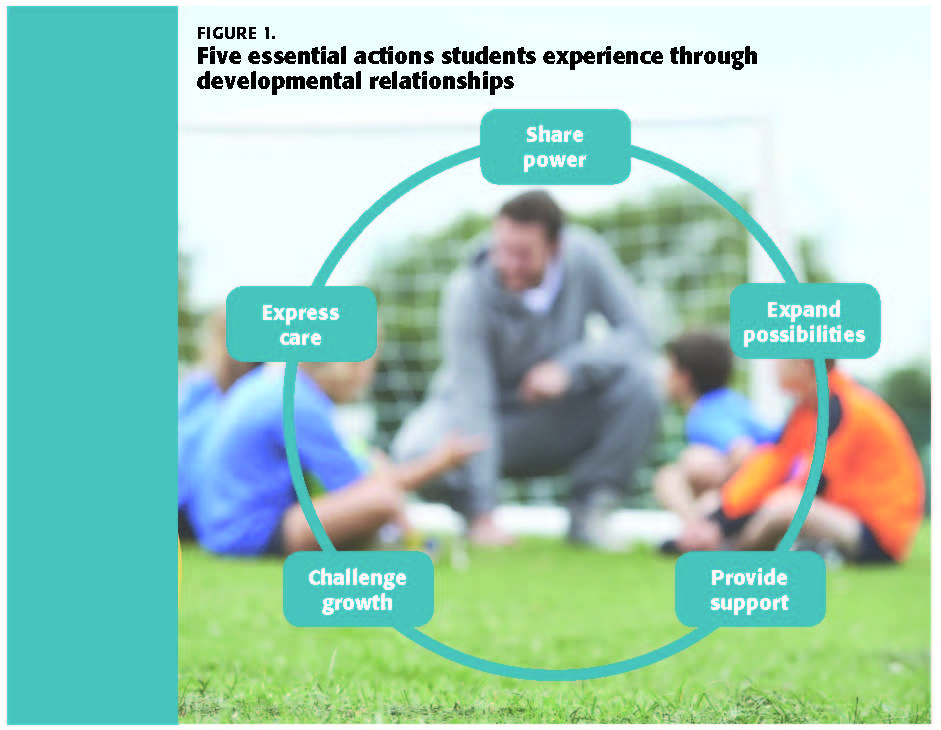
For all of this to work, student-athletes — and all students — need to experience five essential actions we’ve identified through national research: Express care, provide support, challenge growth, share power, and expand possibility. (See Figure 1.) These actions help students build their future aspirations and use what they learned in sports to overcome academic challenges and strengthen their identity, not just as athletes but as students (Broh, 2002; DeMeulenaere, 2010).
When students have developmental relationships, they’re more engaged in school, get better grades, have better mental health, are more socially competent, engage less in high-risk behavior, and have more grit, mental toughness, and perseverance than students lacking in developmental relationships (Pekel et al., 2015). The strongest influences on academically relevant character strengths like responsibility and perseverance happen when coaches share power with students, challenging them to stretch and grow and to expand their possibilities. Under the right conditions, interscholastic sports programs promote each. The greatest effect, academically and otherwise, occurs when students participate in activities that require more “active social engagement, like sports” that provide frequent opportunities for “scaffolded support and challenge” (Ben-Eliyahu, Rhodes, & Scales, 2014, p. 85).
A study of high school basketball players also found they preferred playing for “servant-leader” coaches who emphasized caring for and developing them as people beyond the sport, building a sense of community and belonging, empathy, trust, inclusion, humility, and doing things for others. The players of these coaches were more intrinsically motivated, more confident, better able to deal with challenges, concentrated better, and handled pressure better than players who had autocratic coaches. Those players also felt they were getting better instruction and training in their sport. Not coincidentally, they also had better individual and team records (Rieke, Hammermeister, & Chase, 2008).
What coaches can do
Coaches who focus on building their players as people, developing positive relationships, valuing hard work, encouraging competitive strategies and mental preparation, connecting sport lessons to life, and keeping tabs on students’ academic performance have athletes with better emotion regulation, cognitive skills, prosocial norms, and connection to school and community than other coaches (Fraser-Thomas & Cote, 2006; Gould & Carson, 2010). Students with high levels of developmental relationships are 10 times more likely to have perseverance and grit, including a positive vision of their possible selves, deep intrinsic interests, a growth mindset, and mental toughness (Scales, 2014).
Instead of cutting back on interscholastic sports, we should expand student participation and equity of access, and invest in high-quality professional development of paid and volunteer coaches.
How do we know that such developmental relationships cause these good outcomes rather than merely being yet another good thing that some fortunate students have in their lives? Our research is not yet certain on that, but our quantitative and qualitative studies suggest it is true, and we are committed to testing that proposition over time through experimental studies.
One thing is certain: Most students don’t get this combination of relationship qualities at school. Our study of more than 89,000 6th- to 12th-grade students found that only 35% reported the most basic relationship quality — a “caring” school climate (Benson et al., 2011). Just 22% had a caring school climate and high expectations from teachers, that is, care plus challenge.
The relationships students have with coaches can help fill this gap. It starts with having the right policies and coaching philosophies for middle and high school-age kids. For example, we need no-cut policies so more students can participate and so sports aren’t seen as being only for the athletically talented. In many communities, adults of good character (who may still even be playing their chosen sports) would love to volunteer to coach and mentor young people. They can be tapped to enable no-cut policies to work so more than the current one-third of students can get the benefits of participating in interscholastic sports.
The right coaching philosophy creates the climate for developmental relationships to flourish. This means an intentional emphasis on safety, fun, improvement, and total student development over winning. That’s what the Positive Coaching Alliance calls being a “double-goal coach.” Sure, winning is nice, but the biggest goal is developing the whole child. Or, as the National Federation of State High School Association (NFHS) puts it, “Winning at the high school level should be a pleasant by-product to what you’re really supposed to be doing, which is developing young people into productive citizens” (NFHS, 2013, p. 10).
In our junior varsity tennis program at Parkway South High in Missouri, for example, our motto is “Compete. Learn. Honor.” That motto is up every day on a big poster at practice, and we measure ourselves throughout the season by how well we live up to it. We call on our student-athletes to give everything their 100% effort, on and off the tennis court. We ask them to learn something new every day — to be an eager, open, active learner trying to improve. (Improving is a better goal than winning because improvement is totally under a person’s control.) And honor yourself, your teammates and coaches, your school, and the game in your values and behavior. If those aren’t the kinds of coaching emphases in a given school or district, that isn’t the inherent fault of sports. It’s the fault of administrators, athletic directors, and (inadequately trained) coaches, and often of the big sports — like football and basketball — where some parents pressure administrators, athletic directors, and coaches.
A study of high school basketball players found they preferred playing for servant-leader coaches who emphasized caring for and developing them as people beyond the sport, building a sense of community and belonging, empathy, trust, inclusion, humility, and doing things for others.
Coaches — volunteer or paid, community or faculty members — must have training that emphasizes that double-goal philosophy that prioritizes building developmental relationships with student-athletes. Less than 10% of high school level coaches have any formal training (Merkel, 2013). The training they do have is largely in technique, biomechanics, and strength and conditioning but not in the science of coaching (Beatty & Fawver, 2013). One-third of high school sports participants quit each year, most because they weren’t having fun or didn’t like the coach (Beatty & Fawver, 2013). No wonder: We found that just 5% of 15-year-olds nationally said they had a coach who really “gets” them (defined as “they seem to understand and like you”) or who is a role model or mentor for them (Scales, Roehlkepartain, & Benson, 2010).
Imagine how much more pervasive the positive effects of sports could be if most coaches had quality training in these areas. We need a larger, longer-term commitment to coaches’ professional development that builds relationship-based coaching skills that drive the positive effects of sports participation. One-off training isn’t enough. Building truly developmental relationships has to become second nature and instinctive through repetition, just as we repeat strategy and technique endlessly by design in our practices because that is how student-athletes learn to play instinctively on game day, despite the extra pressure competition brings. Table 1 offers examples of what coaches can do to promote developmental relationships with student-athletes.

It would be daunting if coaches had to do all the things in Table 1 all the time. The key is to pick just one aspect of building relationships and be much more intentional about that action. Over time, the rest will come more naturally. As tennis great Arthur Ashe said, “Start where you are. Use what you have. Do what you can.”
I just got a thank you card from one of my tennis players — a girl who wanted to play but never wanted to embrace all that is needed to be varsity. She’s now a successful freshman in college. It’s the kind of card every coach loves to get. She wrote:
I want to thank you so so so much for everything you have provided to me over the years. Because of you, I grew so much as a person, and although I may have lacked the competitive gene, you taught me that tennis was so much more than what happened on the court.
Every one of our student-athletes should have a coaching relationship that inspires them to feel that way.
There is an emerging science of developmental relationships that shows how we can improve the effect of our sports programs — how we can inspire our kids in their sports and in their classes to do their very best. No school should emphasize sports more than academics. But instead of cutting back on interscholastic sports, we should expand student participation and equity of access, and invest in high-quality professional development of paid and volunteer coaches. Let’s make it a priority for coaches to be trained in and adopt this type of developmentally beneficial relationship-based coaching. The best way to improve the academic and developmental bang we get for the sports buck, which can have positive influence schoolwide, is by ensuring that all coaches are truly double-goal coaches and that all of our sports programs are about creating and maintaining not just positive relationships but truly developmental relationships with student-athletes.
References
Beatty, G. & Fawver, B. (2013). What is the status of youth coach training in the U.S.? (Research brief). Tallahassee, FL: University of Florida, Sport Policy and Research Collaborative.
Ben-Eliyahu, A., Rhodes, J.E., & Scales, P.C. (2014). The interest-driven pursuits of 15-year-olds: “Sparks” and their association with caring relationships and developmental outcomes. Applied Developmental Science, 18 (2), 76-89.
Benson, P.L., Scales, P.C., Roehlkepartain, E.C., & Leffert, N. (2011). A fragile foundation: The state of developmental assets among American youth. Minneapolis, MN: Search Institute.
Broh, B.A. (2002). Linking extracurricular programming to academic achievement: Who benefits and why? Sociology of Education, 75, 69-91.
DeMeulenaere, E. (2010). Playing the game: Sports as a force for promoting improved academic performance for urban youth. Journal of Cultural Diversity, 17 (4),127-135.
Fraser-Thomas, J. & Cote, J. (2006). Youth sports: Implementing findings and moving forward with research. Athletic Insight — The Online Journal of Sport Psychology, 8, 12-27.
Gould, D. (2013). Effective education and development of youth sport coaches. Research Digest, President’s Council on Fitness, Sports, & Nutrition, Series 14 (4), 1-10.
Gould, D. & Carson, S. (2010). The relationship between perceived coaching behaviors and developmental benefits of high school sports participation. Hellenic Journal of Psychology, 7, 298-314.
Merkel, D.L. (2013). Youth sport: Positive and negative impact on young athletes. Journal of Sports Medicine, 4, 151-160.
National Federation of State High School Associations (NFHS). (2013). Fundamentals of coaching. Indianapolis, IN: Author.
Pekel, K., Roehlkepartain, E.C., Syvertsen, A.K., & Scales, P.C. (2015). Don’t forget the families: The missing piece in America’s effort to help all children succeed. Minneapolis, MN: Search Institute.
Rieke. M., Hammermeister, J., & Chase, M. (2008). Servant leadership in sport: A new paradigm for effective coaching behavior. International Journal of Sports Science and Coaching, 3, 227-239.
Scales, P.C., Roehlkepartain, E.C., & Benson, P.L. (2010). Teen voice: Relationships that matter to America’s teens. Minneapolis, MN: Search Institute.
Scales, P.C. (2014). Summary of Search Institute’s initial perseverance studies. Minneapolis, MN: Search Institute.
Citation: Scales, P.C. (2016). The crucial coaching relationship. Phi Delta Kappan, 97 (8), 19-23.
ABOUT THE AUTHOR

Peter C. Scales
PETER C. SCALES is a developmental psychologist and senior fellow for Search Institute, Minneapolis, Minn. He is also a U.S. Professional Tennis Association-certified tennis teaching pro and head JV tennis coach for boys’ and girls’ teams at Parkway South High School, Manchester, Mo.