New York City’s school reopening announcement surprised many, thanks in part to media coverage that’s frequently been unable to get ahead of the fast-moving story.
By Alexander Russo
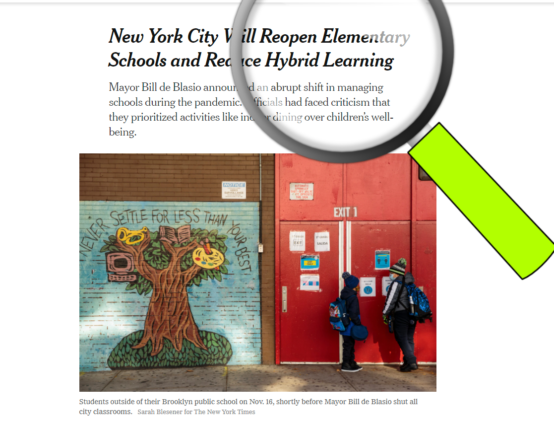
On Sunday, New York City Mayor Bill de Blasio announced a partial reopening of the NYC public schools — reversing his own school shutdown decision from just two weeks ago and breaking away from the nationwide shutdown trend.
But he wasn’t the only person to reverse course over Thanksgiving weekend.
The head of the New York City teachers union, who had supported the school shutdown, indicated his support for the reopening decision. The head of the American Federation of Teachers, who had previously highlighted safety concerns and the need for additional federal funding, appeared on MSNBC to talk about the importance of getting kids back in front of teachers. And New York State Gov. Andrew Cuomo, who has nearly always found a need to contradict or reject the mayor’s announcements, also went along.
The mayor reversed himself. The teachers unions seemed OK with it. Ditto Governor Cuomo. As a result, as many as 200,000 kids — most of them Black and Latino — may get the opportunity to receive some in-person learning starting a week from today. The announcement was a massive turnaround, the result of a complex logistical and political process.
And yet, though few were willing to admit it publicly, these sudden developments surprised some close observers and appeared to have been unanticipated by reporters assigned to cover the story.
The Sunday surprise illustrates coverage concerns that I and others have expressed in the past. While New York City school reopening coverage may appear to be abundant, it has repeatedly proven insufficient for a story so big and important.
How many more times does this have to happen before newsroom leaders decide to make necessary changes?
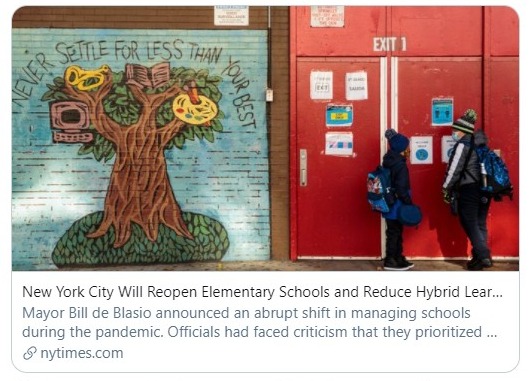
Above: New York Times coverage from Sunday.
There had been signs of interest in reconsidering the New York City shutdown, which was seen as unwelcome by many parents and avoidable by some observers. De Blasio has reversed himself several times in recent memory. But the major stakeholders — mayor, governor, teachers union — had failed to avert a shutdown just two weeks ago, and the reporting behind the scenes had been skimpy since then.
What happened, exactly to change things? How did the new agreement come to be? It’s not entirely clear. Some possible explanations and contributing factors that warrant additional reporting:
- There was nearly universal negative reaction to the idea that bars and gyms were staying open while schools were shuttered, a development that appeared to have lowered school enrollments. A small but vocal group of New York City parents protested against the school shutdown and the arbitrarily low 3% citywide shutdown threshold.
- Mayor de Blasio’s team is reported to have realized that the city’s efforts to satisfy the teachers union were never going to satisfy them — a dynamic alluded to in Politico NY’s coverage of the decision. Teachers unions seemed concerned about being seen as the main obstacle to school reopening. And the governor had urged de Blasio to adopt a community-based system rather than a citywide trigger.
- Last but not least, some places — Bethlehem, Pa, and the state of Rhode Island, along with Western European nations — were showing that it was possible to reopen schools safely despite high community infection levels. And in outlets like Reuters, the Washington Post, and New York magazine, there was an acceleration of the media shift toward examining the costs of a prolonged school shutdown and the feasibility of reopening schools safely.
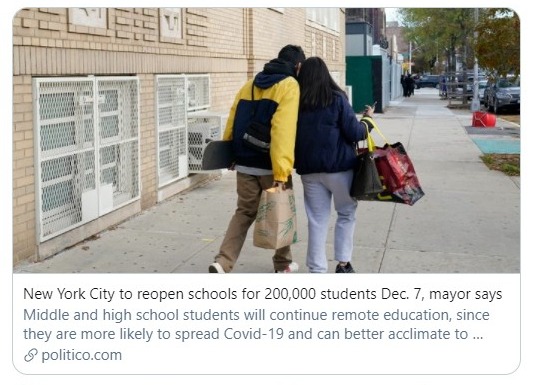
Above: Politico NY’s coverage describes City Hall concerns about excessive — and failed — efforts to appease the teachers union.
In New York City and nationwide, there’s lots that could still go wrong or that could change. Teachers upset with the latest decision could refuse to come to work, creating a staffing shortage that would eventually force administrators to cancel in-person classes. The surge in cases could force widespread quarantines and school shutdowns, whittling down the in-person opportunities to fewer areas of the city. Media coverage could return to its usual form, highlighting fears and concerns and conflicts.
Thanks to this weekend’s events, however, there is some cause for hope for a safe return to school for more kids, which I believe is possible. Parents in other parts of the country are protesting prolonged shutdowns. Democratic officials who have been silent on the shutdown issue may find their voices. The recent media trend could continue to swing toward cautious optimism.
However, the inadequacy of the coverage that’s being produced is an ongoing concern. As I wrote last week, New York City school reopening teams are not sufficiently staffed or coordinated with political desks and with each other to provide readers with the behind-the-scenes reporting that a story as big and important as this requires. If they had been, Sunday’s reopening announcement probably wouldn’t have been nearly as much of a surprise.
Previous coverage from The Grade: Will New York City schools ever reopen? Better coverage might help us find out.
Read more about the New York City announcement: PoliticoNY, Washington Post.
Read more about media negativity: Why Is All COVID-19 News Bad News? (NBER)
Recent reopening coverage: Week in the Life of a Baltimore School Getting Back to Class (NYT)
ABOUT THE AUTHOR

Alexander Russo
Alexander Russo is founder and editor of The Grade, an award-winning effort to help improve media coverage of education issues. He’s also a Spencer Education Journalism Fellowship winner and a book author. You can reach him at @alexanderrusso.
Visit their website at: https://the-grade.org/