|
|
| SHOWDOWN IN CHICAGOThe big education story of the week. |
|
| STUDENT TRAUMAThe best stories of the week. |
|
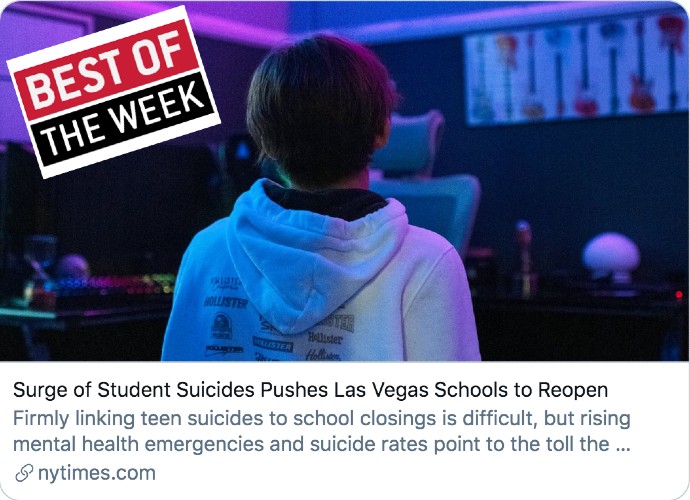
| 🏆 BEST: The best and most talked-about story this week was Erica L. Green’s Surge of Student Suicides Pushes Las Vegas Schools to Reopen in the New York Times (above). In it, she reports about one large Nevada county that lost 18 students to suicide by December, pushing the district to bring kids back to the classroom. “The youngest student Dr. Jara has lost to suicide was 9,” Green wrote. “One student left a note saying he had nothing to look forward to.” The heartbreaking story is a vivid reminder about the impact of keeping kids home. It also kicked off an intense debate about measuring suicides and the connection between them and remote school. Like NPR’s Anya Kamenetz observed, it’s an example of Green “driving the conversation per usual.”🏆 RUNNER-UP: This week’s runner-up is Death, Job Loss And Remote Learning: The Pandemic’s Toll On One Chicago Family from WBEZ Chicago’s Sarah Karp. It’s an audio story that brings to life the experience of remote learning. Karp recorded from inside a family’s home, and you can hear the chaos in the background as the family of six goes about their day working and learning. The topic of student mental health and suicidal thoughts also comes up. |
|
THE UNCERTAIN STATE OF THE EDUCATION BEAT
New commentary and content from The Grade. |
|
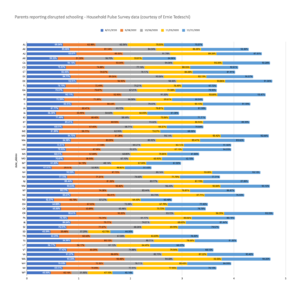
| Above: Data from the Census Bureau’s Household Pulse Survey, courtesy of Ernie Tedeschi, shows consistently high rates of school disruption reported by parents in some states, and varied rates by month in several others.
In a new column this week, I described how EWA’s State of the Education Beat report provides lots of great information about education journalism but seems strangely disconnected from the current moment in which questions about journalism and education abound. It also fails to address key questions about how journalists can improve their coverage and support greater diversity on the beat.
Four out of five education journalists are white, the same as five years ago. Just 8 percent are Latino/a/e/x, compared to 27 percent of K-12 kids. Most are female. They overwhelmingly believe that their work is having a positive impact and — yes! — that K-12 education is heading in the right direction. Four out of five had no experience with free or reduced lunch when they were kids. If they have kids now, they are twice as likely to have sent one to private school than the national average. Three out of five report being harassed or threatened by readers or sources. |
|
| MEDIA TIDBITS
Thought-provoking commentary on the latest coverage. |
|
| 📰 ALL EYES ON TEACHERS UNIONS: Covering teachers unions is not easy and has not been something that education reporters have done particularly often or well. However, the last few weeks have featured a number of strong pieces focusing on the union role. Just this week, the New York Times and USA Today both headlined the role of teachers unions in slowing reopenings in Montclair, New Jersey, and elsewhere. EdWeek asked Has the Public Turned on Teachers? A second Times story explored unions’ role nationally, as did The Economist and Politico. US News focused on the Chicago stalemate, which is the big story of the week. CNN ran segments on it. WIRED explored the union role in advocating for teacher vaccination priorities. More locally, New York magazine featured the union role in a stalemate in Maplewood, New Jersey. Politico California reported that the state union has made vaccination a prerequisite for reopening. The Star Tribune detailed the showdown in Minneapolis. You get the idea. For some, this may seem like overkill, but to me it seems a long time coming.
📰 “COVID PESSIMISM” IN MEDIA COVERAGE: Questions about media coverage of schools continue to show up, including in a new Atlantic piece that squarely blames the media for the delay in school reopening due to the way some journalists “clung to outdated fears about secondary spread among young kids.” While not specifically focused on schools coverage, Julia Marcus’ recent Atlantic essay on vaccination coverage notes how “one news article after another warned about everything that could go wrong.” According to a recent City Journal essay, the media’s new model is to “commodify polarization and threat.”
📰 PROTECTING VULNERABLE SOURCES: The Boston Globe’s new “Fresh Start” initiative will allow people whose names appeared in past stories to petition to have them anonymized or erased. It’s aimed at people who committed minor offenses in the past, but I hope they extend this to their education coverage, too. Vulnerable kids in particular may later regret that their name and story appeared online. One person on Twitter already alluded to this happening to her child. Danielle Dreilinger wrote about protecting vulnerable sources for The Grade last year. Are any education teams or outlets considering these approaches?
Missed some previous editions? You can see the archive of past newsletters here. |
|
 |
| Above: Chalkbeat’s new editor-in-chief Nicole Avery, left, and Washington Post education editor Kathryn Tolbert. |
|
PEOPLE, AWARDS
Who’s going where & doing what? |
|
| 🔥 Huzzah! Chalkbeat has a new editor-in-chief: Detroit Free Press senior news director Nicole Avery, who oversaw reporting on immigration, race, gender, public health, politics, and more during nearly 20 years at the paper. The accolades have poured in: “A golden hire. Nicole is an amazing editor and leader,” tweeted Detroit Free Press editor Sally Tato. “What a get for Chalkbeat. What a devastating loss for us,” tweeted colleague and web editor Amy Etmans Huschka.
🔥 It’s official. Kathryn Tolbert has been formally named the Post’s education editor, a role she’s been playing on an interim basis since late July. “Her steady hand, font of ideas and editing skills have kept The Post’s schools coverage the best in the nation during the pandemic,” according to a staff email signed by Post editors, citing the section’s coverage of remote learning, pods, the conflict over reopening DCPS, and the influence of teachers unions. Fun fact: Tolbert’s first newsroom job was covering Montgomery County schools. We wrote about the Post’s improvements last month.
🔥 Starting up: Public radio station WFYI in Indianapolis is launching an education reporting initiative as part of a new equity-focused news desk. “This team will cover daily and investigative stories that reveal the human impact of educational policies,” they told us. The station is hiring three reporters (investigative, enterprise, and daily) and a digital editor for the team. Longtime education journo Eric Weddle tweets that he is transitioning to ME for this new initiative. No word yet on who’s funding the effort.
🔥 More Chalkbeat news: NY bureau chief Amy Zimmer and some of the NY bureau were given awards by the Newswomen’s Club of New York. Also, Chalkbeat CO is hiring someone who is fluent in Spanish and digitally savvy for a contract gig.
Did someone forward you this newsletter? You can sign up here. |
|
EVENTS
What just happened & what’s coming next? |
|
| Above: Last spring, the Ida B. Wells Society put on a webinar about schools and COVID that featured the New York Times’ Nikole Hannah-Jones and Erica Green. This week, the organization put on another webinar on school COVID coverage featuring NBC News’ Bracey Harris and Chalkbeat Indiana’s Aaricka Washington that includes a slide advising reporters to “Think about what truly makes you angry” and “Tell the story that only you can tell.”
⏰ Deadlines: Journalists under 35, nominate your best work from 2020 for the 2021 Livingston Awards by Feb. 1! The deadline to apply for a Spencer Fellowship is fast approaching on Feb. 15. Four fellows will be selected for the highly competitive program, which combines coursework at Columbia Journalism School and Teachers College with hands-on advising from education writing experts. Lastly, students can apply for financial help to cover conference fees or other journalism-related expenses (including subscriptions, software, FOIA fees, or equipment) courtesy of ProPublica and The Pudding. Apply by Feb. 22.
⏰ If you missed the EWA webinar on their State of the Education Beat report this week, catch up with Politico NY education reporter Madina Touré, who live tweeted the whole thing. You can also search the #StateoftheEdBeat hashtag on Twitter.
⏰ WBUR On Point did a segment on kids and screen time Thursday, featuring NPR’s Anya Kamenetz. The show has become something of a destination for education coverage, thanks to former ed reporter Grace Tatter among others. |
|
THE KICKER |
|
| By Alexander Russo with additional writing from Michele Jacques and Colleen Connolly. |
|
|
|
|
|
|