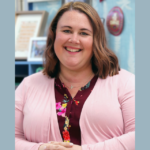
For this month’s column, I spoke to Lindsay E. Jones, president and CEO of the National Center for Learning Disabilities (NCLD), an advocacy organization based in Washington, D.C. NCLD focuses on improving outcomes for the nation’s one in five children and adults with learning and attention issues. In a wide-ranging conversation, we talked about the facts and myths of special education, the unique impact the pandemic has had on students with disabilities and their families, and how the future of special education is both hopeful and scary.
Ferguson: To date, what do we know about the COVID-19 pandemic’s impact on students with disabilities?
Jones: At this point, the research in this area is pretty thin. Partly, that’s because it’s still too soon to know all the ways in which students have been affected. But it’s also because the previous administration neglected to make it a priority to invest in research at the beginning of the COVID crisis.
Earlier this year, under President Joe Biden, the U.S. Department of Education’s Office of Civil Rights released a report, Education in a Pandemic, but since there wasn’t much data to go on, the report couldn’t be more specific than to say, and I quote, “For many elementary and secondary school students with disabilities, COVID-19 has significantly disrupted the education and related aids and services needed to support their academic progress and prevent regression. And there are signs that those disruptions may be exacerbating long-standing disability-based disparities in academic achievement.”
So far, the most substantive piece of research we have is another report, issued in May 2021 by NWEA, that looked at the academic growth of students in special education during school years and summers. It’s actually based on pre-COVID data, and it’s a game changer for our work. First, the report shows that when students spend time away from school, the negative effects are much larger for those with disabilities than for other students — and during the pandemic, kids have spent a lot of time away from school, so we can assume the effects have been significant. Second, the NWEA research also shows that with the right kinds of supports, students with disabilities can experience as much, and even more, academic growth as their general education peers.
These are really important findings, and they have ramifications not only for IDEA (the Individuals with Disabilities Education Act), but also for school staffing and service delivery. Even after COVID, we need to pay much closer attention to long school absences and summer time off. Perhaps most important, though, is that this research challenges persistent deficit narratives about students with disabilities. The truth is that when they get high-quality instruction and interventions, they tend to make great academic progress, just like other students.
When students spend time away from school, the negative effects are much larger for those with disabilities than for other students.
Ferguson: Were you pleased with what the American Recovery Plan (ARP) required states to do to address the academic and social and emotional needs of students with learning disabilities?
Jones: Given how urgently students needed supports and services, it made sense for Congress to give states a lot of flexibility over how they could use the funds. And within the special education community, too, we wanted to get the funds out the door quickly. The U.S. Department of Education always has to thread the needle between giving states flexibility in how they spend federal money and ensuring that they spend it well. This time, they were under a lot of pressure to go easy on the oversight and err on the side of flexibility.
Of course, that trade-off creates some challenges. For example, states aren’t required to share much information about how the ARP funds will be used to support students with disabilities. As an advocate, that scares me. Open and transparent decision making and stakeholder feedback are especially important when it comes to serving kids who’ve always been left out. We need to be able to hold states accountable for using their funds wisely, equitably, and inclusively, and we have to be able to measure the impact of their actions in key areas. We also need quality data to ensure that the needs of specific subgroups are being addressed. So yes, the federal government accomplished the goal of getting the money out the door quickly, but that meant it didn’t require the kinds of data collection and reporting that we always want to see.
Ferguson: Were there any aspects of the state ARP plans that you thought were particularly significant or lacking for students with disabilities?
Jones: NCLD did flag two priorities in the state plans: accelerated learning and social and emotional learning (SEL), both of which are critically important for students with disabilities. But while many state plans went ahead and defined these as major goals, it’s unclear how they’re actually going to accomplish them. Let’s take SEL, for example. The research base about SEL programs is still limited, and virtually none of it is disaggregated by student population. So, while it is great that so many states say they value SEL, we really don’t know how their programs might affect particular student groups. It would have been much better if state plans laid out specifically how they intended to support SEL for students with learning disabilities.
Ferguson: Do any states stand out as particularly innovative in their approach to meeting the needs of students with disabilities during and after the pandemic?
Jones: One of our biggest concerns is the backlog of special education evaluations that has occurred because of the pandemic. Again, we agree that states have needed flexibility during the crisis, but it’s been clear that this backlog was going to become a big problem. For example, New York City has reported that, in any given year, they expect to conduct around 16,000 evaluations. In 2020-21, due to COVID, they conducted only a fraction of that number, leaving them thousands of evaluations behind as they went into the new school year. Only three states — Arkansas, Illinois, and Massachusetts — specifically call this out in their plans, saying that they will address current or future backlogs.
Illinois’ plan is also explicit about addressing discrimination in the identification of students with learning disabilities, but no other state has flagged this issue. For NCLD, though, it’s a top priority. Our concern is that as schools rush to get kids help, they’ll incorrectly identify students who have fallen behind as needing special education services, or not get kids the help they need quickly enough and they’ll fall further behind.
On a more encouraging note, I was glad to see that quite a few plans called out the need to focus on the retention of special education teachers and to improve the pipeline into the profession. This is a huge and ongoing issue for the field. We had horrible teacher shortages even before the pandemic. Now they’re even worse, and if we don’t do something soon, the effects will last for generations to come.
Ferguson: Can you talk about the rising costs of special education and the challenges states and districts face as they try and manage their budgets and their needs? Do you think the resources provided by the ARP will be enough?
Jones: The $3 billion in ARP funds allocated for students served under IDEA will help, no doubt, but it won’t fix the chronic underfunding of IDEA. Federal and state funding for special education is broken, and school district bureaucracies tend to make it hard to spend money quickly or creatively. Districts are like big machines that are incredibly hard to upgrade. We need smart and brave administrators who are willing to be bold and use their funding in innovative ways. The law is not holding them back from being innovative. Most often, it is other things getting in the way.
Ferguson: The special education community has been through a lot during COVID. Can you offer any personal reflections on what you have seen and learned over the last 18 months?
Jones: The biggest moment for me was in March 2020, when schools closed and a few big-city superintendents started saying, “We can’t serve anybody else if we have to serve students with disabilities.” That shocked me, but it also reinvigorated me because it reminded of the importance of the law and the negative mindsets that exist about students with disabilities.
I also realized how much we don’t know about education delivery. COVID presented us with the professional development experience of a generation. It was so challenging, but there was no better on-the-job training for teaching online than just having to do it, all at once and nationwide. I am in awe of the schools and educators that rose to the challenge. It also made me want to double down on high-quality professional development and training because teachers and administrators need to have all the tools and techniques available for their students.
And finally, before COVID, I did not fully understand how differently each school was implementing special education. If we had talked in February 2020, I would have said there was some diversity among districts and states in their special education services, but also some consistency. Since then, I’ve learned that getting good services is like winning at a game of roulette. If you’re lucky enough to have a great principal who makes sure their team is focused on the work that needs to be done, then your child will get a very different and much better education than students in other districts nearby. I see no consistency at all in the provision of special education services from school to school, district to district, or across the country. That has to change.
This article appears in the November 2021 issue of Kappan, Vol. 103, No. 3, pp. 62-63.

ABOUT THE AUTHOR

Maria Ferguson
Maria Ferguson is an education policy researcher, thought leader, and consultant based in Washington, DC.