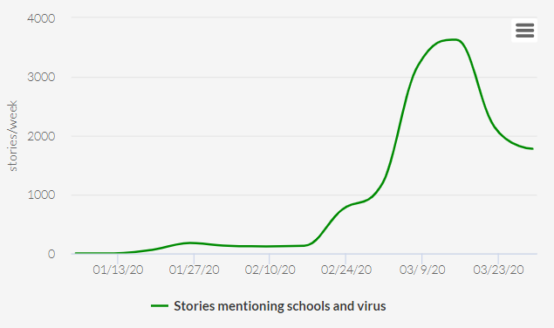
This week’s Media Cloud update shows a steep decline in the number of school-related COVID-19 stories from top mainstream news outlets, along with an overall reduction in COVID-19 coverage. What’s up with that?
An updated report on top mainstream news outlets reveals that the number of COVID-19 stories declined for the second straight week last week, with stories about the virus and schools experiencing a particularly steep decline.
However, these results are counterintuitive and Media Cloud’s own analysis of media trends suggests that the COVID-19 story has received tremendous media attention in the past few weeks.
What’s going on with the data? There are some possible explanations for these responses, which are addressed below.
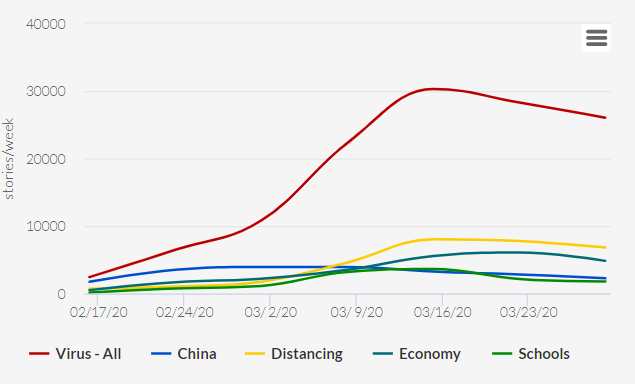
COVERAGE DECLINES: OVERALL & EDUCATION-RELATED
Among the top newspapers and digital sources, as defined by the Pew Research Center and tracked by the web site Media Cloud, COVID-19 coverage (in red) peaked during the week of March 15 – 21, with 30,313 stories, but declined 14 percent to 25,960 stories last week.
That’s according to this Media Cloud query.
Within the COVID19 narrative, each of the categories we’ve been tracking declined over the past two weeks, according to the latest numbers from MediaCloud. For example, coverage about the virus and the economy declined 13 percent.
However, the decline in stories about the virus and schools (in green) was much steeper: a 51 percent drop from a high of 3,629 stories during the week of March 15 – 21 to just 1,777 stories last week.
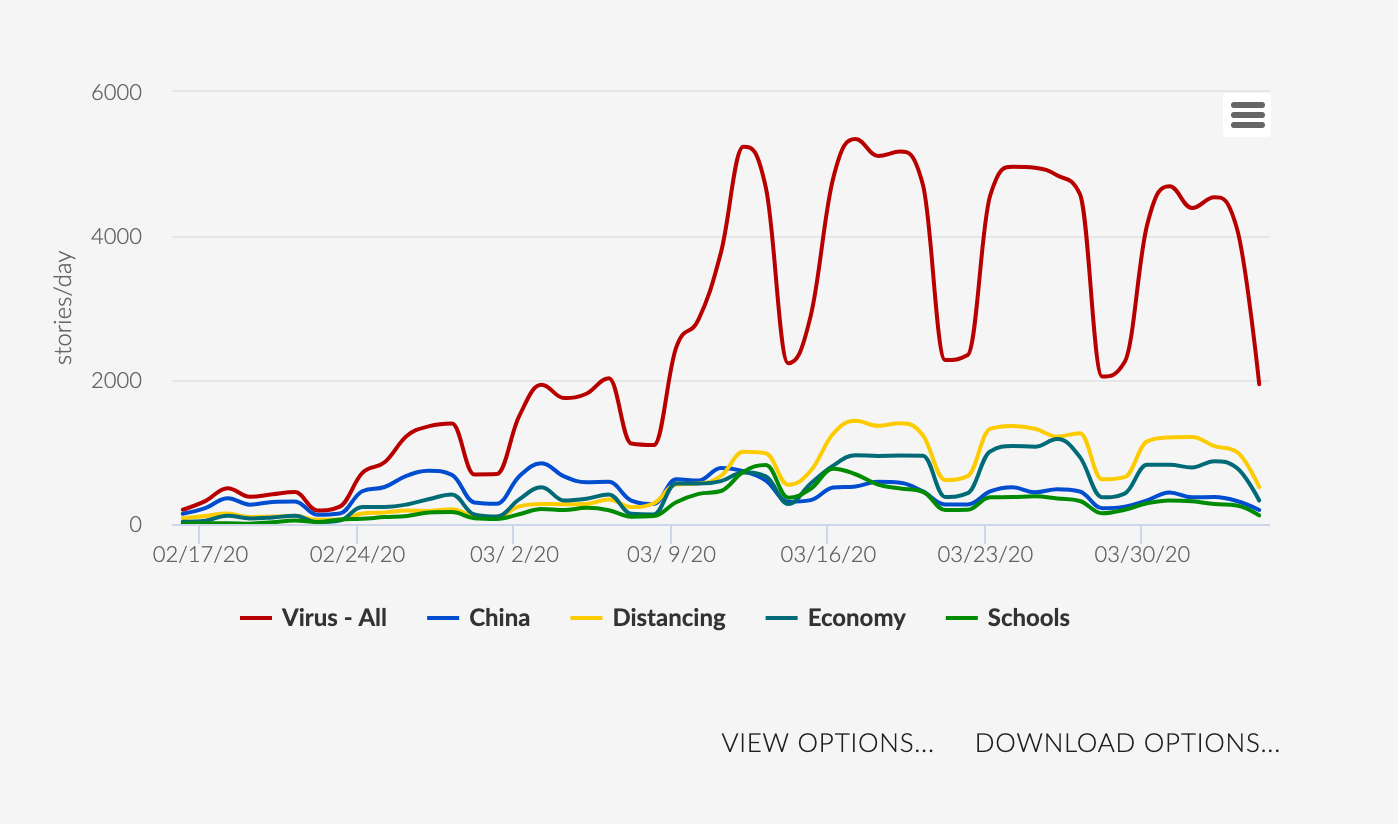
On Friday, April 3, just 257 top mainstream media stories about the virus and schools was the lowest weekday number of stories since Friday, March 6, four weeks ago.
Two weeks ago, at the peak of COVID-19 coverage, 12 percent of all virus stories had some education-related angle. Last week, only 7 percent did.
ANALYSIS
The decline in all stories about the virus from more than 30,000 two weeks ago down to just under 26,000 last week represents a big drop and doesn’t align with our anecdotal experiences about news coverage of the virus.
One possible explanation is that there is some sort of lag in the data MediaCloud is reporting.
Another possibility is that stories are implying coronavirus without actually saying those words and are thus being missed in our filter.
A third possibility is that, after two or three weeks of all-out production, maintsream outlets have throttled back their overall output somewhat.
That is, newsrooms cranked into overdrive the week of March 15, producing a higher than average amount of coverage – something that was not sustainable in the long run.
We’ll keep looking into it.
Previous coverage:
How mainstream COVID-19 schools coverage surged — then fell
ABOUT THE AUTHOR

The Grade
Launched in 2015, The Grade is a journalist-run effort to encourage high-quality coverage of K-12 education issues.