In this week’s newsletter: Kids are refusing to go to school. Voters are electing moderates. Schools are reconsidering student cell phone use. Reporters share the secrets behind in-school reporting. Babies at school board meetings? Yes, please.
SCHOOL REFUSAL
The big story of the week
The big education story of the week is school refusal, which varies from the occasional missed day or in-school escape to a counselor’s office to students who eventually stop going to school entirely (USA Today, Chalkbeat NY, WNYC Public Radio).*
The phenomenon is frustratingly ill-defined. Some research suggests as few as 1% of students are school avoidant while organizations like the School Avoidance Alliance “estimate 5% to 28% of students in the country exhibit school avoidant behaviors at some point in their lives.”
However, reporting on school refusal (also known as school avoidance) does focus helpful attention on why students might avoid school, rather than the more administrative focus on attendance or enrollment. School refusal puts student perceptions front and center.
*Correction: Chalkbeat’s story about students refusing to go to school was published in May 2022.
Other big stories:
📰 UVALDE ANNIVERSARY: Next week is the one-year anniversary of the Robb Elementary School shooting in Uvalde, Texas — a reminder of the surge in school gun violence that has terrified parents, generated concerns about how schools prepare and respond to threats, and prompted some districts to bring police officers back on campus and restrict what kids can bring to school (KUT, Texas Monthly, ProPublica, Politico, Atlanta Journal Constitution).
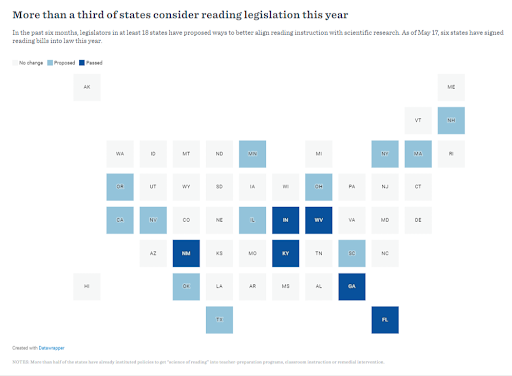
📰 READING REVISED: Four more states have passed “science of reading” legislation and at least 18 states are considering new laws since the release of Sold a Story (EdWeek, APM Reports). One researcher describes what’s happening as “bipartisan convergence.” A handful of states that have revamped their programs have seen strong results (Associated Press). However, teacher training programs in places like Ohio are earning mixed grades and resistance to mandates is becoming an issue in places like Ohio and New York City (The 74).
📰 OAKLAND STRIKE: After more than a week, the school shutdown in Oakland ended with agreement on salary and benefits as well as four “common good” agreements — an outcome that may become more common in the near future (Oaklandside, KQED, East Bay Times, EdSource, The 74).

PHONE-FREE SCHOOL
The best education journalism of the week
This week’s best education news story is Akron Beacon Journal education reporter Jennifer Pignolet’s ‘Like going back in time’: Ellet staff, students react to first days with no cellphones.
The piece answers a question many have been asking: what would happen if schools went back to banning student cell phone use during the school day? According to Pignolet’s reporting on one school’s early experience, there would be some grumbling, some creative disobedience, some happy teachers, and mixed reviews from kids and parents.
The piece isn’t actually from this week — it’s from March. But it’s got so many elements of a great education story that I think you’ll agree it’s worth it. It’s timely, nuanced, and full of in-school details and insights from teachers, students, and parents.
Limiting cell phone use is a topic that more schools and education journalists are covering lately. Earlier this month, the Washington Post’s Donna St. George produced a valuable overview of different approaches and how they’ve fared. The Times Union’s Kathleen Moore recently reported on one school that decided to ban phones next year.
Happy Friday! Sign up for the newsletter here.
Other great stories this week:
🏆 The Republican plan to take over school boards may be backfiring (Vox) See also Oregonian
🏆 How San Diego Unified measures up to CA’s bilingual student goal (inewsource)
🏆 Dallas ISD’s Opt-Out Policy Dramatically Boosts Diversity in Its Honors Classes (The 74)
🏆 America Isn’t Ready for the School-Funding Crisis Ahead (The Atlantic)
🏆 Pushed out of school: Alabama’s ‘culture of removal’ takes toll on Black students (AL.com)
🏆 Special-Education System Stacked Against Families, Lawsuit Says (WSJ)
🏆 The Parents Who Fight the City for a “Free Appropriate Public Education” (New Yorker)
🏆 No Degree? No Problem. Biden Tries to Bridge the ‘Diploma Divide.’ (New York Times)
🏆 Chicago closed 50 public schools 10 years ago. Did the city keep its promises? (WBEZ, Sun-Times)

SECRETS TO IN-SCHOOL REPORTING
Our latest columns and commentary
Above, clockwise from top left: Current and former New Haven Independent education reporters Melissa Bailey, Aliyya Swaby, Christopher Peak, and Maya McFadden.
The New Haven Independent stands out for its commitment to education coverage that features in-school reporting and close community connections.
Contributor Colleen Connolly spoke with four current and former education reporters (above) and two editors about how the outlet pulls off stories like this recent Maya McFadden piece about teachers trying new approaches to literacy instruction (and a slew of others).
“Nothing replaces firsthand insights from inside a classroom on a regular school day,” writes Connolly. “And readers deserve to know what’s going on.”
FREE COLLEGE FOR APPRENTICE TEACHERS
Coverage of promising school innovations & signs of progress
💡 Teacher apprenticeship programs that put educators through college for free have received federal certification in 16 states, allowing for major expansion (Washington Post, PBS NewsHour).
💡 In the face of struggles, some district tutoring programs are seeing success with approaches that include boosting tutor pay, offering them extra coaching, and fitting sessions into the school day (Chalkbeat).
💡 As part of a security overhaul that intends to separate safety from discipline, at least one Colorado district has replaced school police with unarmed officers who focus on threats outside the school and student well-being within, while others have retained school police (KUNC, KUNC).
💡 Student activism around the psychological impacts of the pandemic and gun violence convinced Seattle leaders to launch a pilot program that will hire extra mental health staffers and pay for trauma-informed trainings (Seattle Times).
Read more about the importance of covering promising innovations and preliminary successes.

PEOPLE, JOBS
Who’s going where and doing what
Above: NPR fellow Şeyma Bayram described a group of current and former Spencer Education Journalism Fellows who reunited at Columbia University last weekend as “incredibly talented and generous.”
🔥 Front page: The Washington Post’s Moriah Balingit made it onto the front page of the paper’s May 15 edition with her national story about teacher apprenticeships.
🔥 Awards: Chalkbeat Chicago’s Mila Koumpilova won a Chicago Headline Club Lisagor award for her deep profile of a Chicago high school and its year of struggle after returning to full-time in-person learning. Congrats, Mila!
🔥 Diversifying student journalism: Taking four students to last month’s JEA/NSPA high school journalism convention in San Francisco was an eye-opening experience for Chalkbeat editor and co-director of the Mosaic Journalism Program Sharon Noguchi, who was quoted in an article from Mission Local about the lack of participation from San Francisco Unified students at the national convention. Newsrooms can do more to “recruit more students of color into their programs, support fledgling programs in urban schools, and partner to restore journalism in schools serving Blacks and Latino students,” says Noguchi.
🔥 Journalistic independence: In an essay for CJR about the importance of independent journalism, New York Times publisher A.G. Sulzberger cited former education reporter Brian Rosenthal’s coverage of Hasidic schools despite criticism it received from Hasidic leaders. “Independent news organizations should strive to cover every community with respect, nuance, and sensitivity,” writes Sulzberger. “But even when doing so, journalism will not always reflect the way these groups want to be seen or emphasize the issues they would prefer to talk about.”
🔥 In-depth: Naples News investigative reporter Kate Cimini produced an impressive series of stories about Florida schools’ underuse of federal law Title IX, the federal law that can stem sexual harassment and abuse. According to Cimini’s reporting, just 59 Title IX complaints for sexual harassment or abuse in Florida were filed from 2012-2022. The series includes an explainer, a how-to guide, and features one district that’s making more use of federal law. Read the backstory.
Praise: Hats off to the Dallas Morning News education reporter Talia Richman for her detailed, intimate reporting on the Allen mall shooting earlier this month. ”If you read anything about the Allen shooting, this should be it,” tweeted fellow reporter Lauren Caruba. “There’s no one more qualified to bring such empathy to such horror than Talia,” tweeted reporter Danielle Ohi. “I’m furious she had to write this, but I’m also really glad she’s the one who wrote this.”
APPEARANCES, EVENTS, & NEW RESOURCES
What’s happening and new research
Above: Several more states (in blue) are considering changes to their reading instruction programs, according to an update from APM Reports.
⏰ Podcasts & segments: The PBS NewsHour ran a new segment on the rise of homeschooling and its potential effects on vulnerable children. APM Reports released its second bonus episode of Sold a Story, which delves into how state legislatures have responded since the podcast’s release — sometimes with restrictive laws that go so far as to ban certain teaching methods.
⏰ Book ban coverage: Book bans are unpopular, but — according to a fact-check by the Heritage Foundation’s Jay Greene — several of the 2,500 titles claimed to have been banned in pieces by CBS and others are actually available. One reason, according to Acadia University’s Jeffrey Sachs, is that PEN America and others have gotten many ban decisions reversed. Greene’s not buying it, but the two agree that media coverage of what’s going on has been simplistic. Protect your byline, folks. It’s all you’ve got.
⏰ Candidate forum: Denver mayoral candidates Kelly Brough and Mike Johnston, who will face each other in a runoff on June 6, discussed education and school safety at a recent forum moderated by Chalkbeat’s Melanie Asmar and CBS Colorado’s Michelle Griego.
⏰ Research: A poll by YouGov America found that 43% of parents of K-12 children believe that parents should push for curricular change if they object to instructional material. A Fox News poll found that 60% of voters view book bans as a “major” problem, while 57% think the same about attacks on families with transgender children. Chalkbeat covered a report that concluded that in-school factors during the pandemic like instructional quality and lockdown strictness had more to do with test score declines than what was happening in students’ homes.
THE KICKER
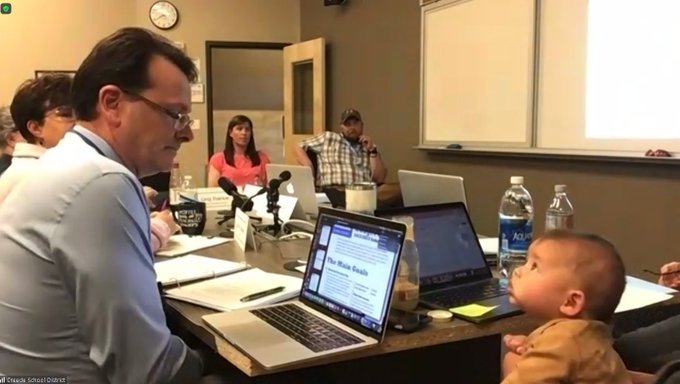
“I think babies should be at all meetings,” tweeted Colorado Public Radio’s Jennifer Brundin from a recent rural school board meeting. “They’re good reminders of the future.”
ABOUT THE AUTHORS

The Grade
Launched in 2015, The Grade is a journalist-run effort to encourage high-quality coverage of K-12 education issues.
Alexander Russo
Alexander Russo is founder and editor of The Grade, an award-winning effort to help improve media coverage of education issues. He’s also a Spencer Education Journalism Fellowship winner and a book author. You can reach him at @alexanderrusso.
Visit their website at: https://the-grade.org/