News outlets rushed to cover the long-awaited Warren K-12 education plan when it came out on Monday. But readers didn’t get the context and depth they sorely needed.
By Alexander Russo.
On Monday, Sen. Elizabeth Warren’s campaign released her long-awaited K-12 education plan, which promises to quadruple federal funding for schools serving low-income students and other federal education programs and to ban or reduce for-profit charters, charter school expansion, and high-stakes testing.
The response from mainstream national and trade publications was strong. Trade outlets like EdWeek and Chalkbeat covered it, as did the New York Times, Wall Street Journal, Washington Post, Associated Press, and many others.
How good was the coverage, though? It was clear and accurate. I saw no major gaffes. These are all good things, especially when journalists are working on tight deadlines.
But at the same time, I can’t help but feel frustrated at the lack of depth and political insight in the pieces I’ve seen — especially given the curious timing of the rollout and the long-running mystery surrounding Warren’s education plan.
The Warren plan is a campaign document, and it lacked any major surprises. So the focus on the plan’s policy provisions seemed like a bit of a waste of time, telling us things we knew already or could easily have found out from the campaign itself.
Backstage is often where the real action is taking place —and journalists are the ones tasked with taking us there. But the Warren plan coverage I’ve seen has done frustratingly little of that.

The Warren plan dropped on Monday and made a fairly big splash among news outlets. But was the coverage any good?
A few weeks ago, there was a persistent clamor growing online for Warren’s education plan. She had plans for everything but K-12 education, it seemed. Most of the other major candidates — Sen. Bernie Sanders, former Vice President Joe Biden, etc. — had already rolled out their ideas.
A handful of outlets — the Washington Post and Chalkbeat come to mind — tried to piece together what her plan might look like if she had one, based on past positions. But that was no real substitute.
Then, more recently, the story of Warren’s short-lived stint as a part-time K-12 educator was intensely scrutinized, fueled in part by outlets and operatives favoring Bernie Sanders as well as Warren opponents. Most of the major news outlets stayed on the sidelines of that slow-moving story until the very end, which I thought was understandable but mistaken.
At last, on Monday, the Warren campaign rolled out its massive (in its length and $800-billion price tag) new plan, and news outlets leaped in to report its contents.
They had a little bit of lead time, but not much. I’m told that reporters received the plan under embargo on Sunday.
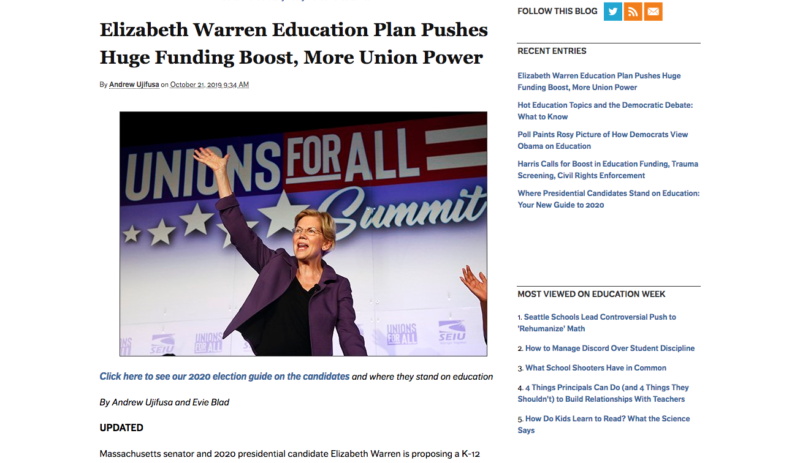
EdWeek’s story covered lots of the bases in terms of the plan’s policy proposals and advocates’ reactions.
Of the stories I’ve seen, all were strong on describing policy provisions but missing some key contextual components.
For example, none reported why the plan was so delayed — or what spurred its release. None reported how, if at all, the plan had evolved. None included the insights of political experts — the Cook Political Report’s Amy Walter — or even campaign veterans like former Obama guru David Axelrod who might help readers understand the plan’s implications. None took us inside the Warren campaign to explain the internal dynamics at play.
What does the release of the plan tell us about the hopes of the Warren campaign as it heads into November? We still don’t know. Others might not care, but for me, that’s a major missed opportunity. Campaign decisions aren’t made lightly or implemented accidentally. It wasn’t by chance that Warren released the plan on Monday and was in Chicago on the picket lines Tuesday.
Some would argue that it’s not an education reporter’s job to address political implications or perhaps even unfair to ask for more from journalists working on fast-moving news stories. But from where I sit, education campaign coverage has been overly focused on wonky policy details and weak on political reporting for far too long now.
The result is siloed, somewhat superficial, policy-heavy coverage — a far cry from the kind of stories mixing policy and politics that could be produced with just a little more attention to the political side of things.
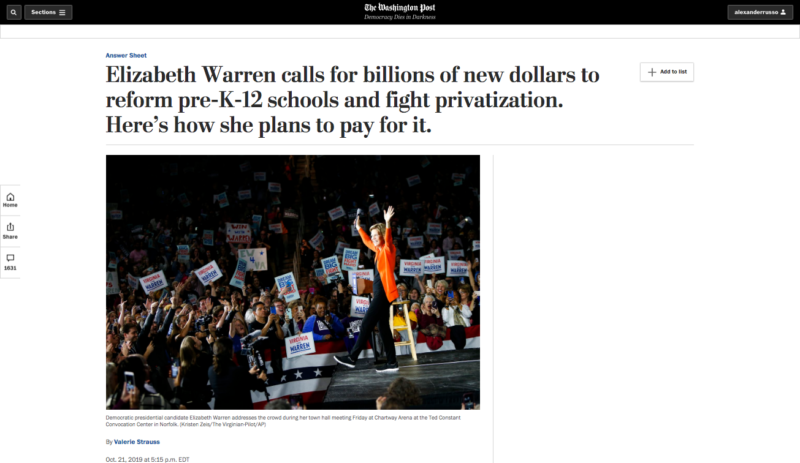
The Washington Post coverage was surprisingly good, asking key questions about the revenues needed to make the plan work.
Most likely, the Warren plan is an effort to garner support from unions and educators and die-hard Sanders supporters. As noted by US News and others, the two national teachers unions both praised the Warren plan. The Times story notes that “Ms. Warren and her Democratic rivals are vying for endorsements from teachers’ unions, which generally oppose the expansion of the charter sector.”
But that’s as far as the coverage goes. Of course the candidates are seeking the teachers unions’ endorsements. Of course the teachers unions are going to praise a plan that promises scads of new funding and teacher pay increases. None of that is news at this point.
What we don’t know is whether the Warren proposal, generous and oversized to the point of ridiculousness, moves the needle in any way — or whether it includes specific provisions that the unions asked for that were not in the Sanders or Biden plans.
On funding, Warren promises more money than Sanders. On charters, Warren also goes somewhat further. According to US News, the Warren plan makes her the candidate who’s “taken the hardest stance against charter schools so far this primary season.”
However, the Warren plan doesn’t really distinguish itself from Sanders’ plan in any dramatic way. It’s bigger, sure. It’s more comprehensive. It’s slightly more anti-charter than the Sanders plan. But it doesn’t propose anything radically different. So if it was meant as catnip for Sanders supporters, it seems inadequate. Why is that? Is there some tension within the Warren campaign about how far to the left she should go, or some effort to split the difference between Sanders and Biden?
As a reader, I appreciate the write-ups of the lengthy Warren plan but I’m frustrated not to know how and why the plan came out the way it did.
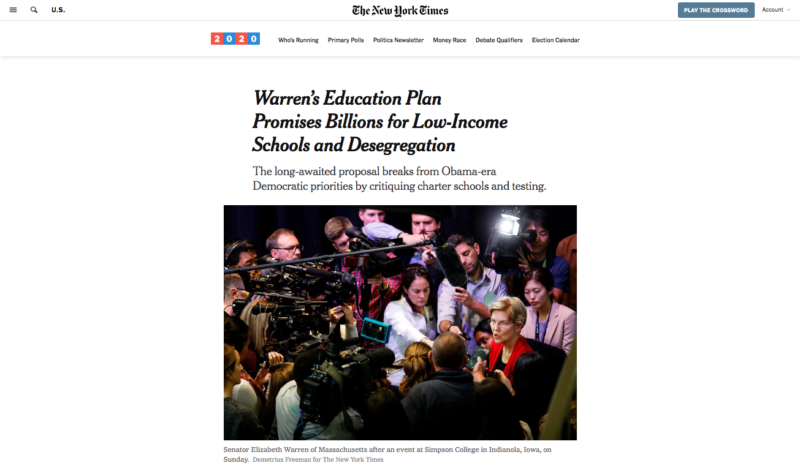
The New York Times coverage was among the writeups that focused on the broader issues.
Here are some of the other issues that the Warren coverage raises for me:
*Some of the coverage made too much of the plan’s charter school provisions. The semiautonomous public schools may be a teachers union boogeyman, but they remain obscure and unimportant in the vast majority of school districts around the country. The attention might be a function of the media’s and some advocates’ obsessions with the topic rather than a true headliner. For a somewhat more expansive view, check out the New York Times coverage, which focuses on the broader aspects of Warren’s plan such as funding for poor schools and racial integration.
*Precious little attention is spent on how Warren would pay for all of these initiatives. The WSJ story was the most focused on the reality that Warren’s plan would effectively use up the remainder of the candidate’s $2.75-trillion wealth tax revenue number. The Post story goes into the funding mechanism, noting that it’s “unclear whether her funding proposals will cover the more than $1 trillion in initiatives that Warren has advanced for pre-K through college.” The EdWeek writeup — perhaps the most deliciously skeptical of the ones I’ve read — describes the increased funding for Title I as a long shot, given current appropriations levels. But most of the writeups downplay the funding issue.
*Warren’s past support for charters and standardized tests is mentioned in several stories. These acknowledgments are a positive development, but not much is done with them. How and why did Warren change her views on such education issues?
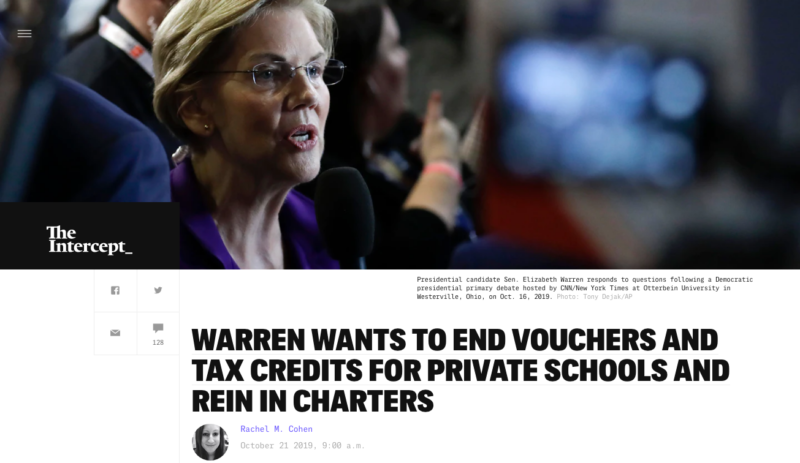
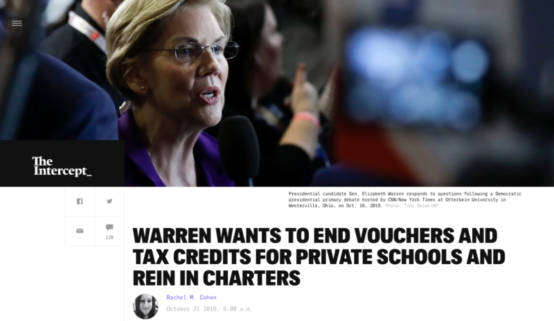
The Intercept writeup focused on the charter school angle but was among the first to get published & included lots of helpful tidbits.
Let’s be honest. There’s not that much in the Warren plan that’s deeply interesting unless you’re a wonk or an advocate.
What really makes the plan compelling as a story is the political backdrop against which it plays, both within the Warren campaign and the larger scene of competing campaigns.
That’s why I wanted a stronger effort to take us behind the scenes or help us understand the political dynamics.
Perhaps the instinct was there but there just wasn’t time.
If so, let’s hope that the days following bring coverage with more depth and illumination — especially when it comes to taking readers behind the scenes rather than merely describing what’s happening onstage.
Related posts:
Covering the ‘education primary’ of 2019
How the media flubbed the Elizabeth Warren story
Accuracy question plagues midterm 2018 education coverage
DeVos confirmation: The cliffhanger that wasn’t.
How seriously to take Clinton’s education shifts?
Don’t let the name fool you: EdWeek’s “Politics K-12” isn’t really focused on politics.
ABOUT THE AUTHOR

Alexander Russo
Alexander Russo is founder and editor of The Grade, an award-winning effort to help improve media coverage of education issues. He’s also a Spencer Education Journalism Fellowship winner and a book author. You can reach him at @alexanderrusso.
Visit their website at: https://the-grade.org/