In this week’s newsletter: Messy weather caused controversy over snow day decisions. How one school has responded to the arrival of roughly 100 new immigrant students. Parents need reporters — and vice versa. Anyone want to lead the Washington Post’s education team? And an ed reporter gets a picture with journalism icons Woodward and Bernstein.
SNOW DAY MELTDOWN
The big story of the week
The big story of the week is how school systems responded to messy weather in the Northeast — and how the media covered the story.
In response to a much-anticipated Northeast snowstorm, school systems from Philadelphia to Boston announced closures and delays (New York Times, Washington Post ). However, the decisions and approaches varied widely. Some districts stayed open because they didn’t have any extra days to spare (NBC Boston). Boston shut down but then —oops! — didn’t have snow (New York Times, Boston Globe). And New York City attempted to implement a remote school day rather than the traditional snow day (New York Times).
Remote instruction in NYC didn’t seem to go well, according to several news reports describing it as a “meltdown” and a “mess” (Chalkbeat NY, New York Times, WNYC, Gothamist, AP). However, the gleefully critical coverage might have mischaracterized the full story of what was happening.
The DOE didn’t have instructional days to spare — and had forced schools to move Google Classroom to a centralized domain (Gothamist, Educators of NYC). Parents who couldn’t stay home appreciated the day-before decision (The Unmuted). And cozy middle-class notions about parents and kids sledding in the park don’t match up with many NYC kids’ realities (Cafeteria Duty).
Other big education stories of the week:
📰 FAFSA FALLOUT: At least 25 colleges and universities are extending their decision deadlines for prospective students past the usual May 1 date — a result of the chaotic rollout of the new (and supposedly simpler) FAFSA form (New York Times, Washington Post). Some of the larger problems that have come up include students whose parents don’t have social security numbers being blocked from submitting the form and the failure to include a sibling discount for families with more than one student in college (NPR, Deseret News). The U.S. Department of Ed announced it will spend up to $50 million to help under-resourced colleges adjust to the new process, but few answers have been given about who will get this money and how it will be used (Inside Higher Ed).
📰 BAD NEWS BUDGETS: Districts across the country are facing steep budget cuts as enrollment shrinks and school funding relief — including the whopper that is ESSER funds — are about to run out (Politico, EdWeek). As they face budgets shrinking by millions of dollars in some places, districts are responding by discussing school closures, staff cuts, and cuts to summer and afterschool programs (Oregon Public Broadcasting, Miami Herald, Minneapolis Star Tribune, Ideastream Public Media, Fort Worth Report, Colorado Public Radio). This is a story that’s only going to get bigger and bigger.

DAY IN THE LIFE OF MIGRANT STUDENTS
The best education journalism of the week
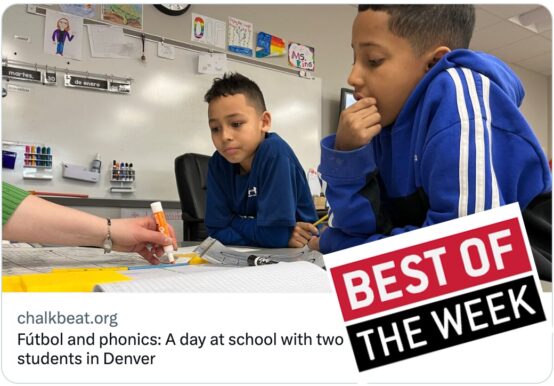
The best education story of the week is Four square, fútbol, and phonics: A day at Denver’s Valdez Elementary with two newly arrived migrant students by Chalkbeat Colorado’s Melanie Asmar.
Full of rewarding scenes, the piece follows 9-year-old Jesus and 10-year-old Leiker, two of more than 3,200 migrant children who have come to Denver Public Schools since the start of the school year.
We watch Jesus, with the help of Leiker and his math teacher, solve a tough multiplication problem. When Leiker’s literacy teacher reminds him to mark the end of a sentence, he makes “a period so big his teacher couldn’t miss it.” During recess, a girl pauses a game of four square to explain the rules to Jesus, who appears lost. “He didn’t know,” she tells the other players.
The piece acknowledges the difficulty of accommodating roughly 100 new students within Valdez Elementary’s limited space, but — unlike many stories about migrant kids — it focuses just as much on the school’s ability to adapt and the enriching effects of immigrant students. The literacy teacher differentiates his lessons “to new extremes,” while the assistant principal drives around town in his pick-up, visiting schools to gather spare desks. The kids and teachers don’t default to English as much.
The changes have been both “hard” and “beautiful,” Asmar writes. As Valdez’s principal puts it, “The bright spots are the growth of our kids and our community.”
Other great education stories this week — and why we liked them:
👏 The story of a boy who could only attend virtual school 45 minutes a day kicks off this radio feature about the loss of special education services in Pittsburgh during the pandemic. Jillian Forstadt captures both the frustration of parents and the struggle of administrators to respond in a piece that deserves regular follow-up (WESA).
👏 Michael Elsen-Rooney charts new ground in the student mental health story by exploring the generational differences between a daughter’s perception of therapy and her mother’s. The piece is full of vulnerable reflections from both (Chalkbeat New York).
👏 In a profile that’s both uplifting and concerning, Erica Breunlin tells the story of the food service director at a rural Colorado school who also tutors kids and shuttles them home, highlighting the critical role of school support workers and documenting how staff shortages affect their well-being (Colorado Sun).
👏 Using student and researcher voices, Patrick Wall makes the mundane-sounding topic of data collection and CTE programs urgent, showing how Louisiana is starting to share information between its education and workforce agencies to measure CTE’s success (Washington Post/Hechinger Report, 2/9).
👏 In an encouraging counterpoint to other coverage on the issue, Asher Lehrer-Small reports on the recent increase in students receiving special education in Houston-area school districts, helpfully spotlighting the state- and district-level changes that are likely responsible — such as focusing attention on students with dyslexia (Houston Landing).

Above: Members of Parent Shield Fort Worth.
PARENT-JOURNALIST ALLIANCE
Our latest columns and commentary
Parents need reporters — and vice versa, says Parent Shield’s Trenace Dorsey-Hollins in our most recent piece on parent-centered education coverage.
“Some journalists and news outlets will help hold schools accountable and point schools toward solutions,” notes the Fort Worth, Texas parent advocate. “But too many seem focused on covering tragic outcomes.”
Parents need reporters to make sure they’re getting accurate information about their children and to make sure schools are following through with the promises that they’ve made.
“Too often things that happen to the students and families we serve go unnoticed for various reasons,” notes Dorsey-Hollins. While “others often claim to be unaware.”
For another powerful parent perspective on education coverage, check out What parents really want (from education news).

Above, left to right: The New York Times’ Hannah Dreier, Business Insider’s Matt Drange, and the Voice of San Diego’s Jakob McWhinney.
PEOPLE, JOBS
Who’s going where and doing what
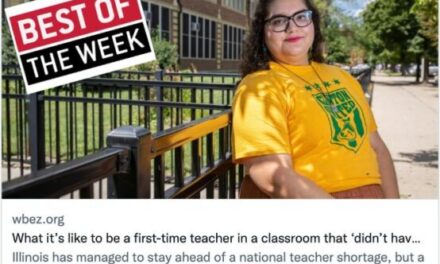
🔥 Awards: Congratulations to the New York Times’ Hannah Dreier and Business Insider’s Matt Drange who were named as two of 30 Semifinalists for the 2024 Goldsmith Prize for Investigative Reporting for their respective work on the exploitation of migrant children and serial sexual predators at schools. We interviewed both of them about their work previously. Dreier is also one of five finalists for the 2024 Shadid Award for Journalism Ethics for the same work.
🔥 Spotlight: I love what Voice of San Diego is doing with its parent guide to San Diego schools, meant to help new parents and those unfamiliar with the school system. “Being a parent is hard,” reminds VOSD education reporter Jakob McWhinney. “So we wanted to give families a way to learn more about schools without having to do the kind of digging we’re paid to do.” The small outlet also excels at school accountability stories and innovative uses of data, including its test scores vs. income metric developed with researchers at UC San Diego. The approach “allows us to see whether schools are outperforming or underperforming where we’d expect them to be given their level of poverty,” notes McWhinney.
🔥 Comings & goings: Texas Tribune public education reporter Brian Lopez is leaving the beat — and journalism altogether — to join his alma mater UT-Arlington as an assistant director of media relations. IndyStar suburban education reporter Rachel Fradette is leaving the paper but staying in the state to cover education. Best of luck to both!
🔥 Job openings: The Washington Post is looking for a new national education editor. The Texas Tribune is hiring a public education reporter to replace Brian Lopez. WITF in Harrisburg, Pennsylvania, is hiring an education reporter. Check previous editions of this newsletter for more jobs that may still be open.

Above: For the sixth anniversary of the Parkland school shooting, the New York Times (above) focused on the parents of victim Peter Wang. (See also USA Today, which profiled the school librarian working to create a safe space in the aftermath.)
APPEARANCES, EVENTS, & NEW RESOURCES
What’s happening and new research
⏰ Podcasts, segments, & documentaries: Check out these six segments from PBS NewsHour on how the landscape of education in the U.S. is changing, exploring “through students’ eyes what’s possible when they get deeply involved in their learning and help shape their school experiences.” EdSource’s Zaidee Stavely hosted a fascinating episode of the outlet’s Education Beat podcast where she interviewed the plaintiff in a parent lawsuit against the state of California over pandemic learning loss. An Oscar-nominated documentary about one of the last school district instrument repair shops in the country is available to stream and will be broadcast this weekend.
⏰ Books: NYU sociologist Eric Klinenberg’s just-published book “2020” tells the story of the first year of the pandemic through the eyes of seven New Yorkers — including a Manhattan principal. The chaotic response to the pandemic created societal long COVID, according to Klinenberg. Read about the book launch event in Brooklyn Heights. Benjamin Herold’s “Disillusioned” has been getting more glowing reviews, and Herold appeared this week on PBS’ “Amanpour and Co” to talk about the deterioration of American suburbs. Laura Pappano also talked about her book “School Moms” and covering parent activism on the “What Works” podcast.
⏰ Research: In her latest Proof Points column, the Hechinger Report’s Jill Barshay writes about a study that found one district’s early warning system for chronic absenteeism was not that effective. NPR analyzed a separate study showing that chronic absenteeism is getting lower — but barely — alongside another study showing gains in lost learning from the pandemic. And a new Ed Working Paper shows that a large and growing share of referrals to juvenile justice come directly or indirectly from schools.
THE KICKER

Name a more iconic trio than “Woodward, (Kati) Kokal, and Bernstein.”
That’s all, folks. Thanks for reading!
Reply to this email to send us questions, comments or tips. Know someone else who should be reading Best of the Week? Send them this link to sign up.
Using Feedly or FlipBoard or any other kind of news reader? You can subscribe to The Grade’s “feed” by plugging in this web address: http://www.kappanonline.org/category/the-grade/feed/.
Read more about The Grade here. You can read all the back issues of The Grade’s newsletter, Best of the Week, here.
By Alexander Russo with additional writing from Colleen Connolly and Will Callan.
ABOUT THE AUTHOR

The Grade
Launched in 2015, The Grade is a journalist-run effort to encourage high-quality coverage of K-12 education issues.