In this week’s newsletter: The Portland teachers strike will keep kids out until at least Nov. 27. The Washington Post goes all in on gun violence and school prevention efforts. What do parents really want from education news? It’s not what reporters usually provide. A new report looks at the mismatch between grades and standardized test scores. A high school principal critiques a New York Times story on cell phone bans. And a Dallas ed journalist takes her reporting to “This American Life.”
NO SCHOOL NOVEMBER?
The big story of the week
The Portland teachers strike — which will now, combined with the Thanksgiving holiday, keep kids out of school for most of November — is the big education news of the week.
Though largely ignored by national news outlets in the past week, the prolonged strike offers a preview of tensions that will likely emerge in other liberal cities with flat or declining enrollments — and provides some useful insights about how news outlets cover school shutdowns.
Along with wages and cost of living adjustments, much of the debate in recent days has centered around the union’s class size reduction demands (Oregonian, Oregon Public Broadcasting). School suspension policies that disproportionately affect non-white students are another point of contention (Oregon Capital Chronicle, Oregon Public Broadcasting).
A handful of stories have featured the strike’s impact on stressed-out parents, anxious high school seniors, family budgets, and teachers’ health care coverage (KGW, Willamette Week, Oregonian, OPB, KPTV, KGW, Oregonian, OPB). This more inclusive approach to school shutdown coverage is much more useful than the traditional focus on teachers vs. districts.
At least one story has noted that the governor has been conspicuously out of the debate, and another has noted that the teachers union is enormously powerful in the state (Oregonian, Oregonian). Classified school staff who operate under separate unions were also featured in at least one outlet (OPB).
As the week has wound down, the two sides appear to be getting closer on cost, thanks in part to the union’s Thursday decision to withdraw class size cap demands (Oregonian, Seattle Times). The earliest kids could go back to school would be Monday the 27th. There’s the possibility that the school year will be extended into the summer to make up for the lost days (KGW).
More big education stories of the week:
📰 GRADE INFLATION: New poll results released from Gallup and the nonprofit Learning Heroes show that the majority of parents think their children are doing better in school than they actually are — largely due to grade inflation (AP, EdSource). “Grades are the holy grail,” said Learning Heroes founder and president Bibb Hubbard in the AP. “They’re the number one indicator that parents turn to to understand that their child is on grade level, yet a grade does not equal grade-level mastery.” Other recent reports have shown the same thing: high grades, but low standardized test results (EdWeek).
📰 LOWERING GRADUATION REQUIREMENTS: New York state is considering dropping the requirement that students take the Regents exams in order to graduate from high school (New York Times, CBS New York, Chalkbeat New York). It’s part of a national trend away from graduation tests, with New York being just one of a few states that still require it. Oregon has also recently dropped its requirement (Wall Street Journal). While the exit exams are unpopular, proponents say losing them will have a negative impact on college readiness — a topic already much debated (USA Today, WYPR).
Last week’s big education story: The blue wave school board elections.
GRADUATION GUNFIRE
The best education journalism of the week
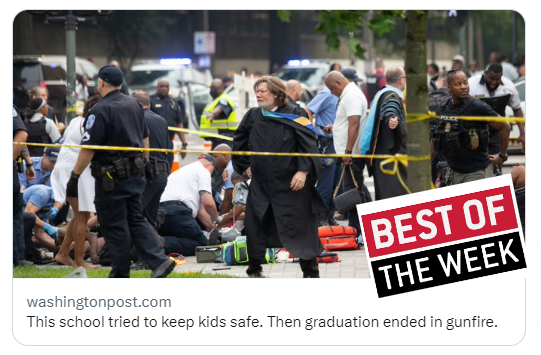
The best education story of the week is The Washington Post’s This school tried to keep kids safe. Then graduation ended in gunfire.
Education writers Hannah Natanson and Moriah Balingit, along with audio producer Sabby Robinson, spent a year inside a Richmond, Va., high school, during which student Jaden Carter was shot and killed behind the school’s baseball fields — one of nearly 30 who have died in gunfire over the past three years.
The piece continues The Post’s streak of excellent reporting on school violence and demonstrates why it’s so important for journalists to spend time in schools.
Firsthand observations from the reporting team include the jaw-dropping sight of instructional specialist Tess Short, who, dressed in jeans, a hoodie, and pink Converse sneakers, “follows in their footsteps, lacing up sneakers, pursuing their class schedule, comforting their friends, and directing people to mental health services as needed.”
Among many school staffers doing their best to help keep kids safe, we also meet social worker Whitney Wilson, who stocks her restorative room with makeup wipes and mirrors “so tearful girls could repair their mascara before returning to class,” but says she isn’t surprised when few students show up in the aftermath of Jaden’s death. “When things like this happen … they either do not come,” says Wilson, “or they may not express.”
Part 1 of the accompanying podcast series is here: Surviving to Graduation.
Bonus: The Post this week also published a broader series on the destructive toll of mass shootings that included disturbing images from Robb Elementary school in Uvalde, Texas.
Other great education stories of the week:
👏 Amazing watchdog/data reporting with real-world implications from The 74’s Beth Hawkins, who provides exclusive data showing that Minnesota could fill its yawning number of special ed vacancies three times over if it lured back 1,500 special ed teachers from less-grueling regular ed classrooms where they now teach. (The 74)
👏 Aitana Vargas brings much-needed nuance to the cops-in-schools debate with this deep dive that features a mother in Southeast Los Angeles who advocates for a police presence in her kid’s school, despite other parents’ concerns about racial disparities in arrests and the criminalization of students. Republished in the Oregonian and NJ.com from the digital news site by the National Association of Hispanic Journalists. (Palabra)
👏 Ariel Gilreath reports that, despite much-publicized fears about Tennessee’s new reading law potentially holding back thousands of students, just 1.2% of all third graders who scored low enough to risk retention were actually held back due to reading scores. Gilreath’s reporting is a good example of the maxim, “If your mother says she loves you, check it out.” (The Hechinger Report)
👏 Is Sarah Carr the Emily Hanford of dyslexia? She’s got two crusading pieces this month that look at a discredited screening tool that fails to identify thousands of children with dyslexia. (Scientific American and The Hechinger Report) A great and careful deep dive by Carr, who is also now overseeing Columbia University School of Journalism’s Spencer Fellowship.

Above: At a certain point, reading education news is “like watching a violent movie over and over and over again,” says Boston parent Vernée Wilkinson (left).
WHAT PARENTS REALLY WANT
Our latest columns and commentary
If education news is going to work for parents, it’s going to have to change.
That’s the central message of this week’s new piece featuring insights from School Facts Boston’s Vernée Wilkinson.
Parents want to know what they can do to help their child and improve the schools they attend, not how bad things are in the school system, says WIlkinson, who notes that repeated exposure to traditional education coverage represents “a certain form of violence towards children.”
What do parents really want from education news? It’s not more of the usual education coverage. But Wilkinson and others see precious little effort to break out of the traditional newsroom approach, in Boston or elsewhere.
Bonus: The New York Times’ recent story about a school cell phone ban gets a scathing review from an assistant principal in New York City, where cell phones have long been banned.

Above: The 74’s Mike Antonucci when he was a military man.
PEOPLE, JOBS
Who’s going where and doing what
🔥 Farewells: Longtime teachers union gadfly (and columnist for The 74) Mike Antonucci is retiring. As his colleague Beth Hawkins posted on X, Antonucci has been “a touchstone for education reporters for decades.” In his final column, he details his fascinating career trajectory, from filmmaker to sheet metal worker to member of the Air Force and finally education journalist (sort of). And in case you missed it, World In Black education data reporter Maya Pottiger is moving on after three years. “This position … has taught me so much about what makes a story successful, education in the United States, and myself,” she wrote in her farewell.
🔥 Job openings & opportunities: The Post and Courier Education Lab is hiring an editor. Newsday, the Charlotte Observer, the St. Louis Post Dispatch, and the South Bend Tribune are all hiring education reporters. Open Campus is offering newsrooms $10,000 — plus reporting, editing, and data support — for “ambitious, one-time stories on a range of higher education topics that center local communities.”
🔥 Books: Chalkbeat’s Kalyn Belsha interviewed sociologist Casey Stockstill about her new book “False Starts,” about how segregation pervades preschool. Kirkus Reviews described Benjamin Herold’s forthcoming book “Disillusioned” as “a deeply valuable study of the decline of suburbia.”

Above: “In Washington DC’s public high schools, about two-thirds of all students last year were chronically absent… About a third were profoundly chronically absent,” writes blogger Kevin Drum. “This is up considerably from the previous year, primarily because of excused absences.”
APPEARANCES, EVENTS, & NEW RESOURCES
What’s happening and new research
⏰ Podcast insights: The Dallas Morning News’ Talia Richman narrated a segment for “This American Life” called “See Something, Slay Something,” based on her story about a student who reported a possible shooting threat — and then was disciplined for it. Talia tells us she learned a lot from her radio experience, including the value of asking open-ended questions, simplifying her writing, and looking for “the kinds of details that can make a person become three-dimensional to a listener.” Meantime, check out the kicker below for a fun pic she shared with us recording the show.
⏰ Events: On Nov. 30, EWA is hosting an webinar on covering chronic absenteeism. I’m glad to see them supporting more attention to this persistent issue! (See also this Colorado Sun story about a spike in dropouts and absences. “Chronic absenteeism goes hand in hand with students dropping out,” the story notes). Also, in case you missed it, Chalkbeat’s Cara Fitzpatrick talked about her book “The Death of Public School” with New York Times critic Wesley Morris at the Stavros Niarchos Foundation Library in New York yesterday.
⏰ Research: The Education Department released data from the 2020-21 school year with lots of interesting findings, including that 88% of public schools operated in a hybrid mode that year (New York Times) and that Black and Latino students were significantly underrepresented in Advanced Placement classes (The 74, AP). Public Impact released the findings from its new poll on parents’ views of reading, which includes a few surprises. New research on student absenteeism from Attendance Works was written up in the New York Times.
⏰ New ventures: The Boston Globe’s Washington, D.C., bureau launched a new project called “Class War.” A piece this week looked at school choice. While the Globe has a seven-person education team (The Great Divide), I’m told this project is completely separate.
THE KICKER

Looks like the Dallas Morning News’ Talia Richman is having fun doing the “This American Life” thing. (Photo via her Instagram)
That’s all, folks. Thanks for reading!
Reply to this email to send us questions, comments or tips. Know someone else who should be reading Best of the Week? Send them this link to sign up.
Using Feedly or FlipBoard or any other kind of news reader? You can subscribe to The Grade’s “feed” by plugging in this web address: http://www.kappanonline.org/category/the-grade/feed/.
Read more about The Grade here. You can read all the back issues of The Grade’s newsletter, Best of the Week, here.
By Alexander Russo with additional writing from Colleen Connolly, Will Callan, and Greg Toppo.
ABOUT THE AUTHOR

The Grade
Launched in 2015, The Grade is a journalist-run effort to encourage high-quality coverage of K-12 education issues.