Though not exclusively an education reporter, he isn’t afraid to connect the dots.
By Alexander Russo
One of this fall’s obvious themes is school closings and consolidations. Pretty much every school district seems to be doing them. And it’s an easy story for journalists to cover, given how concrete and emotionally charged the decisions can be.
But how to cover the story in a way that’s useful and compelling? That’s the hard part. The stories and updates can all start to blur together.
One recent story in the New Yorker and ProPublica, The Death of School 10, suggests one way to deepen the story. The piece details the dismal story of a school closing in Rochester, New York, a district where enrollment has declined sharply.
Rochester is an especially extreme example of enrollment loss, combining suburban flight, charter schools, and inter-district transfers: all the elements that seem to contribute to enrollment declines other than a private school voucher program.
But Rochester is also one of the districts that stayed closed to in-person learning the longest during and after the pandemic. The story connects the temporary (if prolonged) school closures during 2020 and 2021 to permanent closures happening now.
The story is one of a series of education articles written by award-winning journalist Alec MacGillis since the pandemic. Not formally or exclusively an education reporter, his pieces covering abandoned kids, teenage distress during the pandemic, learning loss, and absenteeism are some of the most definitive pieces of the past four years.
In the interview below, conducted by phone and email, MacGillis talks about how he finds and reports his stories (including how he got into School 10), how to ferret out a key statistic that will help you tell the story of your district’s overall health, and the pros and cons of writing about schools from the outside.
“Sometimes it helps to be able to come to a subject with a fresh perspective, unencumbered by long-held assumptions or obligations to various official sources.”
NB: We interviewed MacGillis last year: Complacency and inertia.

Above: MacGillis, author most recently of The Death of School 10.
Alexander Russo: You’ve written about private school choice but avoided other popular topics like book bans and school culture wars. Why focus so narrowly on pandemic-related issues?
AM: Quite simply, the consequences of the pandemic school closures that I’ve been reporting on — learning loss, absenteeism, enrollment decline, and so on — are happening on a vastly broader scale and affecting far more students and educators than are the culture-war skirmishes.
AR: How did you decide to write about school closings?
AM: I’ve kind of made it my mission these past few years to write various pieces on the continuing consequences of the COVID school closings, following my initial article in September 2020 on a student in Baltimore who was left behind by remote learning. Looking at some of the attendance numbers, it became clear that there was, in addition to the absenteeism challenge, a broader challenge of kids who were not on the rolls at all anymore. And so I decided to take on a separate piece about that enrollment drop and what it was going to mean for districts that were going to have to be considering widespread closures.
AR: What if anything surprised you?
AM: Much of what I found was sadly predictable. It’s well established how wrenching school closures are for communities. If I can think of anything that surprised me, it was the extent of the affection that that these communities had for schools that were on paper deemed not successful. To see just how completely attached the students were to these educators and staff gave me a new level of appreciation for just how strong emotions are in these situations that are now going to be replicated countless times around the country.
“If I can think of anything that surprised me, it was the extent of the affection that that these communities had for schools that were on paper deemed not successful.”
AR: Do you have any thoughts about covering the enrollment-based closings story?
AM: There’s been some good reporting on this in various cities. The Wall Street Journal’s Sara Randazzo and Matt Barnum did a nice job looking at the closings coming soon in Los Angeles, really kind of drilling down and showing just how far enrollments have fallen. I saw just now another story out of the Seattle Times, which has done a good job covering the proposed closures there. Going back further, The Associated Press, working with Stanford’s Thomas Dee, has been the foundational source on the post-pandemic enrollment declines.
I do think the one really important consideration is to not report on closings in a vacuum, simply as a matter of enrollment, but really to look at the trend line over the past few years and the factors that led to us to this point — and to sort of try to figure out as best as possible where the kids went and what the dynamic was that has been leading parents to make these moves. It was not inevitable.
And then, of course, it’s important as much as possible to try to humanize the process. That’s not always so easy. In Rochester, some of the schools I was hoping to get into were nearing the end of their school year, and I wasn’t able to get in. But then I was fortunate that at School 10 I found a family and then a whole bunch of educators and I was able to really to bring that school to life.
“I do think the one really important consideration is to not report on closings in a vacuum, simply as a matter of enrollment.”
AR: How did you get access to School 10, anyway?
AM: For starters, it’s going to the meetings. Or at least, back to the recordings of the meetings where these pleas are being made to keep various schools open. In this case, I had met with one mom, Janice Kpor, through another mom who led the districtwide parent advocacy organization, whom I met at a school board meeting. She suggested I speak with Janice, because she said Janice was very committed to trying to keep School 10 open.
I had a really great long talk with Janice and she mentioned that just the next day, the second to last day of the school year, her daughter was having an end of year graduation ceremony in the kindergarten classroom, and so I just appeared at the classroom, signed in along with everyone else at the front of the school, and was there to witness that ceremony. The next day, there was a schoolwide ceremony that was very rich, just lots of emotion, lots of recollections. There were hundreds of people. I came in as a member of the public.
Meanwhile, I was speaking with the PIO at the district to try to get interviews with administrators. That didn’t end up getting me to any principals, but I managed to speak to the principal at School 10 by showing up at this end-of-year ceremony and then speaking with her there.
AR: One of the things that you did in the piece which I don’t see very much is you were able to explain the percentage of school-age kids that Rochester schools were serving. I was curious how you got the number, and whether you thought it was an important number for other reporters to get?
AM: The number seemed hugely important to me, and really kind of shocked me when it first came up in the presentation by the superintendent last September, almost exactly a year ago. He showed the number of kids born in Rochester in a given year, and then how many show up five years later to attend kindergarten — and how much that proportion had shrunk just in the recent past, to a point where fewer than half of the kids born in Rochester five years ago were showing up for school in the regular public schools. The rest were going to charter schools or private schools or were homeschooling or moving to the suburbs by the time they got to kindergarten. It’s just a stunningly small share. Then he made the prediction that if things continued on this course, the city would have fewer than 14,000 kids attending public schools in about 10 years — in a city that’s now more than 200,000 people. And so I used census data to make a rough calculation on my own to show what a small share of the school-aged population that figure represented.
AR: What’s the response been to the story, from readers and other news outlets?
AM: I’ve been hearing from people all across the country, especially in cities that are facing school closures, for whom it seems to have really hit a nerve. My hope is that this story is going help draw more attention to this trend as it now hits one city after another, and helps provide a framework for thinking about it, to tie it back to what happened during the pandemic. There are some cities like Rochester that have had declines in enrollment for years now, due to various forces. But what we saw during 2020-22 was a massive acceleration on that trend, and I think it’s really important that as these closures start happening in various cities, the connections are made back to the decisions that were made during that period.
AR: Let’s talk about that for just a second. Did you find any shift or softening in the reluctance to reconsider the decision to keep schools closed during the pandemic?
AM: I think it really does vary. Adam Urbanski, the long-term head of the teachers union in Rochester, says in my story that they needed to close for so long in Rochester because the district just wasn’t doing enough to assuage the union’s concern on air quality. And he’s still standing by that. But then also, I found several school board members who were quite candid about whether it could have been done differently. There’s definitely a general shift on the subject and more willingness to reckon with the costs of the closures. But I’m still struck by how little they’re being talked about — how little it’s even a part of the nationwide political debate now.
“There’s more willingness to reckon with the costs of the [pandemic-era] closures.”
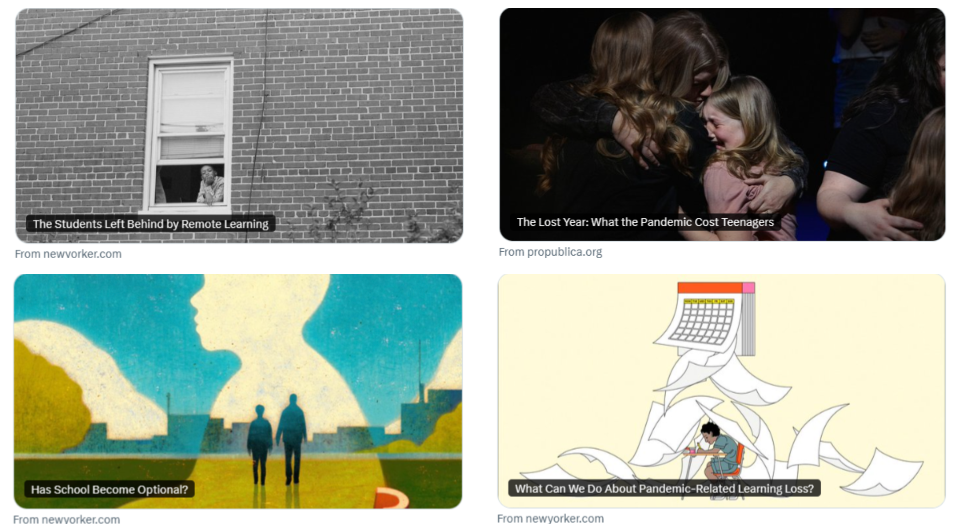
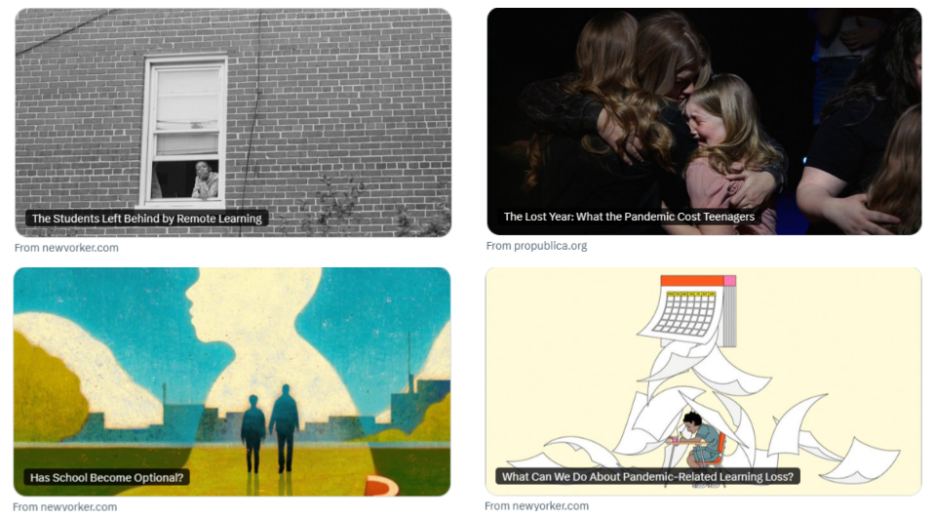
Above, clockwise from top left: Four previous stories through which MacGillis has explored the links between COVID-era school closings and challenges facing American schools: The Students Left Behind by Remote Learning (2020), The Lost Year (2021), What Can We Do About Pandemic Learning Loss? (2023), and Has School Become Optional? (2024).
AR: How about the media interest or appetite for your story? How’s the response been in terms of bookings or pickups or follow ups, compared to your other pieces?
AM: I was invited on All Things Considered, which was heartening. That was, I think, the first time that I’ve been invited on national NPR to discuss any of these education pieces. I would have gladly come on earlier, but, you know, better late than never. And I was a recent guest on the PBS’s Amanpour & Co.
AR: Do you have any thoughts on why your schools coverage, which was recognized for its excellence 20 years ago when you were at the Baltimore Sun, has not been recognized more recently? You’ve won numerous awards for covering other topics.
AM: I’ll leave that one for the judges. I submit my stories to EWA contests, among others, but I stopped viewing journalism awards as arbiters of quality and impact a long time ago.
AR: Looking back on the past four years, in what ways does it help or hinder that you’re not focused exclusively on the education beat?
AM: It really is a mix of pros and cons. On the one hand, I lack the deep sourcing and sense of context that a veteran beat reporter will have — which is why I always take care to read up on their work, as I did with Justin Murphy’s book on the history of segregation in Rochester schools. On the other hand, as in other reporting realms, sometimes it helps to be able to come to a subject with a fresh perspective, unencumbered by long-held assumptions or obligations to various official sources.
Previously from The Grade
The heartbreaking but necessary work of covering school closures (The New Orleans Lens’s Marta Jewson)
The closer (SF Chronicle’s Jill Tucker)
Covering school closings: Lessons from Colorado (Chalkbeat’s Melanie Asmar)
‘Make all the lemonade’: Covering Chicago’s mass school closing (Sun-Times’ Lauren FitzPatrick)
Closings are coming. Cover them well. (Tim Daly)