In this week’s newsletter: Yet another FAFSA fiasco. We need to talk about African American English. A veteran reporter gets honest about school closures — including her own. USA Today gets a shout-out from HBO’s John Oliver. And a look back at a San Francisco reporter who pretended to be a high school student and ended up a goat farmer.
FAFSA FLUB
The big story of the week
The big education story of the week is the ongoing series FAFSA-related glitches that keep emerging — and the insufficient media response that has ensued.
This week’s new flub is a calculation error that makes it difficult to know key information about how much aid they’re getting (CNN, AP, NPR , USA Today, PBS NewsHour, Chronicle of Higher Education, Washington Post). In response, at least one state — California — has extended the student financial aid deadline (CalMatters, Politico, LA Times, EdSource).
This week’s coverage has been more energetic, as you can see above. But the botched FAFSA rollout should generate more focused, ongoing scrutiny than it has. Instead of a series of stories about FAFSA, we’re being given one-off updates and stories about how excruciatingly hard it is to get into Duke, what a mess student protests have made of life at Stanford, or how applications dropped at Harvard.
Other big education stories this week included budget cuts, layoffs, chronic absenteeism, and a social media ban for minors in Florida. Look back through @thegrade_ for all the top education headlines every morning.
WE NEED TO TALK ABOUT AFRICAN AMERICAN ENGLISH
The best education journalism of the week
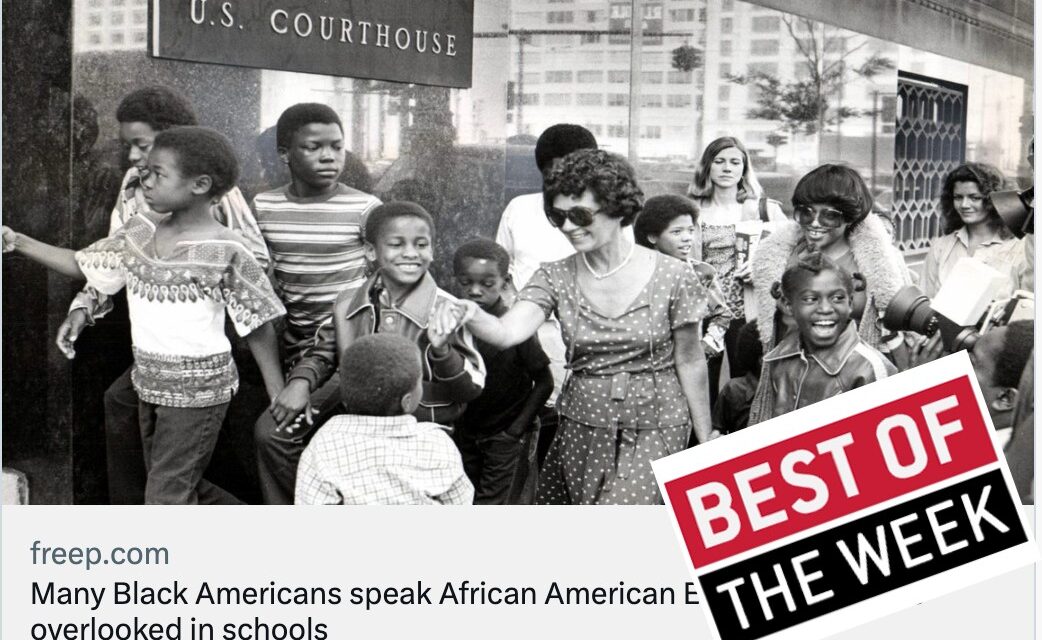
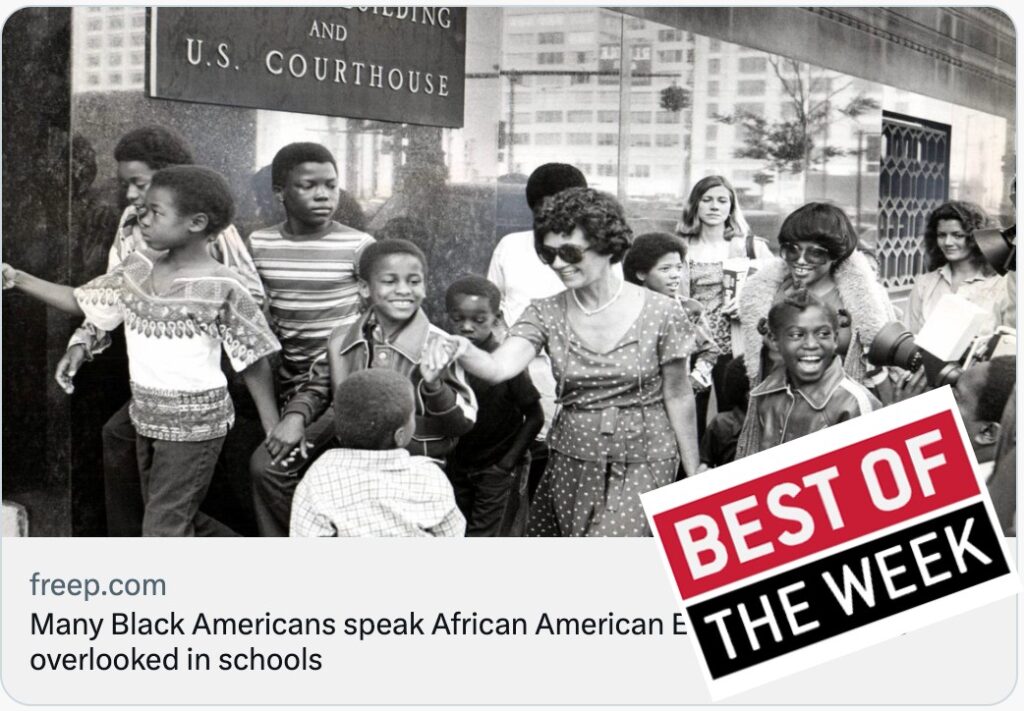
The best education journalism of the week is Many Black Americans speak African American English. But is it embraced in schools? by Lily Altavena of the Detroit Free Press.
In this story, Altavena smartly and sensitively explores Black students’ use of African American English (AAE), which receives little media attention but has roiled culture war debates in past decades and is deeply relevant to the current push to help more students read.
Telling the story through the eyes of Geneva Smitherman, a co-founder of the African American and African Studies Department at Michigan State University, Altavena recounts Smitherman’s personal journey and draws attention to a landmark federal court case from Ann Arbor, Michigan.
Avoiding the easy, overheated pitfalls of such a topic, Altavena does a great job navigating the complexities of language barriers in education and drills down to what advocates say is the transformative impact of embracing AAE — and the young people who speak it. AAE is a language, not slang. And as one scholar puts it, AAE is “not going anywhere.”
It’s a long read but a good model for journalists wanting to dip their toes into culture war issues while relying on history, with a great main character and smart, sensible voices throughout.
Other education stories we loved this week include the Boston Globe’s story on crazy expensive police details in one district, Stateline’s story on Republican infighting over vouchers, the Economist’s look at the Chicago Teachers Union, and a slightly older (but still worthwhile) Washington Post story about what an extremely critical community member learns after she wins a school board seat.
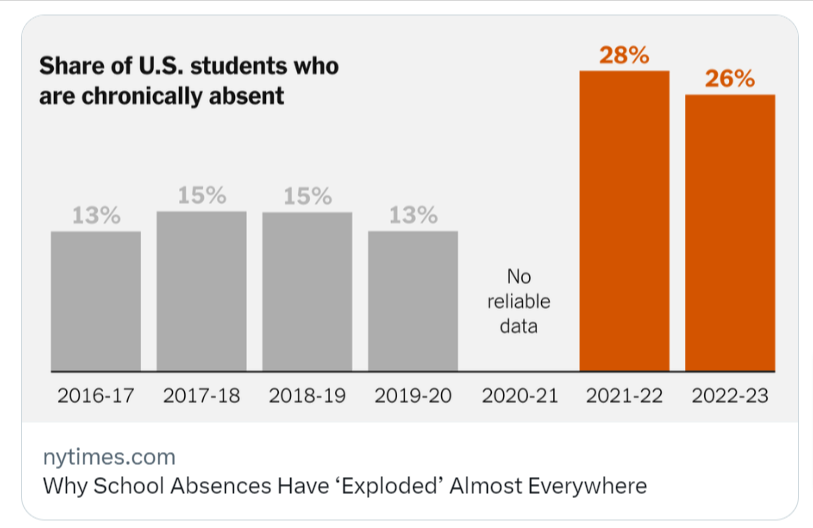
Above: The New York Times has a new piece about chronic absenteeism out this morning.
CHRONIC ABSENTEEISM & SCHOOL CLOSINGS
Our latest columns and commentary
Coverage of student absenteeism doubled last year, according to the folks at Attendance Works who have helped draw attention to the issue, but the challenges still urgently need media attention.
In a new interview also published this week, veteran San Francisco Chronicle education reporter Jill Tucker tells us that she understands how upsetting school closings are — in part because she experienced one as an elementary school student. But that doesn’t make it any easier to cover them.
On the topic of closings, Tulane’s Douglas Harris reminds us that, historically, traditional public schools close at a consistent rate of about 1% per year. However, closings may occur at a higher rate in the near future because of ongoing declines in birth rates, movement out of cities, and the expiration of ESSER funds. “Whether students suffer academically depends on how closures are carried out,” according to Harris, who would be a good person to talk to when reporting on closings.
PEOPLE, JOBS, & EVENTS
Who’s going where and what’s happening

Above: “If you need any more incentive to read our coverage,” posted USA Today education reporter Zach Schermele. See the Alia Wong story that got a nod from John Oliver here.
📰 Cell phone bans: NPR’s “All Things Considered” dove into Indiana’s ban, and Steve Inskeep spoke with author Jonathan Haidt (“The Anxious Generation”) about the consequences of a smartphone-centered childhood. The Boston Globe and Rhode Island PBS also teamed up for a segment on schools banning cellphones in the state.
📰 More podcasts, segments, & appearances: Chalkbeat and The Bell launched a new student-run podcast called P.S. Weekly. Chalkbeat national editor Erica Meltzer joined WBUR’s “Here & Now” to talk about the new digital SAT. And the Wall Street Journal’s Matt Barnum appeared on “This Morning with Gordon Deal” to discuss how states are trying to keep teachers in the workforce.
📰 Books: See the first review in Kirkus of former LA Times education reporter Sonali Kohli’s book — coming out in June — profiling three girls of color who fought for change in their communities and won. Coming in July (and also reviewed in Kirkus) is Jennifer C. Berkshire’s and Jack Schneider’s book “The Education Wars” about culture conflicts in public schools.
📰 Sound-off:
- “We need to tell more stories through kids’ eyes,” said Washington Post enterprise reporter John Woodrow Cox at the recent Power of Narrative conference (via Mandy McLaren). “I don’t have any preternatural gift at this.”
- “Reporters must be careful not to parrot the anti-immigrant rhetoric used by politicians — Democrats and Republicans alike — that casts newcomers as an unwanted burden,” cautioned The 74’s Jo Napolitano in a piece for EWA.
- “No matter how many times columnists say the public was big mad about school closures in 2020, we must reiterate that surveys of both Americans and of parents never showed that,” said Vox’s Rachel Cohen.
Also notable this week: the arrest of a higher ed reporter covering student protests, a Toner award for coverage of a Michigan town roiled by culture war politics, the latest in a slew of strong stories from the New York Times’ Sarah Mervosh, and a new investigation into Oregon’s early learning agency from a reporter new to us, Follow @thegrade_ to get the full scoop in real time.
THE KICKER

From undercover student in California to goat farmer in Wales, former San Francisco Chronicle reporter Shann Jones might have the most interesting journalism resume of all time.
That’s all, folks. Thanks for reading!
Reply to this email to send us questions, comments or tips. Know someone else who should be reading Best of the Week? Send them this link to sign up.
Using Feedly or FlipBoard or any other kind of news reader? You can subscribe to The Grade’s “feed” by plugging in this web address: http://www.kappanonline.org/category/the-grade/feed/.
Read more about The Grade here. You can read all the back issues of The Grade’s newsletter, Best of the Week, here.
By Alexander Russo with additional writing from Colleen Connolly
ABOUT THE AUTHOR

The Grade
Launched in 2015, The Grade is a journalist-run effort to encourage high-quality coverage of K-12 education issues.