In this week’s newsletter: Media outlets downplay the Fauci interview and Randi Weingarten’s Congressional testimony — including a potential bombshell revelation. Republicans reverse themselves on teacher salaries and maternity leave in Oklahoma. And nearly 20% of the just-announced Report for America cohort will cover education.
DOWNPLAYING FAUCI & WEINGARTEN
The big story of the week
The big education story of the week for me is the New York Times’ confrontational interview with Anthony Fauci and the contentious House subcommittee appearance by AFT head Randi Weingarten that yielded a potential bombshell revelation.
Both Fauci and Weingarten played major roles in school COVID responses and the current enrollment, attendance, behavior, and learning challenges many schools now face. The Weingarten testimony revealed how an unnoticed change to the CDC COVID guidance may have helped teachers block in-person instruction.
But both high-profile figures continue to downplay their roles and to resist reflecting on their possible mistakes. And — based on the responses I’ve seen — many others in journalism didn’t see these as important stories at all.
To most mainstream news outlets and education teams, it seems, Fauci is old news and the Weingarten hearing was nothing more than political theater. Meanwhile, districts struggle with the effects of prolonged closures and some like DCPS just announced that negative tests would be required to return to school after spring break. And Twitter — Twitter! — is doing a better job fact-checking Weingarten’s claims than any news outlet I’ve seen.
Readers might have understandably assumed that a New York Times interview of Fauci was going to be a sleepy affair. The Times has rarely challenged Fauci’s role or influence, and the interviewer, David Wallace-Wells, has tended towards caution when it comes to COVID responses. But in this piece Wallace-Wells declares that “almost certainly, schools stayed closed longer than they needed to” and takes Fauci to task for his role, prompting Fauci to downplay his influence and disavow the CDC guidance.
“Show me a school that I shut down,” says Fauci. “Never. I never did. I gave a public-health recommendation that echoed the C.D.C.’s recommendation, and people made a decision based on that.”
Many would question Fauci’s response and report on the role he played — along with the CDC and others. But not the mainstream news outlets and education teams. One former Times reporter took issue with the aggressive questioning of Fauci, but that’s about it that I’ve seen.
The media response to Randi Weingarten’s appearance before the House subcommittee was a little better, but still quite demure. ABC News, The Hill, and a handful of other outlets covered the hearing. The Times Magazine has a new Weingarten feature out today. In her written testimony, Weingarten declared the need to defend teachers against “unrelenting attacks… over pandemic era school closings.” Twitter appended her claim with a reader rebuttal documenting Weingarten’s many statements against reopening.
Most important of all, a potential bombshell was revealed during the hearing regarding the AFT’s role in adding a section to the CDC guidance that may have effectively blocked or limited in-person learning during the pandemic by expanding teachers’ eligibility for workplace accommodations in the CDC guidance. The 74 mentioned the CDC language in its coverage. The 74’s Beth Hawkins and parent Eileen Chollet wrote Twitter threads explaining how things played out in Minneapolis and Fairfax.
Other big stories of the week:
BUDGET PROBLEMS: The looming end of ESSER, combined with declining enrollment and a reluctance to close or consolidate schools, is creating big budget problems in districts across the country. At stake are staff jobs, student clubs and music programs, and — yes — school closures down the line (Boston Globe, WPR, OPB, Seattle Times, Pittsburgh Post-Gazette).
AP AFRICAN AMERICAN STUDIES: The College Board announced it will make changes to its AP African American studies course after being accused of bowing to Florida Gov. Ron DeSantis and watering it down (New York Times, NBC News, USA Today, Washington Post). What will those changes be? We don’t know yet. So much coverage for a vague announcement. In the meantime, there’s a new book out by a New York City public high school teacher who slams the AP program and its emphasis on testing.
REPUBLICAN REVERSAL
The best education journalism of the week
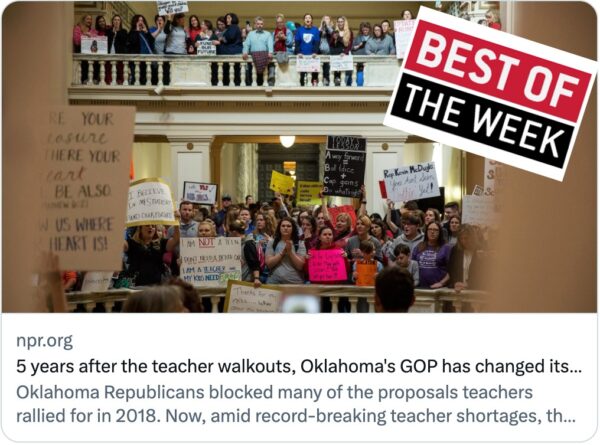
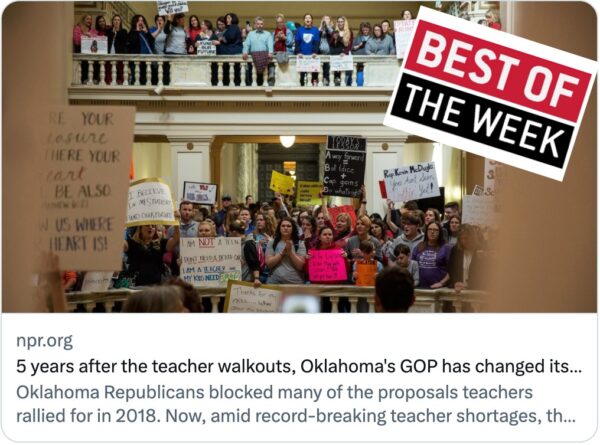
Out of several top contenders, the best education story of the week is Beth Wallis’ NPR piece 5 years after the teacher walkouts, Oklahoma’s GOP has changed its tune, which tells readers something surprising and important going on in education politics in Oklahoma and other parts of the country.
As former teacher Wallis recounts, Oklahoma teachers went on strike in 2018 for more school funding and better pay from the Republican majority who control the state. Five years later, the state’s Republicans are now “backing record-level education funding measures, including teacher raises and a slew of pro-labor bills” including maternity leave, a pay raise, and an expansion of the mentor program.
What happened? According to Wallis, who is an ed reporter for StateImpact Oklahoma, teacher shortages have gotten worse. Pay increases and school funding increases didn’t make as much of a dent as hoped. And so some Republican lawmakers have come around to the need to do more — even as their colleagues may be attacking teachers and schools.
It remains to be seen if these measures pass. However, Oklahoma is not the only place where Republican lawmakers combine salary increase proposals with attacks on school culture. Great story.
BONUS
🏆 As Schools Brace for More English Learners, How Well Are They Being Served Now (The 74)
🏆 Blocked Crossings Force Kids to Crawl Under Trains to Get to School (ProPublica)
🏆 How to teach kids who flip between book and screen (MIT Technology Review)
🏆 Panic over ChatGPT cheating ebbs as teachers start to see potential (San Francisco Chronicle)
🏆 The Education Community Braced for Guidance on Student Discipline. It Never Came (The 74)
🏆 Florida just expanded school vouchers — again. What does that really mean? (Hechinger Report)

HIDDEN GEM
Our latest columns and commentary
Above: Investigative reporter Steph Machado
WPRI Providence’s Steph Machado works as an investigative reporter for a relatively small outlet in a very small state, and she doesn’t even officially cover education. But vulnerable kids and parents are a core concern, and it shows in her coverage. She’s “the perfect combination of tenacious and compassionate,” according to Dan McGowan, who covers Providence for the Boston Globe.
Check out her candid new Q&A with contributor Colleen Connolly about covering the state takeover and finding vulnerable kids who aren’t getting served.
“I would like to see more stories about how school systems are serving (or failing) the most vulnerable students,” says Machado. “Sometimes it keeps me up at night thinking about the kids who are slipping through the cracks.”
TEACHERS IN CHARGE
Coverage of promising school innovations & signs of progress
💡 Schools where the teachers make decisions on curriculum, budget, and personnel have appeared in a handful of districts; early data suggest the model can improve retention and job satisfaction (Hechinger Report).
💡 A community college program that places two instructors in one classroom — one to provide job training, the other to teach basic skills — is helping older students who might be rusty in areas like math or writing get through their courses and graduate (Seattle Times).
💡 Parents and teachers at Fulton County Schools are beginning to see progress among young readers after the Atlanta-area district set aside about a third of its pandemic aid to implement a more phonics-based literacy curriculum (The 74).
💡 A Colorado bill will increase special education funding in the state by 13.4%, fulfilling a commitment legislators made in 2006 but failed to honor (Chalkbeat Colorado).
Read more about the importance of covering promising innovations and preliminary successes.

PEOPLE, JOBS
Who’s going where and doing what
Above: Nearly 20% of the newest corps members of Report for America will report on a beat involving education, according to Executive Director Kim Kleman.
🔥 Report for America: The newest cohort of Report for America corps members was announced this week, and we count at least 10 with beats related to K-12 or higher education. Some whose work we’re looking forward to include Sofi Zeman, who will cover education, safety, and crime for the Uvalde Leader-News, and Alaina Bookman, who will cover violence prevention for AL.com (find out here why education editor Ruth Serven Smith is so excited). RFA Executive Director Kim Kleman writes, “Good, local education coverage is one of the bread-and-butter beats that seems to be lacking just about everywhere. Every year, it’s among the most popular beats among newsroom applications.” See the full list of new members here.
🔥 Reporter reflections: “These are really hard stories to report,” says ProPublica’s Melissa Sanchez about her 2020 coverage of teens who work in factories while they try to go to school. Working immigrant teens have lots of good reasons not to talk to anyone, for themselves and their coworkers. “Their livelihoods – and their families’ well being back home, are on the line.” So Sanchez — who used to cover education and whose father was an immigrant teen worker — encourages reporters to be extremely careful building trust with them, to let them make the decisions about whether to name the employer or how to be identified, and to follow up after the story publishes.
🔥 Impact: The LA Times’ Teresa Watanabe reported on a 4.0 student who beat long odds to get into the University of California, but then couldn’t afford to go. Immediately after publication, offers of aid began to pour in from readers, and now he’s going to his dream school. Kudos to all involved.
APPEARANCES, EVENTS, & NEW RESOURCES
What’s happening and new research
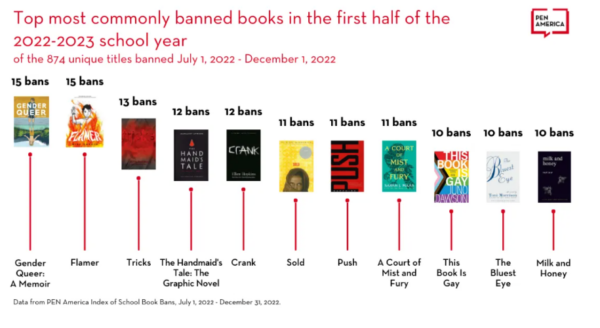
Above: Bookriot’s graphic of the most-banned books in 37 states so far, based on the new PEN America report.
⏰ Book ban report: PEN America is out with a new report on school book bans that includes more than 800 titles in 37 states, with Texas and Florida ranking at the top for most book removals and “Gender Queer” topping the list of the most challenged books (WLRN, The 19th, AP, LA Times, New York Times). CBS Sunday Morning also ran a segment on book bans, and folks on the left and right were critical in predictable ways. The top banned books are mostly graphic novels. Here are some images purported to be from some of the most controversial titles, if you’re curious.
⏰ More research: The Hechinger Report’s Jill Barshay takes a look at the latest reading study that’s getting a lot of buzz, urging caution against over-interpreting the results. A new report in Education Next looks at research on teacher evaluations and pay and their impact on student outcomes. Turns out that how — and how much — you pay teachers might matter after all. And an opinion piece in the New York Times by Jessica Grose looks at why those low college admission rates are misleading, because of both the ease of applying to elite colleges and how the colleges manipulate their numbers. (The media also plays a role in hyping how hard it is to get into some schools, as we’ve pointed out in the past.)
⏰ Segments & appearances: For CNN, Athena Jones looks into the switch to the “science of reading,” touting the statistic that about 1 in 3 American fourth-graders can’t read at a basic level of comprehension. Boston Globe higher ed reporter Hilary Burns was on the TV show Boston Globe Today talking about special treatment in acceptance decisions.
⏰ Protecting student sources: I don’t know the particulars in this most recent case in which the Washington Post removed a student name three weeks post-publication, but individual reporters and media outlets are slowly becoming more careful about protecting kids’ identities — sometimes with help from watchful districts and parents. There’s a case to be made that kids’ identities should be verified, but their full names shouldn’t be used in news coverage unless absolutely necessary. Ideally the decision should be made pre-publication.
⏰ BuzzFeed and Chalkbeat: The recent demise of BuzzFeed makes me think of Chalkbeat, the much-loved nonprofit education news network. No mass layoffs there, but the expansion has stalled, the model is expensive, three very senior executives (Bene Cipolla, Alison Go, and Scott Elliott) have left or been pushed out, and at least one major funder (the Emerson Collective) has bailed. They’re nowhere near the 18 bureaus they said they would reach by 2025.
⏰ Wait, what? There were precisely zero San Francisco public school students among the 3,000 attendees at the national high school journalism convention held in San Francisco, according to Mission Local.
THE KICKER
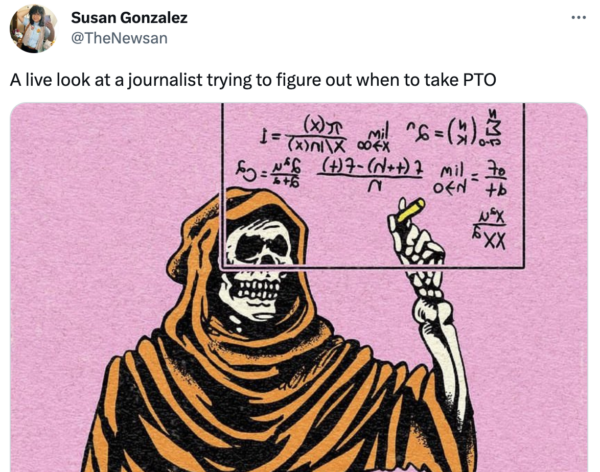
Ed reporters deserve a spring break, too. Right? (H/T Chalkbeat’s Susan Gonzalez)
That’s all, folks. Thanks for reading!
Reply to this email to send us questions, comments or tips. Know someone else who should be reading Best of the Week? Send them this link to sign up.
Using Feedly or FlipBoard or any other kind of news reader? You can subscribe to The Grade’s “feed” by plugging in this web address: http://www.kappanonline.org/category/the-grade/feed/.
Read more about The Grade here. You can read all the back issues of The Grade’s newsletter, Best of the Week, here.
By Alexander Russo with additional writing from Colleen Connolly.
ABOUT THE AUTHOR
Alexander Russo
Alexander Russo is founder and editor of The Grade, an award-winning effort to help improve media coverage of education issues. He’s also a Spencer Education Journalism Fellowship winner and a book author. You can reach him at @alexanderrusso.
Visit their website at: https://the-grade.org/