How CRPE’s remote learning database emerged as a major source of information for education reporters.
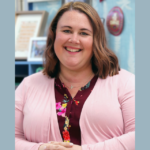
If you feel like you’ve been seeing Robin Lake’s name a lot in recent weeks, you’re not imagining things.
Lake and a database of district and charter network responses to the COVID-19 crisis created by the organization she heads, the Center on Reinventing Public Education at the University of Washington, have been ubiquitous lately — featured everywhere from the LA Times to the Washington Post.
For journalists and education leaders starved for reliable information about a fast-moving and highly varied situation, the frequently updated database may appear like a godsend.
Lake’s helpful insights and calm demeanor have turned her into a go-to source for quotes and explanations.
The result has been a media phenomenon that is the closest thing to the viral success of EdWeek’s school closings map we’ve seen in recent weeks.
A handful of education activists have objected to the media’s reliance on a pro-school-choice organization. But in the current information vacuum, Lake is as close as it comes to an education version of Anthony Fauci.
Disclosure: Several of CRPE’s funders also support The Grade.
In the current information vacuum, Lake is as close as it comes to an education version of Anthony Fauci.
In just the past week, CPRE’s work and/or Lake’s insights have been cited in two New York Times stories, the Boston Globe, and on NPR.
Lake’s ideas about making up for lost learning time this spring are part of the latest New York Times overview of where things stand with schools and reopening:
To make up for lost classroom time, schools may need to provide remedial instruction, additional special-education services and counseling, said Robin Lake, director of the Center on Reinventing Public Education.
The Times also included Lake and the CRPE database in a Learning section overview of the situation late last week, in a piece produced by the Hechinger Report:
“Nobody knows the right path forward,” said Robin Lake, director of the Center on Reinventing Public Education… “We’re all going to have to try things and give each other grace.”
The Boston Globe quoted her in a recent story about how differently state remote learning plans have turned out:
“A lot of the state guidance was to wait and think through equity and try to get this right before you do anything,” Lake said. “That was pretty dangerous to do because private schools and advantaged families were not going to wait.”
NPR interviewed CRPE’s Bree Dusseault on All Things Considered about variations among district remote learning programs.
Major newspaper editorial pages such as the LA Times, Washington Post, and New York Times have also been frequent users of the database. Earlier in the month, Chalkbeat also cited the database in its overview of remote learning attendance tracking policies.
Related story: Making the map: How EdWeek turned its school closings map into an iconic piece of journalism.
In just the past week, CPRE’s work and/or Lake’s insights have been cited in two New York Times stories, the Boston Globe, and on NPR.
It’s easy to figure out why Lake and her report have become so popular.
The thirst for reliable information has been strong since the early weeks of the COVID-19 crisis, when states and districts and even individual schools have all appeared to be doing different things.
Reporters struggling to get a grasp of the situation understandably appreciated the think tank’s efforts, which initially featured information about 82 school districts and 18 charter school networks.
“CRPE found a quick way to get comprehensive information about what schools were doing at a moment when, honestly, it wasn’t clear to a lot of us what our kids’ own schools were going to be doing,” noted the Century Foundation’s Conor Williams. “That’s a huge advantage during a crisis this unprecedented–particularly one that limits reporters’ access to information gathering.”
“Reporters are tearing around like crazy, trying to figure out what the heck is going on,” said Williams. “Then they find this database where someone’s done a bunch of the early legwork for them.”
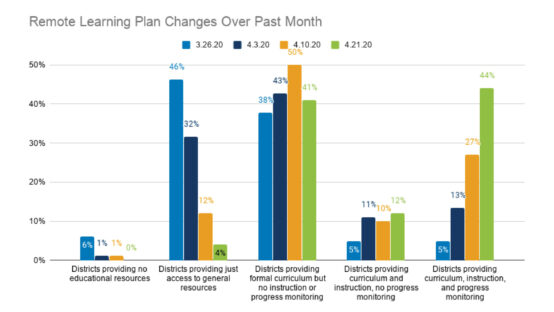
While not nationally representative, the CRPE database could tell a reporter how many of those districts had launched their remote learning programs or had an attendance-tracking policy in place.
And, while CRPE is distinctly pro-charter, Lake generally comes off as reasonable and informed rather than ideological.
“Reporters are tearing around like crazy, trying to figure out what the heck is going on,” says the Century Foundation’s Conor Williams. “Then they find this database where someone’s done a bunch of the early legwork for them.”
There are other, competing databases and reports, including the right-leaning American Enterprise Institute’s COVID education response survey and the moderate Democratic-run Education Reform Now report on distance learning.
And, though the clamor hasn’t been enormous, charter school opponents and others would likely object to the media reliance on a database produced by an organization that is pro-charter.
In response to an early-April LA Times editorial urging districts to provide a more robust remote learning program for students, Chicago-based educator and activist Xian Barrett recently castigated CRPE for its role in having “fed this same bizarre take to all the major editorial boards.”
However, in the absence of a similarly timely and helpful source of information from a more liberal education nonprofit like the Center on American Progress or the Brookings Institution, you can expect to see reporters continuing to use the CRPE database and quoting Lake for quite a while.
“The fact that CRPE already had these relationships allowed it to move quickly to answer some questions,” noted 50CAN’s Marc Porter Magee, who compared the database to the EdWeek map. “And they update it regularly so it provides a weekly hook.”
Related coverage: 20 days and counting; making English learners part of COVID coverage
ABOUT THE AUTHOR

Alexander Russo
Alexander Russo is founder and editor of The Grade, an award-winning effort to help improve media coverage of education issues. He’s also a Spencer Education Journalism Fellowship winner and a book author. You can reach him at @alexanderrusso.
Visit their website at: https://the-grade.org/