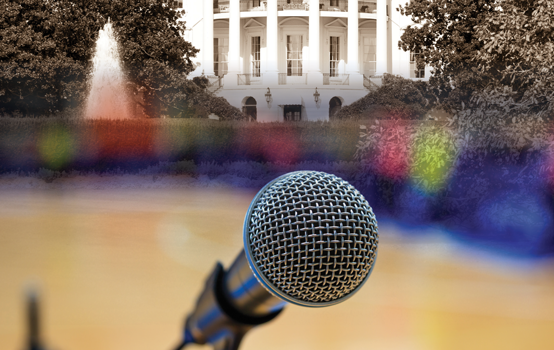
The secretary of education has a responsibility to lead an inclusive national discussion of our schools.
In his classic work of political theory, Jeffrey K. Tulis argued that the “essence of the modern presidency” is “rhetorical leadership” (1987, p. 4). Unlike the presidents of the 18th and 19th centuries, who relied on Congress to bring the will of the people into government, modern presidents, starting with Theodore Roosevelt, have sought to be the voice of the people, using the bully pulpit and the tools of mass communication. Now that every person, place, and thing in the executive branch has a Twitter handle, Tulis’ theory applies more broadly than ever, not just to the president, but also to the secretary of education.
Founded in 1979, the Department of Education was meant to institutionalize the government’s role in leading civic discussion about education. As he signed the legislation creating the new federal agency, Jimmy Carter explained that he considered its rhetorical mission the equal of its regulatory mission:
I came to the office of the Presidency determined that the American people should receive a better return on their investment in education. I came equally determined that our Nation’s formidable educational challenges should be brought to the forefront of national discussion where they belong. (Carter, 1979)
For Carter, the secretary of education would be integral to the success of the new department because the secretary would be the driving force behind its rhetorical leadership. “For the first time,” he declared, “there will be a Cabinet-level leader in education, someone with the status and the resources to stir national discussion of critical educational concerns.” By “stimulating needed debate of educational issues,” the secretary was to be, in effect, a national storyteller for the schools.
Forty years later, it is safe to say that Carter’s vision has been fulfilled. The secretaries of education — 13 of them to date — have been integral to every major civic discussion of education from the 1980s to the present. Indeed, it has become difficult to imagine what a national discussion of education policy would sound like without their leadership.
And yet, that is exactly what Secretary Betsy DeVos has challenged us to do. Portraying the very existence of the Department of Education as a “giant nod to union bosses,” DeVos counts its creation among a series of failed reforms. To correct this misstep, she urges her fellow Americans to cut government out of the loop, insisting that “federal mandates distort what education ought to be: a trusting relationship between teacher, parent, and student” (DeVos, 2018).
Given DeVos’ repudiation of the Department of Education’s regulatory mission, what has become of the secretary’s role as national storyteller? It is, I think, a good time to take stock: What sorts of rhetorical leadership have the previous secretaries enacted? How does DeVos fit into that tradition? And finally, what kind of rhetorical leadership should we expect from future secretaries of education?
A pair of responsibilities
From A Nation at Risk to No Child Left Behind, the past 40 years have seen a transformation of how education policies are made (Henig, 2013) and represented to the public (Hlavacik, 2016). Just as Carter hoped, education has become a national political issue, featuring arguments over accountability, choice, and equity that rely on comparisons between schools that are most meaningful when made at scale. But whereas this nationalization of the politics of education has put the secretary in a powerful position near the center of the discussion of education policy making, it has not fundamentally changed the federalist dynamic that ensures state and local control over what happens in the schools every day. So, although Carter declared the regulatory and rhetorical functions of the Department of Education equal, the reality is that most secretaries of education have relied on the bully pulpit as their main source of influence.
Given how central storytelling has been to the secretary’s work, it might make sense to articulate specific expectations for the secretary’s rhetorical leadership, just as we’ve defined specific guidelines for her regulatory decision making. However, this would require us first to recognize that promoting a national discussion about the schools has inherent value, insofar as it brings the public together to debate the kind of society we want to become (Labaree, 1997; Tyack & Cuban, 1997). From this perspective, the secretary of education is not just the appointed leader of a smallish federal bureaucracy, but the symbolic leader of an important civic enterprise. She should be measured not just by her regulatory successes and failures but also by her successes and failures in engaging people in a healthy democratic conversation about our educational priorities.
In other words, she should be assessed by both what she says and how she says it.
The first responsibility — choosing what stories to tell or what issues to talk about — is familiar to scholars from various fields. (Scholars of rhetoric use the term topics. Linguists call it framing. Media scholars often refer to it as cultivation. Political scientists describe it as agenda setting. In the business school, they talk about the attention economy.) As the face and executive of a federal agency, the secretary of education has powerful tools for influencing what we talk about when we talk about the schools. With speeches, testimony, reports, tours, policy rationales, press releases, and so on, the secretary tells the nation a story about the schools.
Whenever the secretary points to a specific student, teacher, administrator, school, district, or state, and whenever she releases a report or changes a policy, the content of the story she tells is met with scrutiny, discussion, and further research, as it should be. In this way, secretaries of education are held accountable by journalists, academics, teachers, and the public for the veracity, consistency, and fairness of what they say.
In addition to the responsibility to choose the content of their communications wisely, the secretaries also have a responsibility to select the form of their communication with care. This second responsibility requires a recognition that the national discussion about education is valuable in and of itself, and not just as a means by which to advance certain reforms and get them turned into policy. If we want the secretary to lead a discussion reflecting the principles of deliberative democracy, then we should expect her to practice inclusivity, reason giving, and reciprocity (Allen, 2004; Gutmann & Thompson, 2004; Young, 1999) as she calls Americans together to address their collective responsibility to educate our young people.
So, how have past secretaries of education handled this pair of rhetorical responsibilities?
Past secretaries and their rhetoric
The secretaries of education are difficult to characterize collectively. Some of them (e.g., Terrel Bell, Margaret Spellings, and Arne Duncan) sought and received a great deal of media attention, whereas others (Lauro Cavazos, Richard Riley, and Rod Paige) did not cast such long rhetorical shadows. A couple of them (William Bennett and Lamar Alexander) are better known for their work outside the department, and others (Ted Sanders, John King Jr., and Phil Rosenfelt) served transitional roles.
However, among those who’ve had the most lasting impact on the politics of education, we can make one generalization: While they’ve differed widely in their policy preferences, they’ve shared a basic commitment to encouraging the American people to take collective responsibility for the nation’s educational future.
During her brief time in office, Shirley Hufstedler, the first secretary of education, focused on defining a role for the new department and defending an increase in federal funding for education. To those ends, she repeatedly stressed the department’s usefulness in addressing issues that are too big or costly for the states or local authorities to tackle on their own. As she put it in an address to the National State Boards of Education:
I hope that you will feel with me that the Department should be more than a conduit for federal funds . . . that it should be a source of inspired and constructive leadership. I hope that you will involve yourselves with the development of the Department and its programs . . . and that you will persuade others in your communities to help us make them work. In this way we can move together to restore the nobility of our professions of education and to enhance the future of our children. (Hufstedler, 1980)
As Hufstedler saw it, the department was to seek partnerships with local educational authorities by offering both its resources and its leadership when local authorities acknowledged a need for them.
Hufstedler’s successor, Terrel Bell, was appointed by Ronald Reagan, who had promised to return education to the lesser status of an office. However, Bell hoped to carve out a meaningful role for the new department, focusing on the pursuit of educational excellence. Toward that end, he commissioned the Nation at Risk report, now widely regarded as a turning point in the politics of education (Graham, 2005; Mehta, 2015). Bemoaning a “rising tide of mediocrity,” the report’s bombastic rhetoric received a great deal of attention when it was released. According the National Commission on Excellence in Education, the blue-ribbon panel that wrote it, the report sought to “renew the Nation’s commitment to schools and colleges of high quality” (NCEE, 1983). Indeed, it helped to establish the idea that school reform is an urgent matter of national importance, which continues even today to frame many of our education policy debates.
The secretary of education was meant to be, in effect, a national storyteller for the schools.
As George W. Bush’s second secretary of education, Margaret Spellings oversaw a critical period during the implementation of the No Child Left Behind Act. To Spellings, the law was essential to preventing states and local educational authorities from condemning disadvantaged children to “the soft bigotry of low expectations” (Bush, 1999, p. 223). Whereas Hufstedler pleaded for buy-in from local authorities and A Nation at Risk conceptualized education reform as a commitment to high-quality schools, Spellings spoke of the need to monitor schools that failed the public trust by shirking standards for some or all of their students. School accountability, she argued, entailed a collective commitment to high standards in all parts of the educational system — to that end, she commissioned a blue-ribbon report, in the mold of A Nation at Risk, calling for the principle of accountability to be extended to higher education.
When Barack Obama was elected, he replaced Spellings with Arne Duncan, who objected to how “No Child Left Behind did a lot of labeling of schools as failing,” but commended its focus on closing the achievement gap, while also calling for a major new effort to restore the nation’s college graduation rate to its previous status as the highest in the world (Richardson, 2009, p. 24). Using some of the loftiest rhetoric of any secretary, Duncan called this “our Moon Shot,” suggesting that, like the space program, its success would depend on the collective will of the American people:
Too many people don’t understand how bad their own schools are . . . They always think it’s somebody else’s kid who’s not being educated. They don’t understand that it’s their own kid who’s being short-changed. How do you awaken the public to believe that your own kid isn’t getting what they need and you don’t know it. If they would wake up, they could be part of the change. We need to wake them up. (Richardson, 2009, p. 29)
While these secretaries pursued varied reforms, reflecting their differing political beliefs, they all made use of the same broad rhetorical strategy: calling the nation together to confront its shared responsibility for education. Hufstedler envisioned national leadership that could only succeed if state and local authorities lent their approval. Bell’s report, grandiloquent though it was, compared the effort to improve the schools to fighting a natural disaster or a war, both cooperative enterprises. As Spellings pursued accountability, she sought national buy-in by commissioning a new blue-ribbon panel. And of course, Duncan’s invocation of the space race drew on an inspirational example of the application of our collective national will. So, how does DeVos’ rhetorical leadership compare?
What Secretary DeVos says and how she says it
Despite the intense vitriol Betsy DeVos has attracted since her nomination, little of what she has said as secretary of education has been new to the politics of education or unprecedented for the secretary.
As a longtime advocate for charter schooling, DeVos has voiced strong skepticism of top-down policy solutions that emanate from Washington. However, bureaucratic self-effacement has been typical of previous secretaries from both parties, nearly all of whom have insisted that the best ideas in education come from outside the Beltway. Indeed, Hufstedler’s original act of rhetorical leadership — in which she argued that the Department of Education could be most helpful when addressing problems too big for state and local governments — showed deference to the idea that schooling works best when it is adapted to its local context.
When not attacking Washington for its regulatory overreach, DeVos often takes public education to task for what she sees as its stagnation. For example, speaking at the American Enterprise Institute (AEI) in 2018, she asked why more schools don’t break the mold by keeping students in session over the summer, grouping students by some means other than age, or offering ways for students to pursue their education without attending school in a building. For DeVos, education reforms that fail to “rethink” school — including every reform since and including the founding of the Department of Education — amount to just another “new coat of paint on the same old wall.” This criticism might be galling to some audiences, but it’s hardly original to DeVos, and it offers little more than an update of the rhetoric of the school choice movement. As early as 1980, for instance, Milton Friedman was making the case on public television that the best educational outcomes arise from market competition (Hlavacik, 2016). DeVos’ appeals to “innovation” simply replace earlier appeals to “competition,” much as Silicon Valley has replaced Wall Street as a symbol of how and where economic success is made.
DeVos departs from the rhetorical leadership of previous secretaries not in what she says, but in how she says it.
DeVos departs from the rhetorical leadership of previous secretaries not in what she says, but in how she says it. For instance, in that same AEI address, DeVos (2018) blamed “Chicken Littles,” “Washington bureaucrats,” and other “sycophants” of “the system” for their determination to run the schools “the same old way.” Taking a side in the timeless debate over the proper scope of Washington’s role in education is part of the secretary’s job, and there’s nothing new about condemning federal overreach. However, it is unusual — and remarkably insulting — to liken federal employees (or anyone who envisions a more active role for the federal government) to sycophants and chickens.
Addressing AEI again, in 2019, DeVos described her educational vision as having come under attack from bureaucratic sponges, loud-voiced bullies, and anti-parent, anti-student union leaders. In addition to directing her partisan name calling at opponents on the left, she also attacked the legitimacy of her critics on the right, declaring herself “dumbfounded that some conservatives who masquerade as education reformers have criticized” her Education Freedom Scholarships bill.
Such rhetoric is not an attempt to persuade those who disagree with her. It is not even an invitation for further conversation or meaningful debate. Instead, the insults that pepper her addresses serve to exclude any part of her audience that disagrees with her and — given how many Americans disagree with her, by her own account — functionally makes the enactment of rhetorical leadership on a national scale impossible. None of the previous secretaries, even those (like Bell) who courted controversy, have chosen to lead only a portion of the American people rather than appealing to all of them.
Whereas DeVos’ anti-Washington rhetoric functionally abandons the secretary of education’s post as a national leader, the way in which she appeals for school choice causes a deeper harm. “Freedom,” she often says, is the “thing that makes American great.” Offering this as the guiding principle for her educational tax credit policy, she laments that, “on this we can all agree — or at least, we should be able to,” suggesting exasperation with the difficult task of talking through the nation’s differences of opinion on the subject of education policy. But that — however frustrating — is the secretary’s job. She cannot lead an open and respectful dialogue by asserting that it is illegitimate to disagree with her.
If DeVos (2018) is correct that education, in its most ideal form, entails “a trusting relationship between teacher, parent, and student” free from the interference of any federal mandate, then there should be no need to pursue a difficult and often contentious national discussion about it. But many of us would argue that the point of education policy is not just to muster concern for the fate of each individual student, but also to encourage a collective, civic struggle over what kind of society we want. And if this is the case, then what should we make of the secretary of education using her position to push the American people to give up on this difficult task? I would argue that this invites a kind of civic dissolution, in which we all go our separate ways and retreat into the private relations among individual teachers, parents, and students. This might allow each American to take greater control of the education within arm’s reach, as DeVos envisions, but it means letting go of the wheel that steers our society into its future.
The future of the rhetorical secretary
The secretary of education has a responsibility to lead the national discussion of our schools. Whereas such rhetorical leadership might include a broad range of political positions that makes much of what any given secretary says a worthwhile contribution to this ongoing discussion, how she says it is also important. If the secretary of education is to enjoy legitimacy as a national storyteller for the schools, as the central figure promoting the discussion of U.S. education, then she must treat that discussion as an end in itself and choose her rhetoric with care. If, as a society, we cannot marshal a cohesive civic discussion of our schools that is broadly considered to reflect the national will, then the position of U.S. Secretary of Education will be rendered useless and the part of our civic life she has been tasked with overseeing will have vanished.
Secretary DeVos’ rhetoric may prove an aberration. In a world where subsequent secretaries return to the task of bringing Americans together to face their educational challenges, the rhetorical secretary may function much as it has in the past. But, if that is not the case, and the secretary of education becomes just another position from which its occupants hurl political insults, then Americans will be forced to look elsewhere for rhetorical leadership about education. Perhaps they will look to educators they know, perhaps to journalism they trust, perhaps even to academics or think tanks with popular followings. And perhaps that would be good thing.
On the other hand, though, they might also turn to more brazenly political figures, such as the unions DeVos disdains. After all, if the rhetorical leadership of the secretary of education is indistinguishable in form from the rhetoric of any other partisan organization, then why not? Indeed, it may be possible for such organizations to outperform the secretary of education as a force for bringing Americans together to confront their collective educational future. Either way, no society that wishes to shape its own future can give up on the collective effort to shape its schools, and that will remain true regardless of what the secretary of education says or how she says it.
References
Allen, D. (2004). Talking to strangers: Anxieties of citizenships since Brown v. Board of Education. Chicago, IL: University of Chicago Press.
Bush, G.W. (1999). A charge to keep: My journey to the white house. New York, NY: William Morrow.
Carter, J. (1979, October 17). Department of Education organization act remarks at the bill signing ceremony. The American Presidency Project. www.presidency.ucsb.edu/documents/department-education-organization-act-remarks-the-bill-signing-ceremony
DeVos, B. (2018, January 16). Prepared remarks by U.S. education secretary Betsy DeVos to the American Enterprise Institute. Washington, DC: U.S. Department of Education. www.ed.gov/news/speeches/prepared-remarks-us-education-secretary-betsy-devos-american-enterprise-institute
DeVos, B. (2019, October 1). Prepared remarks by Secretary DeVos at the American Enterprise Institute. Washington, DC: U.S. Department of Education. www.ed.gov/news/speeches/prepared-remarks-secretary-devos-american-enterprise-institute
Graham, P.J. (2005). Schooling America: How the public schools meet the nation’s changing needs. New York, NY: Oxford University Press.
Gutmann, A. & Thompson, D. (2004). Why deliberative democracy? Princeton, NJ: Princeton University Press.
Henig, J. (2013). The end of exceptionalism in American education. Cambridge, MA: Harvard Education Press.
Hlavacik, M. (2016). Assigning blame: The rhetoric of education reform. Cambridge, MA: Harvard Education Press.
Hufstedler, S. (1980, March 3). Remarks before the joint legislative meeting of the National Association of State Boards of Education and Council of Chief State School Officers, Washington, D.C. College Park, MD: National Archives and Records Administration.
Labaree, D. (1997). Public goods, private goods: The American struggle over educational goals. American Education Research Journal, 34 (1), 39-81.
Mehta, J. (2015). The allure of order: High hopes, dashed expectations, and the troubled quest to remake American schooling. New York, NY: Oxford University Press.
National Commission on Excellence in Education. (1983). A nation at risk: The imperative for educational reform. An open letter to the American people. A report to the nation and the Secretary of Education. Washington, DC: Department of Education.
Richardson, J. (2009). Quality education is our moon shot. Phi Delta Kappan, 25 (9), 24-29.
Tulis, J.K. (1987). The rhetorical presidency. Princeton, NJ: Princeton University Press.
Tyack, D. & Cuban, L. (1997). Tinkering toward utopia: A century of public school reform. Cambridge, MA: Harvard University Press.
Young, I.M. (1999). Inclusion and democracy. New York, NY: Oxford University Press.
ABOUT THE AUTHOR

Mark Hlavacik
Mark Hlavacik is an assistant professor of communication studies at the University of North Texas in Denton and author of Assigning Blame: The Rhetoric of Education Reform (Harvard Education Press, 2016).