Louisville’s school integration program “looked good on paper, but it didn’t work well,” according to reporter Krista Johnson, who reflects on what mattered most when she was a kid growing up poor in Davenport, Iowa.
The Courier Journal’s Krista Johnson isn’t the first education reporter to rethink school integration in recent years. She isn’t even the first education reporter from the Courier Journal.
But Johnson has just recently produced an important new series looking back at the two year-old effort to revamp the original program so that West End families aren’t forced to send their kids across town — even if it means a less racially integrated experience.
And in this new conversation, you’ll see that reporting and writing the integration story has generated a lot of new insights and reflections from Johnson about LCPS schools and about her own experiences as a student growing up in Iowa.
As a kid who got free lunch, what mattered most to Johnson was having teachers who “made me feel that me showing up really actually mattered [even] when it didn’t to the people that it should should have.”
As for Louisville’s famous integration program, which has now been rolled back in many ways, “it looked good on paper, but it didn’t work well.”
The following interview has been edited lightly for clarity.
This is Alexander Russo with The Grade, and this is The Education Show. I’m so happy to have Krista Johnson from the Louisville Courier Journal here to talk about her big series on changes to the student assignment and integration plan in Jefferson County Public Schools (JCPS). Krista, welcome to the show.
Thank you. Thank you so much for having me.
I really appreciate you being here. I’m going to introduce myself, just in case you are curious, or anyone listening hasn’t heard more than enough about me. And then I’m going to ask you to introduce yourself.
I’m a longtime education journalist who, about 10 years ago, started The Grade, which is a newsletter and a podcast about education journalism. The goal is to help people who do education journalism think about their work, celebrate their work — improve their work.
I grew up in Chicago, and I went to Montessori school first, and then I went to private progressive school. My sister went to public school for a little while, and then joined me at the private school I was at.
Do you mind telling those of us who don’t know about you a little bit about yourself and about what school was like for you?
So I’m originally from Davenport, Iowa. I went to public schools there, and after graduation, went on to the University of Iowa to study journalism. Once I graduated, I went to a very small little paper in West Texas where I reported on business.
And then I got the opportunity to move over to a paper in Montgomery to cover the education beat. And that’s essentially what I’ve been doing since. I spent four years in Alabama before moving here about four years ago, and I’ve been covering JCPS for a little more than two years.
I was attracted to the education beat because it seemed like a very important thing. I’d enjoyed school, and it seemed like education included a lot of different social and political issues.
Above: Johnson (left) and I spoke on the phone a little over a week ago.
Did you choose the education beat, or was it just luck of the draw?
It was just luck of the draw. I was just happy to get a job, and that people thought I was worth hiring initially. But like you said, the education fee is very encompassing of many aspects of society, and I found that it’s about a lot more than what happens in a school board meeting when we think about our communities and as a whole. I think the state of our schools is the most important aspect to whether or not a community is thriving or succeeding.
What was, if I can ask, your experience with school integration — with where the schools that you were going through, were they trying to do anything on diversity and integration, or were they not, or were you just being a kid and you didn’t notice or pay much attention?
Well, I think it’s a little different in Iowa. It’s a very white population in general, so I don’t think there was a lot of integration efforts as far as race. However, I was raised in a very poor household, and I think our schools did a pretty good job of providing some equity. And in my experiences, I felt like even though my home life was a bit of a struggle, I was still being given a quality education that my peers from more well-off homes were receiving simultaneously.
Glad to hear it, and I’m curious. What did that look like in terms of the quality of the schools?
Yeah. I mean, it’s not something you think of as a kid, obviously, and it’s, it’s just something I see more of now that I’m focused on these things professionally. You know, I had free and reduced lunch and then I, when I was applying for colleges, there were waivers for ACT testing and for the college applications. There was a lot of assistance from the counseling teams, both academically and emotionally, that I was able to receive, and then also teachers that were just very, very involved in my well-being. Teachers who opened their homes to me, and made me feel that me showing up really actually mattered [even] when it didn’t to the people that it should should have.
So I guess it’s not all about programming and funding. It was really on a person to person level that made the difference, and why I even, you know, when I was the first person in my family to graduate high school, so I don’t think that would have been possible without the teachers that chose to go above and beyond.
“Even though my home life was a bit of a struggle, I was still being given a quality education.”
I’m glad to hear that. And as you know, that doesn’t always happen, even when the programming is is there, sometimes the teachers can’t convey that sense of value or expectations. One thing I wanted to say about Iowa and integration is that one of the most famous — to me — instances of school integration took place in Iowa in the form of journalist Nikole Hannah-Jones’ experience as a child. Do you know the Nikole Hannah-Jones story?
Not her personal story? I didn’t know there was an Iowa connection there at all. I’ve read a ton of her work.
She comes from Iowa, and she was bused across town and got what seems like a high-quality education, and obviously went under tremendous success. And she never says it explicitly, or I’m not sure that she says it explicitly, but certainly she had this very vivid experience with busing. Sometimes she describes the challenges of it, but obviously her work is very pro integration, at least as I read it. And I think it’s interesting that you and she both come from Iowa.
That is very interesting. Now I am going to have to go look up her story. I had no idea.
Above: The Courier Journal’s Beyond Busing series was published last month.
You and I met online a little bit back because I was curious about your big story about integration efforts and the recent reversal in in Louisville, and also the comment you made in the Q and A and to me as well, about the the contrast between the the hype — the positive media attention — that Louisville has gotten over the years from journalists, from news outlets, and the local reputation of the effort. Can you say a little bit about the gap between what people might read about Louisville’s integration efforts, and what people in Louisville actually say and think?
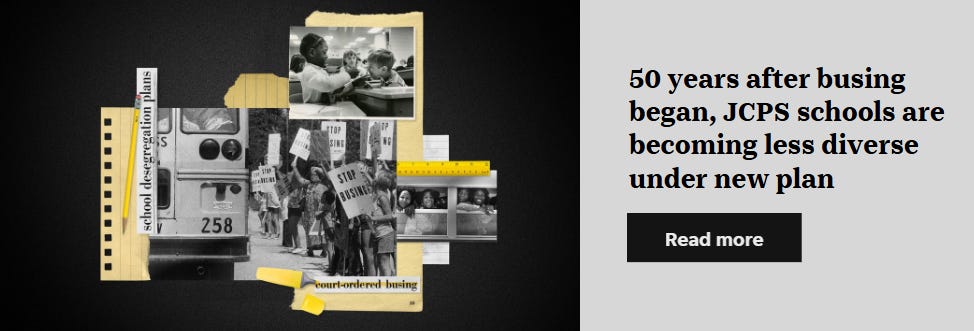
Yeah, absolutely. I think on the national level, the narrative for a very long time was that Jefferson County was very committed to integration, well beyond what was required of them. And what was even the trend, you know, in the 70s, when, when the two systems were merged and busing began, that was court ordered. And it wasn’t very long after that that the court’s interest in forcing integration dissipated. And, you know, JCPS went through multiple legal battles in which courts cited that, you know, they shouldn’t be busing kids. They shouldn’t be using race as a factor to design student populations. And still, they persisted, which is all very true.
But locally, what happened was that the responsibility of integration was falling solely on Black families and these there was little choice in it that student assignments plans continued to be altered in a way that were more accommodating to white families who didn’t want to send their kids on bus rides across town, who wanted their children to go to schools and the communities that they lived in — or they wanted to go, you know, apply and attend magnet schools.
And at one point, the district decided to use those kids that were, you know, choosing to ride a bus to a magnet school, the same as Black students who were forced to attend a school outside their community in terms of desegregation efforts.
And so, you know, by 2015-2016 this started becoming a bigger issue in the community that was talked about more: the lack of investment and belonging our Black students were having in these schools that were so far from their communities that really hampered their ability to participate in extracurricular activities. It didn’t allow for their parents to come to those extracurricular activities, or to come to parent teacher conferences, or if they missed the bus, to even attend school. So it became, you know, it looked good on paper, but it didn’t work well.
“It looked good on paper, but it didn’t work well.”
And the outcomes, and the outcomes for the kids who were bused across town where they dramatically improved or not so much?
It’s hard to say. There were some. There’s some years you can point to that. If we looked at West End students who were taken out of their community, they did perform at a higher level than their peers that were left behind, but there’s the academic achievement gap still persisted across the board. And then, you know, there were other years where that wasn’t the case, and like, the graduation rate was never on par with white students.
I’ve learned through this latest series the academic achievement gap is a flawed way of looking at things in general, but overall, a lot of parents and a lot of community members felt the risk was not worth the reward, and also that they weren’t given a choice if they wanted to send their kid to a school down the street. The district was making decisions for them rather than giving them opportunities.
And you know, something else? I guess I was naive to was the fact that a lot of families didn’t feel safe with the busing situation. You know, a couple years ago we had this busing disaster where some kids didn’t get home till almost 10PM, and obviously that’s a huge issue. But I never really thought down to like, the parent level, how scary that is.
When you think about this, this very large city and the amount of crime there is. And if you’re a mom that’s stuck on one side of town without transportation to get to your child, if something happens on the other side of town. That is scary. So it’s more than ‘I just would like the convenience of my child being a few minutes away.’ It’s ‘I don’t feel safe that my child is so far away.’
“It’s more than ‘I just would like the convenience of my child being a few minutes away.’ It’s ‘I don’t feel safe that my child is so far away.’”
What else was this was unexpected or a surprise, or just you didn’t know coming into this series you’ve just done, which is about reconsidering the current choice plan. Were there lots of surprises or new things for you?
One other big one that I think needs to be a story — so hopefully none of my competitors are listening right now — but I heard from multiple people that the new student assignment plan is supposed to give families in and around the West End choice on whether they attend close to home school or further away from home school, and the idea is that if you still believe that despite the additional funding that has funneled into the schools in the West End, that your child will still have better opportunities at that far away school, the district is supposed to give you the means to get there with transportation.
It’s supposed to be treated as your resident school, regardless of where you live at that point, if that’s the choice you make. And I have heard from multiple administrators and community members that that isn’t happening — that because this choice exists, there is now a cultural shift, a shift in school buildings to push West End students into those close to home options, and they’re being made to feel that they are not welcome or they’re not good fits for the schools that are, you know, predominantly in the East End.
Just to make sure I understand, the West End schools are seeing these enrollment increases from parents who didn’t want forced busing and wanted their kids close. Some of that is, some of that is parent choice, but some of it it sounds like is them being shut out of schools that they used to be able to go to on the East Side?
Yeah, I don’t know at this point how grand of an issue that is, you know, if it’s, oh, a few cases. But it sounds like it’s not. It sounds like it’s become a larger issue that needs to be explored, because you can’t say you’re giving people choice If one of the choices is not supported, right?
I was curious about whether you got into Hudson or Shaunee — is it pronounced Shannie or Shawnee? Did you get into either of these schools that had parents you talked to? Did you get a chance to get into the buildings and get a feel for them in the present?
I spent some time in Shawnee, and Shawnee is, I think, an example that the district wants to point to as the success of this plan. Shawnee was in this really weird position during the previous student assignment plans because it’s this huge school, and it had almost nobody in it, like 400 kids, and it’s [grades] six to 12.
And now they’ve seen this, this huge uptick in enrollment, and they’ve got this new administrator who is very eager to be there, and they’ve added all these additional classes, these new programming programs, these new extracurriculars. They’ve revived this rivalry with another school in the area that just couldn’t exist anymore because they didn’t have enough kids to be rivals.
So it’s exciting, you know, and obviously, as the story points to, it’s too early to see whether or not all of these changes result in higher student performance.
Do we know whether it sounds like the vibe is good and the school is popular? Do we know whether the kids are doing as well or better as they were before?
Anecdotally, the principal has said yes. The release of those scores haven’t come out yet. She said there has been an increase in students even taking these tests, and she said when the scores come out, they should indicate an increase in performance as well.
And how about attendance? Attendance attendance isn’t a perfect metric, but it’s usually available faster than test scores, and it does indicate whether kids are going to school and hopefully going to class rather than walking the halls.
Yeah, I haven’t looked at that yet. That’s a good question. I should, I should see.
Hudson sounded like it wasn’t so successful for the family you interviewed.
No, and we’ve heard a lot of a lot of issues at Hudson since it was created or established. And I wasn’t able to get into the school. The district isn’t always very welcoming for that sort of thing. But what you know from the beginning there were issues with Hudson, because when we started talking about the new student assignment plan, the district quickly started saying they were going to put a new middle school in the West End.
It was going to be the first new middle school down there in decades. And that was really appealing to families. But then it quickly turned into, ‘Well, we’ve got to build it first, so this first year, we’re going to put you in this old elementary school.’ And I think that was a little disappointing, but everyone said, you know, everyone was kind of like, ‘Okay, we get it. That’s fine.’
Then that elementary school was over-filled immediately, and the next year, they moved them to a different old elementary school that was a little bit bigger. And now this year, they’re in two different schools. Two grades are in one building, and the 8th grade is in another. There’s that lack of stability in building changes, but the school has suffered significantly more than any other school in the district with staffing right and so much so that the choice zone schools — which Hudson, most of the a lot of the West End schools are considered choice zone schools, meaning they get hiring priority and additional funding. All of those schools were given teachers $8,000 stipends each year to choose to work in those buildings. They bumped Hudson’s [stipend] up to $14,000 this year, trying to get people to come in there. And it’s still not working.

There’s the great line in your piece about how the building can be new, the programs, the extracurriculars, can be abundant, but if the teachers and the culture of the school aren’t right, it’s all for naught.
Yeah, I think that’s been an issue in the district for a long time — of throwing money at the problem in a way that it looks better, but doesn’t equate to an improved student experience being beyond materialistic items.
Chasing silver bullets. Right? The silver bullet of school integration through forced busing, and then the silver bullet of a shiny new building. That’s, that’s, that’s the theme that comes to mind for me, at least. You mentioned competitors, and I’m curious about what the education journalism ecosystem is like, where you are? Are there 10s of you? Are there two of you?
There’s two of us, actually,
Okay, who’s your rival?
Her name’s Jess Clark. She is with Louisville Public Media, and she’s great. We try to work together as often as they allow us. And she I’m sure she picked up on that issue within my story, so she could already be working on it. I don’t think I revealed anything.
I’ve been writing and learning a lot over the last year about what I’m going to call non-traditional journalists and alternative platforms. These are people who are not trained or working as professional journalists, but performing a journalistic function, to some extent — sharing information, unearthing things that haven’t been found. Sometimes they’re on a listserv, sometimes they’re on social media, sometimes they’re on old-fashioned email. Is there anyone out there who performs that function in Louisville?
Yeah, Olivia Krauth is one reporter doing a great job with that. She used to be the education reporter here at the Courier Journal, and now she is focused more on politics. But whenever anything happens in Frankfurt education-related, she’s all over it. And then we have a lot of live streamers that started during the pandemic and, you know, in the aftermath of Breonna Taylor’s killing, who have really big followings, who do a lot of great work. None of them are focused on one specific beat, but they kind of dabble on everything.
Is there a Facebook page or a parent listserv that parents and civilians used to get information about the schools or an inside scoop kind of situation?
Yeah, there’s a “Dear JCPS” Facebook group that’s really popular here, that is kind of a catch-all of parents, teachers, and reporters who share what’s going on or share complaints and concerns. That’s that’s been a pretty good resource for me, as far as finding people who who are willing to talk about a specific issue,
Nice. I used to run a blog 20 years ago about Chicago public schools and parents and people inside the central office would get on there. This is back in the days when you could sign on to a blog without using your real name. You know, you could make up something, and people would come on and just I got so much information off of that it felt like the best water cooler ever.
Sounds amazing. There is a big issue with the district regarding transparency in this culture of retaliation for people who speak out against leadership. And that’s not just my personal feeling. It’s been cited in audits. It’s part of what led to the busing disaster, according to the audit right. But that comes up so often. You know, people, teachers, have real concerns, and they’re pointing out systematic issues that the board has not ever addressed, but they are scared to speak with me. Sometimes I’ll get one who will go off the record, but trying to get others is extremely difficult because they fear for their jobs, fear of being punished.
Have you experienced any of this kind of treatment yourself?
Directly? No, I don’t think so. I mean, I’ve dealt with people not wanting to share information that pushback to certain requests and public records, or like I mentioned, going into Hudson, wasn’t really going to be an option for me. That sort of thing. But I don’t think it’s anything beyond what most reporters in cities would experience.
Not the kind of situation where someone says, ‘Hey, if you write this, you’re never going to get to sit in another board meeting.’ That kind of thing?
Maybe I just haven’t come across that big story yet. That would be great, though, for them to try that.
Please let us know if they do!
Speaking of responses, what’s the response been from the district or the community or other education journalists or the or the education research community at large to your piece — not just that the new plan may not be working, but sort of reiterating the way your piece does that the old plan, the forced busing plan, didn’t work.
Integration is something that a lot of people feel very strongly about, in favor of, and feel very strongly that it’s a real solution to a lot of problems. I’m thinking of the Gary Orfields of the world and a lot of journalists like you said, have written positively about Louisville’s longstanding robust effort to integrate schools through busing. Have people reacted to you telling them some version of that there is no Santa Claus?
A lot of the reactions here locally that I received were about how they should have quit forced busing a long time ago. And there wasn’t a lot of acknowledgement for the benefits that that that brought about, and it’s hard to decipher what the what the personal feelings are behind that, whether — I don’t know — sometimes it feels that people just don’t care about the idea of integration and what it can do, and other times people feel that it was wrong to not give families a choice in where their kids went to school.
Now when we’re looking at this new plan, I think people are still trying to figure out how the district can make this work, because it’s not right now, at least on a large scale. You know, right there are perks you can see in Shawnee of it, and there’s a few other perks along the way, but overall, the schools in the West End have the largest shortages. They are becoming less diverse, and we don’t know what the long term impact of what that’s going to be?
When I talked to researchers like Tina Rosenberg and Erica Frankenberg, the researchers felt that while the previous student assignment plan had flaws, JCPS should not have scrapped its integration efforts altogether in the way that this plan does.
And do they feel that your story captures that sentiment or that possibility, or did they think that there’s throwing out the baby with the bathwater thing going on in your piece, as well as in the community?
I’m not sure. I didn’t hear either of those things from them.
Well, listen, I think it’s an important story locally, but I think it’s also an interesting, important story nationally, because so many places have tried to achieve integration through schools through through busing, and there has been such a wave of media coverage of it, whether it’s Boston related or elsewhere. And your story gets at a lot of the nuance and the history, and it’s a sobering story, right? It’s not the happiest read of all, but it’s interesting to see what a community does post- busing, and the challenges that come from that?
Yeah, thank you. I think you know one aspect of this that could be talked about a lot more. And this is something the researchers also pointed to, is there was a lot of focus over over the decades on district policies regarding integration, and they wondered what would have happened if that much attention would have been given to the city leadership when busing was only necessary because our neighborhoods are segregated.
And at what point do we say, this isn’t just a school district [issue]. Well, what can the city be doing? Schools make a difference, but they’re putting societal issues on the backs of schools.
Yeah, yeah. I hope that more people read the story. I’m sure a lot of people have already read it and I hope that more people read it. I hope that you get invited on all the talk shows and podcasts to talk about this, because, again, this is not just a local story, and you obviously put in a tremendous effort to tell it. Are you booked on NPR and everyone else this week and next, I hope?
No, no. I mean, I did talk to Louisville Public Media about it. I talked to you, and we did a panel last week locally with some community leaders and district leaders to discuss the legacy of busing and where we move forward. But that’s it so far.
Well, maybe more will come. Krista Johnson, so nice to talk to you. Congratulations on the series, and thanks so much for talking with me about your reporting and your findings.
Thank you. I appreciate it.
Previously from The Grade
Pulling back the curtain on desegregation in Louisville
Nikole Hannah-Jones, the Beyoncé of education journalism
New book exposes flaws in media coverage of Northern integration efforts