
The new era of accountability and student-centered learning requires agencies to rethink how they work with schools.
Driven by research on how students learn, the nation’s education system is slowly beginning to transition from an assembly-line, industrial-era model that treats all learners the same to a student-centric model for the digital era.
The emerging system employs principles from the science of learning and development that indicate that students learn best through strong relationships. They benefit from working as partners with teachers and peers in a learning environment whose structures and practices are closely attuned to students’ developmental needs.
In these environments, students feel safe and cared for and develop a personal relationship with the content they study through inquiry and problem solving. In the student-centric model, students have greater agency (more voice and choice) in how and what they learn, enabling them to connect knowledge to their lived experiences, feel more engaged in learning, and apply crucial concepts and skills in real-life situations so that they “own” what they learn. (Darling Hammond et al., 2019).
As schools make this shift, state and local education agencies will need to systematically rethink not only accountability, assessments, and the ways they give schools feedback on how to improve, but also how they operate and work with each other.
Next-generation accountability
Authentic assessments
More authentic assessments go hand in hand with student-centered learning. Making such assessments part of the external evaluation of schools can break the nation’s current fixation with state summative assessments that provide little actionable information to address individual student progress. More timely and authentic approaches to measurement give school-level educators important feedback so they can make real-time adjustments in instruction, student engagement, and other school-related factors that research says strongly influence student achievement.
Progress is already being made. More than a dozen states are adopting more timely, curriculum-based assessments that break traditional state summative assessments into multiple shorter testing periods; ensure that students are tested on what they learn; provide timely feedback to students, teachers, parents, and families; and produce for policy makers a summative score that can be combined with other information to provide a more accurate view of a school’s quality, performance, and efforts to improve (Education First, 2023).
External evaluation
States such as North Dakota and Kentucky have sought to spur school improvement by encouraging school districts to work with outside partners to evaluate institutions. Periodic third-party evaluations provide schools with an independent, objective analysis of what they are doing well and what actions they must take to do better.
These formal evaluations are based on standards for school quality that describe what an effective institution does. Evaluators weigh evidence — including student performance data, classroom observation data, stakeholder feedback, and focus interviews — to identify areas of effectiveness and potential improvements. Enhanced school evaluation reports analyze the root causes behind areas of potential improvement and provide clear direction on what changes schools need to make. The results of these evaluations provide a rich, comprehensive understanding of the school’s context and how it operates, which can give parents greater insight into the school.
From compliance to improvement
These and other approaches are promising in their own right but have another distinct advantage: They allow for structural changes that affect how our education system works collectively to foster ongoing school improvement. New approaches to accountability will allow states to get out of the compliance business — in which they set arbitrary achievement requirements and demand schools meet them without providing adequate expertise, resources, and support. Instead, they’ll be in the continuous improvement business (Elgart, 2017a, 2017b).
School improvement should not be a compliance activity, yet today most institutions develop improvement plans solely to fulfill governmental regulations. In general, policies for school improvement emphasize the expectations and structure of the annual improvement plan. These plans, no matter how polished or detailed, don’t do much to actually improve schools.
Achieving sustainable improvement requires changes in behaviors, not compliance. Continuous improvement is not a plan, but a journey. Some desired changes can take years while others may take only months. Making a sustained change in how the school operates and embedding it within the school culture determines the success of an improvement effort. When the focus shifts from achieving compliance within a certain time frame to engaging in an ongoing journey, continuous improvement becomes an embedded behavior within the culture of a school. In its journey, a school constantly focuses on the conditions, processes, and practices that will improve teaching and learning by regularly identifying the behaviors it must maintain and those it must change.
With these new models, state education agencies will be able to reinvent themselves to provide coaching support and expertise, actionable information, and systematic tools to identify what is and is not working. Local agencies will implement policies that expect every school to commit to and demonstrate progress in their journey of continuous improvement.
New roles for state agencies
Currently, state education agencies (SEAs) spend massive amounts of time, resources, and effort to design, develop, and implement an annual testing program for which they primarily serve as test administrators and compliance officers. State education officials don’t have the bandwidth to gain a comprehensive understanding of what is happening in every school, beyond test results.
A more flexible accountability system
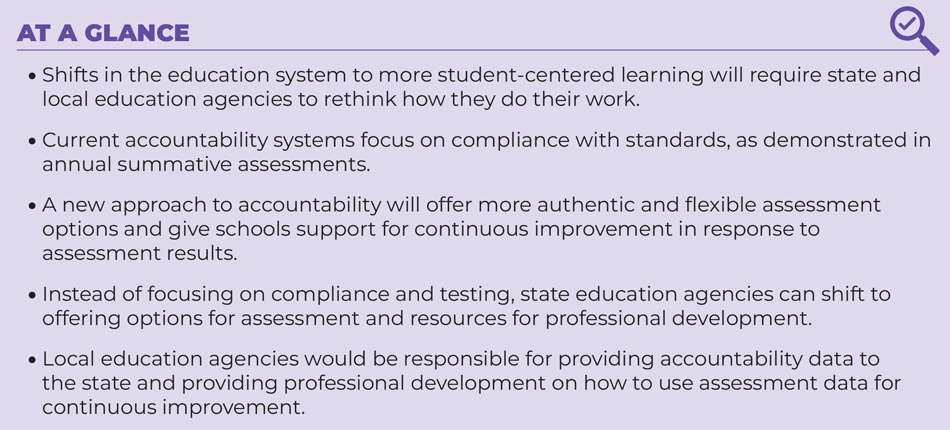
In a new accountability system, the SEA must establish and communicate a clear direction, make available needed resources, and help build the capacity and capabilities of local education agencies (LEAs) and their schools to improve teaching and learning. SEAs can get out of the testing business and into the business of improvement, working as partners with districts to understand what is working, how much progress is being made, and how districts can help schools improve.
As part of this shift, SEAs can introduce statewide, curriculum-based professional learning and literacy support alongside new assessments. If large numbers of districts work with states to introduce professional learning to accompany the assessments, states can increase their impact as they help educators use their data for continuous improvement.
This change would require states to give districts flexibility to select from a menu of course-aligned assessment items so that their interim assessments are aligned with their curriculum while still demonstrating whether students can meet standards and providing comparable data for federal accountability reporting. Under this approach, SEAs can exercise two options for periodic, curriculum-based assessments:
- They can provide a system of “testlets” aligned with state standards but allow the LEA to determine when to administer them.
- They can provide a list of approved assessment providers and allow the LEA to work with the one that best meets its needs and objectives.
Tools for improvement over time
SEAs also must change their school improvement policies to reflect an understanding and recognition of what it takes to achieve desired improvements over time. Instead of focusing on an annual process that may see schools make sporadic progress and subsequently lose ground, policies should emphasize the journey of continuous improvement, where time needed to improve is variable and evidence of change in behavior is the constant.
Some states already are connecting information from third-party evaluators and their own accountability systems to data dashboards that provide a deep and timely look at the quality of their schools. Richer just-in-time information on broad aspects of performance within such systems not only helps educators meet expectations but also supports schools on their ongoing improvement journey. SEAs also should consider developing hubs of services that include aligned professional learning, technical assistance, and other supports to help educators put a broader range of data to use for continuous improvement in teaching and learning.
Implementation at the district level
LEAs will still be expected to provide the SEA with evidence of improvement of student learning in a new accountability system, but their own roles would expand.
LEAs would be accountable for providing professional learning that enables educators to analyze instruction and make decisions about how to modify it. Districts cannot assume that when the data reveal gaps in student knowledge, educators know how to identify the root issue, develop a plan, implement strategies, and evaluate student progress. LEAs must put in place an initial and ongoing professional learning plan to show educators how best to manage and apply data from more frequent and targeted assessments.
A periodic third-party evaluation process should be designed to collect evidence regarding the effectiveness of the LEA and its schools. The primary objective of the evaluation is to improve teaching and learning. Results should clearly indicate the processes and practices that are effective as well as those in need of improvement. As with student assessments, the SEA should identify a short list of approved evaluators from which each LEA will select. The LEA must commit to a program of evaluation that will guide and inform its improvement efforts. They must share the results of the evaluation, and follow-up efforts must be shared with the SEA as part of their accountability requirements.
The SEA also should provide clear direction, assistance, and resources for every LEA to engage in continuous improvement, including a list of SEA-approved providers that districts must choose from to support local improvement efforts. The level of state support and assistance ought to be distributed according to the degree of improvement needed. The LEA must provide annual evidence of ongoing improvement, including student performance, teacher learning, and family engagement. Recognized progress by the LEA should be included and considered as part of meeting the state accountability requirements.
What are the implications of such a system?
The most important shift that Congress, the U.S. Department of Education, and states can make to move toward this vision of student-centered learning and change-minded schools is aligning accountability efforts with improvement. A system designed to improve education must provide educators with the tools and timely information required to make continuous adjustments. Constant small changes in program focus, teaching that empowers student voice and choice, and effective changes in behaviors of teachers and students — not a summative ranking and abstract test score — typically lead to big results.
Exploring better ways to measure performance can help schools achieve elusive goals for students and school performance, including closing achievement gaps and seeing schools continuously improve rather than make sporadic progress and sometimes lose ground. By fully embedding test results in the teaching and learning process, requiring independent third-party evaluation, and creating a culture of continuous improvement, a new accountability system will shift from ranking schools to guiding teaching practices and informing student learning progress.
These changes will force states and districts to build new types of relationships that focus on continuous improvement and transform instruction to ensure that every child is successful in their learning. If we truly are committed to ensuring that every child is successful in their learning, then we can and must change our accountability systems — and how states and districts work together — to do just that.
Note: The themes of this article are explored in more detail in the white paper Design for Improvement: The Case for a New Accountability System by Mark Elgart (Cognia, 2024).
References
Darling-Hammond, L., Flook, L., Cook-Harvey, C., Barron, B., & Osher, D. (2019). Implications for educational practice of the science of learning and development. Applied Developmental Science, 24 (2), 97-140.
Education First. (2023). Policymakers’ guide to through-year assessments: Addressing ESSA pain points. Bill and Melinda Gates Foundation & Walton Family Foundation.
Elgart, M. (2017a). Can schools meet the promise of continuous improvement? Phi Delta Kappan, 99 (4), 54-59.
Elgart, M. (2017b). Meeting the promise of continuous improvement insights from the AdvancED continuous improvement system and observations of effective schools. Cognia.
This article appears in the October 2024 issue of Kappan, Vol. 106, No. 2, p. 39-41.

ABOUT THE AUTHOR

Mark A. Elgart
MARK A. ELGART has served as president and CEO of Cognia since 2002. Under his leadership Cognia was established following the merger of AdvancED and Measured Progress to bridge the gap between school evaluation and student assessment.