In an elective student-led science class, students and their teacher discover the joy of solving real-world problems together.
It is 7:50 a.m. on a Monday morning, and you are set to conduct your first classroom observation. You push open the door of Room 338 and, within seconds, you are bombarded by the potent smell of raw bone marrow, the sight of students in blue surgical masks rushing around, and the screech of power drills and students’ shrieks of excitement. You marvel as small groups of frantic students in surgical gowns hold screws and metal plates over a rack of goat bones or mumble behind their masks with sutures in their hands. Projected on the wall is a notice reading “Today’s Surgery: Femoral Osteoplasty” and a timer counting down the remaining minutes as students exclaim, “We got this,” and “This is it! We’re going to win this!”
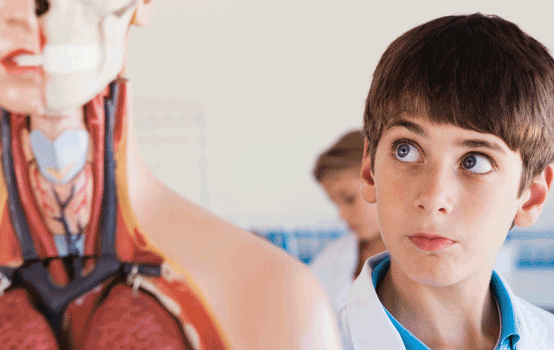
Welcome to anatomy class, where our 26 students are racing against time to perform a self-designed surgery to repair a fractured goat femur, a lab activity that required them to gain a deep understanding of the skeletal system. Our students describe anatomy class as a “double shot of espresso” because it awakens their minds at 7:30 a.m. and is “deep, rich, and complex.” In this student-led elective course, our learners act as researchers, designers, engineers, doctors, and teachers as they work together to complete various labs, case studies, projects, games, and simulations that are inspired by their own questions and their shared vision of becoming scientific leaders.
This is the kind of classroom that I had envisioned when I decided to become a teacher: a space that hums with student agency and leadership as they joyfully engage in inquiry together. But we did not get there on Day 1. In fact, it took a lot of trial and error to build this kind of learning environment. When we did, though, my students and I found ourselves enjoying the best year of learning we’d ever had.
Dream vs. reality
When I started teaching, I dreamed that my class would be filled with passionate and joyful learners, but most of the time, my students were, at best, merely interested and hard-working. For many years, I taught science through traditional means: lectures and labs. It seemed easier, more efficient, and safer than more unpredictable forms of instruction. My classroom might look familiar to many teachers: a classroom dominated by well-organized lectures and labs that students completed dutifully. Yet I knew my students needed to be challenged more and to be entrusted with more opportunities to direct their own learning.
When I started teaching, I dreamed that my class would be filled with passionate and joyful learners, but most of the time, my students were, at best, merely interested and hard-working.
On occasion, I observed green shoots of enthusiasm, and I took note of what the students were doing. These moments of joy and inspiration that enlivened the learning space for students and me tended to take place during debates, inquiry labs, hands-on investigations, creative projects, and case studies. And when I asked former students what learning experiences resonated, they consistently recalled these interruptions to the usual lecture-and-lab routines.
For a long time, I tried to be content with this situation, finding opportunities for more student-directed, joyful learning where I could within this traditional structure. But then two students came to me with a proposal for a club that evolved into a class, and that class became the one I had always dreamt of.
It all started one day during lunch at the independent grade 5-12 school of approximately 900 students in San Jose, California, where I currently teach. Two former biology students came to me with a proposal: “We want to start an after-school club dedicated to learning anatomy in an interactive way.” I asked them what they meant by interactive, and they responded, “We want to help students learn anatomy by running labs and case studies, like the ones we did in your biology class.” Their idea was that this club would inspire their peers to learn about medicine by giving them exciting experiences that made learning something to look forward to.
The anatomy class
The club that grew from the conversation that day was so successful that it eventually blossomed into a new elective course, offered to all students grades 10-12 who have completed biology. Building on the lessons learned from the club, the student leaders organized the new course with three goals in mind: (1) inspiring their peers to care about the subject, (2) placing students at the center of the learning by charging them with leadership roles, and (3) instilling in students a love for learning.
It took eight months of planning before the start of the course to finalize our master curriculum. As their mentor, I pushed the student leaders to identify what they wished to gain from this experience as leaders as well as what they desired for their peers to experience and accomplish as learners. We then drafted the course’s learning objectives, measurable goals, lessons, activities, and assessments. I did my best to minimize hand-holding and instead focused on supporting and coaching the student leaders to plan, design, lead, and facilitate an enriching classroom experience.
Our planning and reflections continued once the course began. Months into the class, students of anatomy began to pitch in ideas for activities. Students began to volunteer to lead learning initiatives, such as designing case studies or teaching an interactive lesson. Instead of passively accepting their learning roles, our students were actively seeking leadership challenges.
Ultimately, the course’s success was shaped by four important facets: experience, relevance, empowerment, and collaboration.
Experience
A great deal of the student learning involved working on and solving the kinds of problems medical professionals might encounter in the real world. Instead of reading about or observing this work, students experienced it for themselves. During our cardiovascular unit, for example, students were given the following design challenge: Patient X has been admitted to the hospital following a heart attack. The doctors recommend an immediate angioplasty. Design and prototype a surgical procedure to restore blood flow in his clogged artery.
On the first day of the challenge, students formed teams of four and began planning the angioplasty. After some initial brainstorming and idea pitching, each team settled on a plan that they wrote out on poster paper, whiteboards, and interactive slides. This involved compiling a list of tools and drafting a step-by-step procedure with intricate details on how to remove the plaque from the artery. Using household supplies, teams created surgical tools they would use the next day for the operation. Plastic bottles simulated the patient’s blood vessels, and clay was placed in the center of the bottle to represent the plaque.
The following day, students became apprentice surgeons. There was a quick “pre-op” period during which they reviewed their procedures and delegated roles. Each team of four included two lead surgeons, one suturer, and one examiner who took detailed notes on the surgery. Then the timer was set and the students rose up from their seats. Ready, set, go!
One team inflated a balloon to expand the plaque within the artery, another team inserted a self-designed drilling contraption to ablate the plaque, and yet another team molded aluminum foil rings to open up the arterial walls. Creativity, collaboration, problem-solving, and enthusiasm filled the air as students worked together to perform their surgery. At each step of the way, students were fully engaged and captivated.
The urgency in the room was almost palpable, because the learning was experiential. Students assumed center stage and took on actual responsibilities for getting the work done. Reflecting on the activity, one student asserted, “We had all our steps planned out, and it was just great motivation for us to know that we were going to do the angioplasty well.”
Relevance
Before the angioplasty challenge was introduced, one of our students presented the following case study: As the CEO of a company, Ollie led a busy and unhealthy life — feasting on burgers and averaging four hours of sleep a day. Within 10 years, Ollie suffered two heart attacks. He was advised by his doctor to improve his lifestyle habits. After outlining the case history, the student then told the class: “And Ollie is my grandpa.”
With this announcement, the mood of the class shifted: All of a sudden, students were on a mission to save a life. There was purpose and value in the task at hand, which fueled their motivation to do well.
Using the case-study method, students were asked to think like doctors and to compile information based on case clues, prior knowledge, and their own research to diagnose a patient. Students found these activities intensely meaningful and satisfying because they saw the learning as “real, authentic, and relevant.” They often saw themselves as doctors, developing critical skills that one day would be of great value. One student attributed her enthusiasm to being able to “live” the knowledge, and another was excited because “the case studies guide you to think the same way doctors think.”
“Why should I care about this?” is a common question that students ask when learning something. When students are able to see how the learning is connected to them and their world,they place greater value on it (Lyons, 2006; Osborne, Simon, & Collins, 2003). One student summarized this perspective by stating:
In this class, we are concerned with the real world. We talk about how we can take what we learned to make a change in the world. So, I’ll always be thinking about how I can use what I learned in this class to do something in the world and not just learn it for myself.
Empowerment
As part of our ongoing, year-round Agent of Change project, our students were asked to build a creative project to help their communities. Because heart disease is the leading cause of death, some students decided to apply what they learned in the angioplasty challenge to help others. Subsequently, a team launched a project called Med-ucate to educate young kids about eating healthy and staying active.
One of Med-ucate’s founders told us about the sense of purpose she gained from working on this project:
Even though we’re not doctors yet, we’re still able to do something with our education. I feel like on our path to college, we often forget where we are in life and that we can actually do something now instead of just waiting until later. In a way, we are giving back to the community.
Our anatomy students were not simply motivated by how their learning could improve their career prospects, but they felt inspired and empowered to make a difference right there and then. Whether they were teaching a topic in class, mentoring their peers, taking the lead on a project, or helping their communities, our students derived joy from their ability to positively influence those around them. One student, for example, declared that teaching the class was “a big awesome moment for me because it was really cool to think that I get to be the reason these people know this information!”
Collaboration
During the exercise to repair the goat femur, tension began to permeate the room. In one team, a student gasped, “The two bones are not aligned correctly! There’s still a gap between the bones.” Another student cried out, “I told you guys we should have inserted an intramedullary rod into the bone marrow to stabilize it!” The third member jumped in, “Well, there is no time to go back now! We have 15 minutes to correct it and suture this closed.”
Reflecting on their collaborative efforts during the bone repair project, students agreed that there was a steep learning curve. “I’m not one to let others take control,” one student confessed. During team projects, some members assumed more dominant roles than others. Many of them admitted that “trusting their peers” was often a challenge. Some students were uncomfortable with group work that seemed disorganized. The prospect of original plans falling apart or taking detours made some students edgy, and when things did go awry, stress levels peaked.
Delegating, communicating, listening, trusting, and accepting were just a few skills students wrestled with throughout the year. Working with other minds so different from their own challenged many students as they sought to, as one student put it, “have that balance between listening to other people’s ideas, giving your own, and coming up with solutions together.” Gradually, our students learned to recognize and value the strengths of their peers and to trust one another. As one student summarized:
Sometimes when someone is under pressure, they feel the need to take over. But I think a big part of being able to cooperate is that we trust each other enough to know that even if they mess up, it’s OK because we trust them to try their best to fix it.
Six months into the school year, our anatomy class became the anatomy family. Students were no longer divided by grade levels or friend cliques. Instead, the class was, as one student characterized, “a close-knit community, one that learns together, struggles together, and succeeds together.”
For the first time, students saw learning as a team sport; instead of an individual focus on one’s own goals, there was unity, urgency, and collectivism. One of our more timid students commented on how he felt about his experience:
It’s not that you are learning for yourself, but you can also use it to help people around you. The climate is such that people can inspire one another with their own ideas or support each other. Whether it’s a case study or a project, we can all be there for each other and that really helps us all connect as one group.
The power of joyful learning
When this class began, I was cautiously optimistic. I knew that it would be a challenge because my students were conditioned to learn and process information the old-fashioned way — through listening and memorization. They believed that passivity and compliance would lead to success. This class was different — and more joyful for everyone.
I remember distinctly a student asking me if they were supposed to be having this much fun while learning. This was particularly jarring for me because I live for the sound of laughter in my classroom. I live for the aha moments. And I live for the smiles on students’ faces when they finally get something. After all, how can anyone dislike learning when it is so full of pleasure? But this kind of learning often requires a fundamental shift in the way we and our students do things in the classroom. Fortunately, kids are naturally fun-loving, and it took little time for our anatomy students to warm up to this new style of learning.
Over my teaching years, I have dabbled in different forms of creative instruction, with varying degrees of success. Even when my students achieved high test scores, I felt that much of their learning was superficial and unlikely to stick with them. I knew that if they were to become better learners and thinkers, they would need to be at the center of it. In anatomy class, I witnessed powerful learning that I wish for all my future students to experience.
Our class was by no means a perfect model. It was one class in one school. We encountered numerous challenges and setbacks. We took many leaps of faith. At times, it was a trial by fire. But that fire lit a learning culture that transcended what I could have ever done in a more traditional lab-and-lecture format.
Even though it was just one class, it offers glimpses of what can potentially energize and motivate learners in all settings. As a teacher, I have been nothing short of amazed and humbled by the results. In one year, students far exceeded my expectations and blossomed as planners, learners, critical thinkers, problem solvers, collaborators, and leaders.
Most educators today will agree that just memorizing and recalling information is insufficient for our students. They need to be able to apply their knowledge, make connections, think critically about issues, and creatively solve problems on their own and in teams (Wagner & Dintersmith, 2016). Some classrooms, however, continue to employ a drill-oriented pedagogy in which students listen, take notes, and pass tests (Hess, 2006; Lewis & Williams, 1994). Without the opportunity to ask their own relevant questions and seek out creative solutions, students in these classrooms often become disengaged and disaffected (Galton, 2002; Jenkins, 2000; Lyons, 2006). Our anatomy class experience suggests that when students are entrusted to take on active roles in the classroom, learning becomes exhilarating and empowering.
When it comes to learning, the instructional methodology we choose today may shape our students’ habits and mindsets in the future. We can encourage them to assume passive roles, or we can invite them to be co-teachers, codesigners, and co-facilitators of their own learning.
In summarizing his experience in anatomy class, one student explained:
Every single student is part of the student-led experience, so you have a role in this class. I think that really helped shape our culture because if every student thinks that they matter in this class, and that their role is very important in the education of their peers, that motivates everyone.
As teachers, we can require our students to learn, but we cannot require them to enjoy it or care about it. If joy is our goal, we must create classrooms that encourage our students to be creative, to take a lead, and to make an impact. If we do that, then school may just be a place that our students wake up excited to attend.
References
Galton, M. (2002). Continuity and progression in science teaching at key stages 2 and 3. Cambridge Journal of Education, 32 (2), 249-265.
Hess, F.M. (2006). Educational entrepreneurship: Realities, challenges, possibilities. Cambridge, MA: Harvard Education Press.
Jenkins, E.W. (2000). The impact of the national curriculum on secondary school science teaching in England and Wales. International Journal of Science Education, 22 (3), 325-336.
Lewis, L.H. & Williams, C.J. (1994). Experiential learning: Past and present. In L. Jackson & R.S. Caffarella (Eds.), Experiential learning: A new approach (pp. 5-16). San Francisco, CA: Jossey-Bass.
Lyons, T. (2006). Different countries, same science classes: Students’ experiences of school science in their own words. International Journal of Science Education, 28 (6), 591-613.
Osborne, J., Simon, S., & Collins, S. (2003). Attitudes towards science: A review of the literature and its implications. International Journal of Science Education, 25 (9), 1049-1079.
Wagner, T. & Dintersmith, T. (2016). Most likely to succeed: Preparing our kids for the innovation era. New York, NY: Scribner.
ABOUT THE AUTHOR

Can Viva Zhao
CAN VIVA ZHAO is an educator, biology instructor, and instructional coach in San Jose, CA.