In this week’s newsletter: A new book raises tough questions about school integration. Why reporters should focus on regional state colleges that are most vulnerable to Trump budget cuts. Education reporters talk about the challenges they faced during another hectic month on the beat. A new Netflix show highlights hot-button school issues. And an education reporter asks: How come nobody ever invites me to join a secret group text?
Note: We’ll still be sharing news and posting new columns, but the Friday newsletter is going to be on Spring Break for the next two weeks. See you back here April 18th!
INTEGRATION, RECONSIDERED
The big education story of the week
The big education story of the week is Noliwe Rooks’ new book, INTEGRATED, which raises difficult questions about the myths behind the much-admired 1954 Brown v. Board of Education decision.
For decades, educators and journalists have celebrated the Brown decision and looked to school integration as a path to improving academic and social outcomes for students from marginalized communities. Interest in school integration peaked most recently in the late 2010s, with the massive popularity of This American Life’s The Problem We All Live With and the writings of New York Times journalist Nikole Hannah-Jones.
However, in the new book and on her current book tour, the Brown University professor takes on the widespread belief that racial integration of American schools is realistic — or necessarily successful when it’s attempted.
The book has been featured in The Atlantic, on MSNBC, KMUW Wichita Public Radio, LitHub, and This Is Hell. I saw her at a Brooklyn event where she was interviewed by Columbia professor Sonya Douglass. Watch the replay of her Baltimore event (where she was interviewed by former NYT education reporter Erica Green).
It’s challenging to rethink such a beloved idea as school integration, but journalists owe it to themselves and to their readers to understand its limitations and downsides. Rooks has upcoming events in Detroit and Tampa, among other places.
Other big education stories of the week include lawsuits and other forms of pushback against the Trump administration, as well as the ongoing pressure Trump officials are putting on colleges and student protestors. Follow @thegrade_ for education news each day of the week.

REFOCUSING ON REGIONAL EFFECTS
The best education journalism of the week
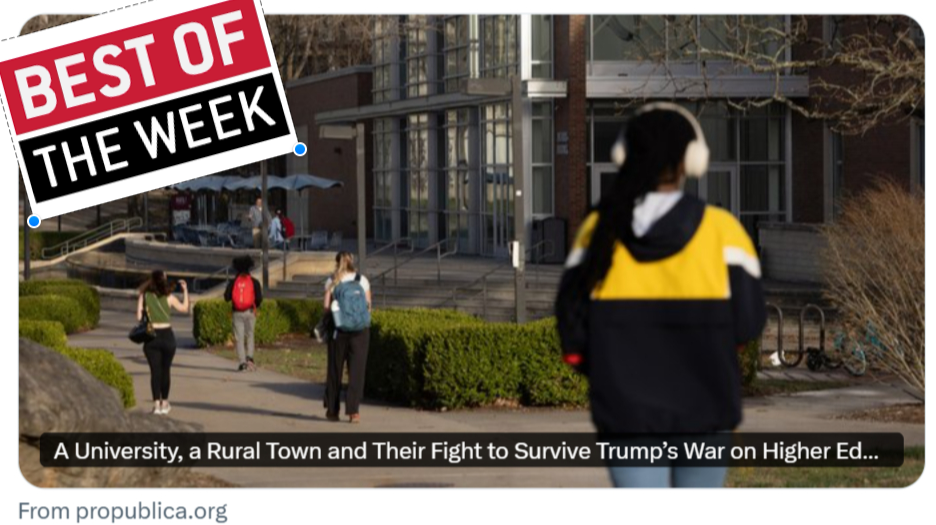
The best education journalism of the week is A University, a Rural Town and Their Fight to Survive Trump’s War on Higher Education by Molly Parker of Capital News Illinois, republished by ProPublica.
Parker writes about her long-ago alma mater, Southern Illinois University (SIU), providing a kind of reported commentary about the fate of regional public universities and their vulnerability to federal budget cuts and DEI threats.
The Trump administration’s deep cuts to research — and conservatives’ evisceration of DEI programs — present an “existential threat” to institutions that are often the economic backbone of conservative rural regions.
Parker beautifully zeroes in on the dilemma that these institutions now face, laying bare the small role of “woke” ideology at the school and the huge role of federal research funding. Most of SIU’s research offers ways for struggling farmers to kill invasive species and grow more crops. State officials say proposed cuts to NIH grants alone would cost SIU about $4.5 million.
It’s a timely piece of reporting that cuts through our tendency to focus on elite institutions and our ideas about what happens in college. The focus on beloved middle-tier state schools offers a good model for other journalists to follow. What a great opportunity for journalists to take a trip back to their roots for consequential reporting — and what a great reminder that most American universities aren’t Columbia, Penn or Brown.
SPECIAL MENTION: Check out Education Week’s See All the Lawsuits Filed Over Trump’s Education Policies, an incredibly useful overview of the growing pushback against Trump administration initiatives. The listicle offers links to 19 complaints, the latest actions in court, and EdWeek’s coverage — a smart, well-conceived bit of service journalism that larger outlets should have emulated by now. It also helps remind readers that, for all of the recent overreach and bluster, many of these efforts are likely to be overturned by courts.
Other education stories we liked include the future of equal access without the U.S. Education Department (AP), too many high schools in Portland, Ore. (Willamette Week), and how the LA wildfires hit Latino and low-income students especially hard (Inside Climate News/Chalkbeat).
Above: In a new reporters roundtable, Kalyn Belsha (Chalkbeat), Mandy McLaren (Boston Globe) , and Zach Schermele (USA Today) reflect on what were the big stories and success of March — as well as the likely stories coming up in April.
WHAT JUST HAPPENED? MARCH IN REVIEW
Our latest columns and commentary
In the 40-minute conversation, reporters discuss their own efforts and praise coverage from other outlets including stories from the Bangor Daily News, ProPublica, the Chronicle of Higher Education, and Hechinger Report.
“The second month felt like there were effects that were actually hitting classrooms,” reflected Belsha. “Figuring out what was noise and what was actually happening on the ground was imperative.”
“One of the national outlets had a headline that said definitively that HHS was going to take special education and the Small Business Administration was going to take the student loan portfolio,” said McLaren. “I don’t think the story said that definitively.”
“Were we spending too much time thinking about the Executive Order?” asked Schermele.
If the embed above doesn’t work, you can watch the replay (and read the show notes) here.
In case you missed it, we also published The Reopeners, a collection of insights and experiences from school reopening advocates who tried — and mostly failed — to persuade American schools to reopen during COVID.
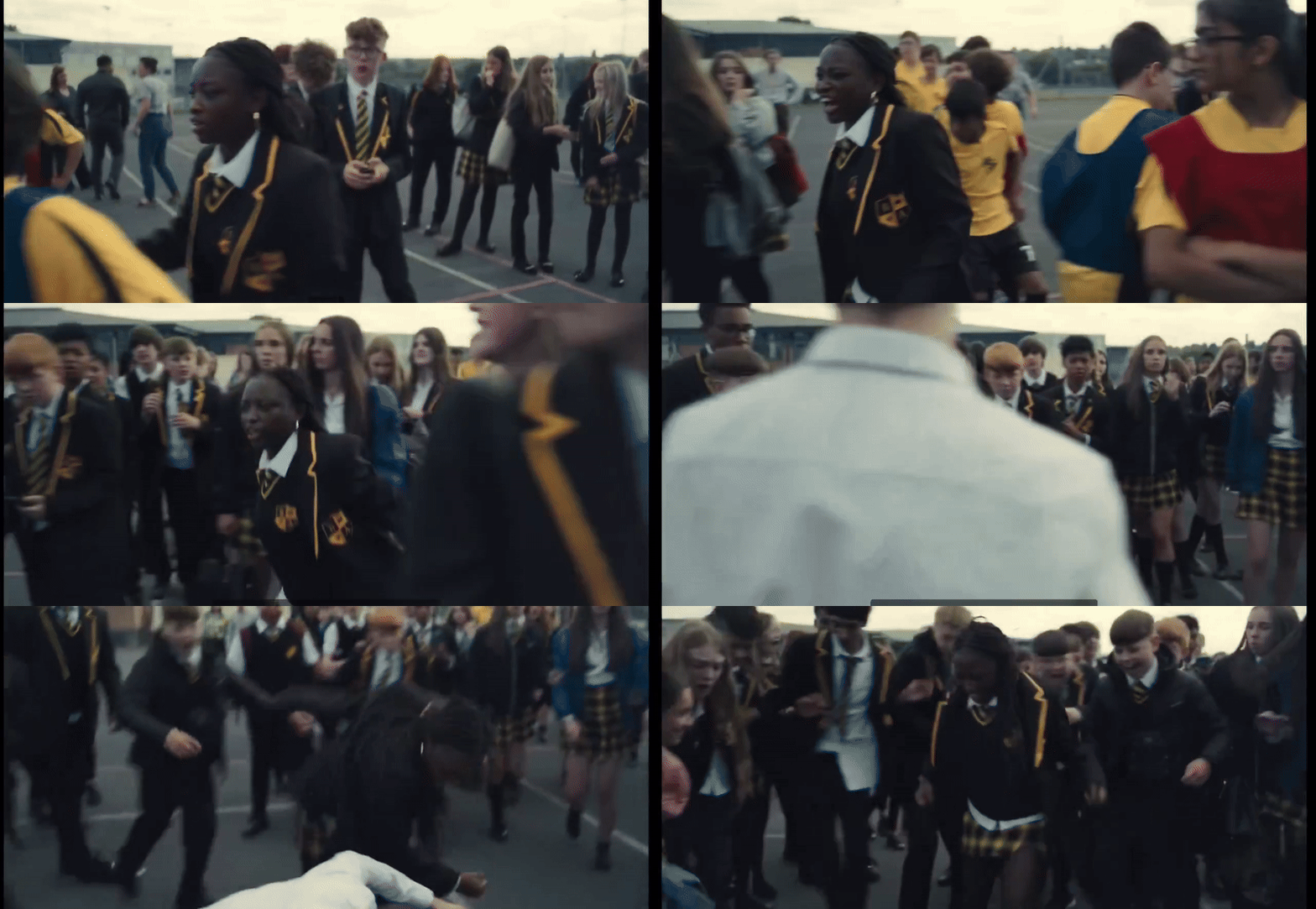
Above: Two episodes in, Netflix’s “Adolescence” makes a pretty strong case against unfettered exposure to cellphones and social media – and gives a vivid reminder how utterly miserable schools can be for kids and adults. Read about the controversial show in the Post,, WSJ, USA Today, and The Free Press.
PEOPLE, JOBS, & EVENTS
Who’s going where and what’s happening
📰 Spotlight: “Rumesya is one of the kindest, sweetest people you’ll ever meet. She is an educator, one who has always been passionate about helping children.” That’s a tweet by Hechinger reporter Javeria Salman about a recent ICE apprehension. Salman tells us her friend “isn’t an activist. She wasn’t heavily involved in campus protests either. She co-authored an op-ed for her college newspaper last year calling on her university to recognize the plight of the Palestinian people. She is a kind, soft spoken woman, and one of the sweetest people you’ll ever meet. She doesn’t deserve this.”
📰 Job moves: The New York Times’ David Leonhardt, who helped lead the drumbeat questioning COVID response measures, has left the the Morning Newsletter he helped found and is moving over to the editorial section, where he’ll work with long-ago education journalist Katherine Kingsbury. I’m not sure if it’s all that new, but former ProPublica ed reporter Annie Waldman is featured as part of the team covering HHS.
📰 Quotable:
“Well-orchestrated events feed political junkies’ voracious appetite for cultural conflict [and] also underscore the pathetic lack of interest Capitol politicians have in a real crisis, the shamefully low levels of academic achievement in CA’s schools.” (Dan Walters)
“We tend to see technology as a panacea, but it comes with new risks, particularly in the education sector.” (Mark “An Ed Tech Tragedy?” West)
“The five year anniversary [of the pandemic] felt like the right time to look at the current state of things…. In doing so, we felt it was important not to spend too much time looking backwards and relitigating decisions that were made years ago.” (Adam Eisenberg)
📰 Magazines: This week’s trove of magazine- and feature-length education articles includes Schools Are Banning Phones. What About Laptops? (Washingtonian), A magnetic pouch is key to enforcing school cellphone bans. Kids are getting around it (LA Times), and Using ChatGPT to Write Your College Essay Won’t Help You Get Into Your School of Choice (Teen Vogue, via Hechinger).
📰 Events: The ResearchED US conference takes place tomorrow morning in New York City, featuring Holly Lande and education journalist (and The Grade contributor) Holly Korbey. Journalist David Zweig’s book is about a month away from its big publication date. There is already a NYC event scheduled for Monday April 28th. There are also events in Berkeley, CA, on Saturday, April 26th, and Washington, DC, on Friday, May 2nd.
📰 Wonkery: “ChatGPT, please compare and contrast this week’s TL:DR commentary about Democrats’ lost education luster from Slow Boring’s Matt Yglesias, The 74’s Kevin Mahnken, and independent researcher Chad Aldeman (in The 74). Please also explain why mainstream and trade news outlets seem so disinterested in covering this pressing topic.”
THE KICKER
We saved the best for last.

“Nobody ever accidentally texts me any secret DOE plans,” writes NY1 education reporter Jillian Jorgensen.
“But one time I accidentally texted a then-city-councilman instead of my husband, asking ‘What should we have for dinner?’
“He replied: ‘My wife is making chicken cutlets.’”