
Legislative efforts to increase teacher salaries are a mixed bag for early-career teachers.
At a Glance
- Teacher shortages have led some states to pass legislation raising minimum teacher salaries.
- Many teacher pay reforms do not target prospective or early-career teachers.
- Representative polling indicates that prospective teachers, the public, and parents alike cite low pay as a barrier to a teaching career.
- Federal ESSER funding’s expiration may limit districts’ efforts to boost pay, complicating teacher recruitment aims.
How do salary expectations shape the strength of the early teacher pipeline? Has recent legislation affecting school funding and teacher salaries made teaching more attractive? Contemporary debates about teacher shortages often intersect with the expiration of the Elementary and Secondary School Emergency Relief Fund (ESSER). As a result, the fate of a robust pipeline of new teachers may depend, in part, on the financial resources public schools have available to compensate their educators.
Amid surging inflation in 2021 and 2022, inflation-adjusted teacher wages declined to their lowest point in nearly four decades. At the same time, interest in the teaching profession and perceptions of its occupational prestige reached 50-year lows (Kraft & Lyon, 2024). In response, President Joe Biden’s administration lobbied Congress in 2023 to codify a national $60,000 minimum teacher salary, higher than every state’s minimum teacher salary (Stanford, 2023).
The national proposal drew significant skepticism and ultimately fizzled out (Hansen, 2023). However, 34 states have introduced 125 legislative bills since 2023 to change how and how much they pay teachers (Aranda-Comer, 2023; Thymianos & DiMarco, 2024). Twenty-two bills passed in 15 states, legislation which applies to nearly one-third of the 3.2 million public school teachers nationwide. However, it remains to be seen how recent compensation changes and the erosion of wages due to inflation will shape the attractiveness of the teaching profession — both for people considering entering the profession and those considering leaving the field (Aldeman & Silberstein, 2022).
The expiration of federal stimulus funding likely will pose significant challenges for many district budgets and, by extension, improvements in teacher compensation. Employee salaries and benefits make up nearly 70% of public school expenditures, with the vast majority spent on teachers (National Center for Education Statistics, 2024). Yet, the share of funding spent on teachers has declined more than 4 percentage points over three decades, resulting in a significant “teacher wage penalty” relative to college-educated individuals in other professions.
The Economic Policy Institute estimates teachers today suffer a 26.4% wage penalty and a 17.0% penalty when employee benefits are included (Allegretto, 2023). As increasing teacher turnover, a dwindling teacher pipeline, and worsening teacher morale continue, many public schools’ darkening financial horizons add to the worry.
Pandemic-era teacher turnover and the teacher pipeline
During the pandemic, reports of sharp increases in teacher turnover, attrition, and shortages captured considerable attention among practitioners and policy makers, including the Biden administration (The White House, 2022). Although the share of teachers leaving the profession declined in many settings ahead of the 2021-22 school year, turnover spiked the following year to record highs in many states. As many as 15% of teachers left their positions in some states, jumping by more than 5 percentage points from previous years. For example, North Carolina experienced a 50% increase in turnover. Other regions experienced even higher turnover — in Austin, Texas, one in four teachers left their positions (Barnum, 2023).
Teacher turnover and related teacher shortages are expected to abate in the years to come. However, ESSER’s expiration may complicate the picture in districts that have leveraged stimulus funding to maintain or grow their staffing (Will, 2023). In addition, teachers have continued to report declining satisfaction with their working conditions, even after the end of pandemic-era schooling (Baker & Koedel, 2024).
Amid higher turnover and increased reports of burnout, strengthening the early career teacher pipeline is of vital importance. Enrollment in teacher preparation programs grew 12% from 2018-19 to 2021-22, but the current pipeline remains 35% lower than 2009-10 (McMurdock, 2024). Over that period, only Texas (56%); Arizona (25%); Washington, D.C. (16%); Mississippi (10%); and Washington (3%) experienced increased enrollment in teacher prep programs (Fuller, 2024). The number of candidates completing teacher prep programs increased 6% over the past five years, though it remains 17% lower than a decade ago (Nguyen & Bleiberg, 2024). Finally, the pipeline of teachers of color has also failed to keep pace with a quickly diversifying student population (Goldhaber, Theobald, & Tien, 2019), and in some contexts it has sharply declined (Kwok & Bartanen, 2024).
Collectively, these turnover and pipeline figures underscore the need for improved strategies to attract new teachers.
Recent teacher pay legislation
Will recent teacher pay legislation improve the attractiveness of the teaching profession? We examined the 22 teacher pay bills passed over the past two years and found they vary considerably in how they prioritize early-career teachers.
Several bills increase statewide minimum salaries. For example, the 2023 Arkansas LEARNS Act, which guaranteed a minimum $2,000 salary increase, effectively increased state-mandated minimum teacher salaries from $36,000 to $50,000 and doubled funding for student loan repayment to $6,000 (Zamarro et al., 2024). These increases shrunk salary gaps between higher- and lower-income districts and increased the supply of new teachers to fill shortage areas. Tennessee’s Teacher Paycheck Protection Act also increased minimum salaries to $50,000, though the increases are phased in over four school years (Styf, 2023). Like the LEARNS Act, Oklahoma’s SB1119 guaranteed a minimum of $3,000 increase for teachers of four or fewer years’ experience, with incremental increases up to $6,000 for teachers of at least 15 years’ experience (State of Oklahoma House of Representatives, 2023).
Not all minimum salary increases are created equally, though. For example, Missouri increased its statewide minimum salary from $25,000 (not a typo!) to $40,000. Teachers in metropolitan areas with competitive local labor markets already received salaries at or near the new minimum, which effectively shut them out of the increases. Districts in the St. Louis and Kansas City regions, for example, must offer salaries higher than the statewide minimums to compete with other local industries (Anglum, Manion, & Varkey, 2024). The minimum salary reforms also effectively excluded underrepresented minority teachers and prospective teachers who tend to be concentrated in these metropolitan areas (Edwards et al., 2024).
These types of state-level efforts to improve average teacher salaries often fail to prioritize novice teacher pay. Indeed, experienced teachers tend to reap more salary-related gains through school finance reforms than novice teachers (Nguyen, Anglum, & Crouch, 2023). This could be because “employed experienced teachers have a concerted interest in capturing salary gains, whereas future novice teachers were not present to self-advocate for higher salaries or increased hiring” (Nguyen, Anglum, & Crouch, 2023, p. 13).
One promising avenue for prospective and novice teachers is payment for student teaching, a crucial step for budding teachers who typically remain unpaid for their services (Álvarez, 2023). Over the past two years, Pennsylvania established the PA Student Teacher Support Program, wherein student teachers can receive student-teaching stipends of $10,000, with an additional $5,000 allocated to student teachers in high-need areas and $2,500 to the cooperating mentor teachers. Student teachers must subsequently fulfill a three-year teaching commitment in the state (Pennsylvania Higher Education Assistance Agency, n.d.), potentially encouraging novice teachers to stay in the profession during the period when they are most likely to leave. The program proved to be popular, with more than double the number of prospective teachers applying than could be funded. The funding was allocated on a first-come, first-served basis (Commonwealth of Pennsylvania, 2024), raising potential equity questions. Nonetheless, this initiative may serve as an important test case as we strategize how to ease the financial burden on prospective teachers while encouraging them to stay in the profession.
Prospective teachers and teacher pay
Improving teacher pay has consistently garnered widespread public support in recent years. As many as three in four adults support higher teacher pay, outstripping the four in 10 adults who favor increasing education spending more generally (Houston, 2024). In fact, recent iterations of the PDK Poll of the Public’s Attitudes Toward the Public Schools have indicated that 60% or more of adults would not recommend their child pursue a teaching career. In the 2024 poll, nearly half of current public school parents cited inadequate compensation as the reason they wouldn’t want their child to become a teacher, a reason selected more than three times as often as other concerns, such as student discipline and job-related stress (PDK International, 2024). In this context, it is unsurprising that many polls also find public support for short-term financial initiatives like one-time teacher bonuses (64% approval, 23% disapproval); grants to teach in high-needs schools (59% approval, 20% disapproval); and systemic changes to broaden teacher loan relief (47% approval, 25% disapproval) (Anglum, Manion, & Varkey, 2023).
These figures indicate popular public support among adults rather than among those most likely to consider entering teaching, including college and high school students. In a survey administered to college students, providing information about teacher and non-teacher salaries generated large increases in reports of the intent to major or minor in education and become a teacher. Although the percentage who enrolled in education programs was smaller (Christian, Ronfeldt, & Zafar, 2024), the result shows promise in sharing accurate information about salaries.
Gauging high school student interest
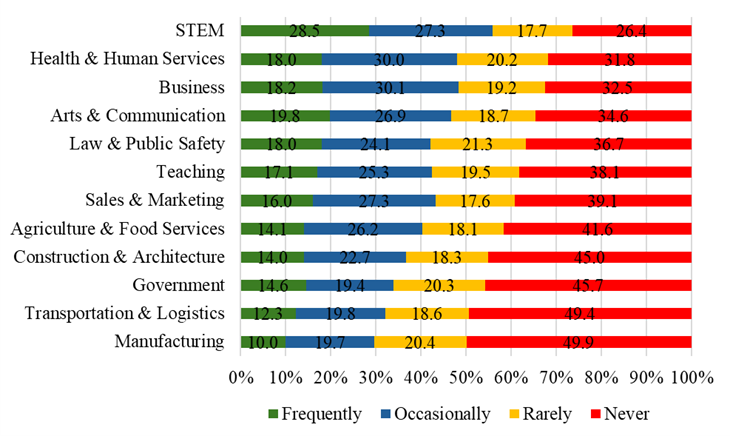
To complement evidence on college students’ teaching aspirations, we conducted a nationally representative survey of 857 high school students at the end of the 2023-24 school year to gauge their interest in teaching and assess factors that may propel or hinder their path to the profession. Forty-two percent indicated at least some teaching interest, with 23% indicating stronger interest (“somewhat” or “very”). Forty-two percent also indicated they have had frequent or occasional conversations with school personnel about a teaching career (see Figure 1). This was greater than dialogue focused on careers in government (34%); similar to conversations regarding careers in law and public safety (42%) and sales and marketing (43%); but trailing those focused on careers in health and human services (48%), business (48%), and STEM (56%).
Figure 1: Career-focused conversations with school personnel
High school student responses to the following prompt: “How often have you had conversations with school personnel (e.g., guidance counselor, teacher, etc.) about potential career opportunities in the following areas?”
High school students were clear about the factors influencing their interest in teaching (see Figure 2). Among the prompts provided, financial concerns — such as teacher salaries and benefits (78%) and college costs (76%) — were the most frequently cited barriers to the pursuit of a teaching career (students responding with at least “somewhat important”). A frequent focus on professional stability (74%) among prospective teachers may also relate to compensation expectations, though additional research is necessary to better understand how teachers consider stability (e.g., Protection against job loss? Consistency in day-to-day expectations?) and whether prospective and veteran teachers consider stability differently. These figures exceed other aspects of the teaching profession, including opportunities to work with children (72%) and to serve the local community (69%).
Figure 2: Barriers and facilitators to an interest in teaching
High school student responses to the following prompt: Rate the importance of how the following factors may impact your interest in becoming a teacher
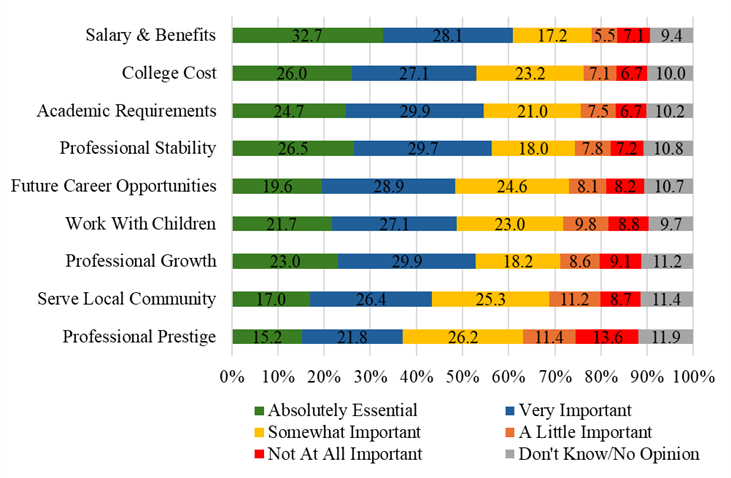
Note: Options included the following: teacher salaries and benefits; cost in university/college to become a teacher (e.g., tuition, loans, alternative wages); academic requirements to become a teacher (e.g., certification, university course requirements); the employment stability of the teaching profession; the available employment opportunities if one leaves the teaching profession; opportunities to work with children and young people; opportunities for professional growth as a teacher; opportunities to serve the local community; the public perception of the prestige of teachers and the teaching profession.
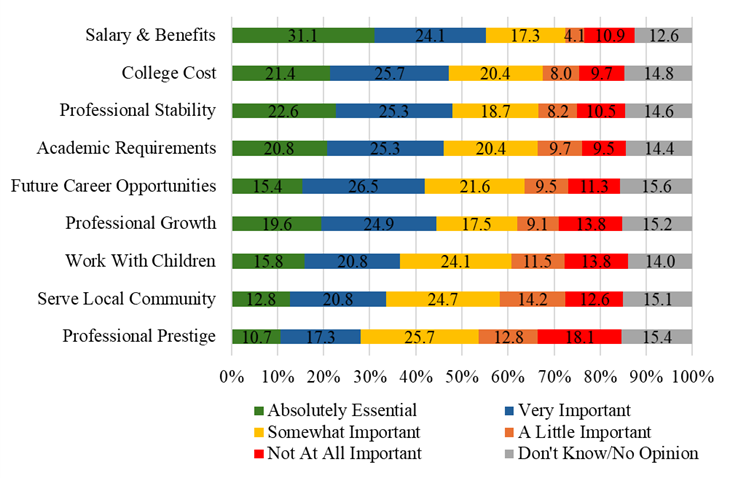
On the one hand, it might be true that those interested in teaching believe the profession offers a stable career (both for employment prospects and compensation) and lower college costs than many alternative professional paths. Alternatively, prospective teachers might maintain teaching interest despite low salaries. However, by examining the responses broken down by interest or disinterest in teaching, some noteworthy findings emerge. Among those without teaching interest, salaries and benefits were the most cited aspect of the profession (see Figure 3), likely signaling salaries comprise a leading pushout factor from the profession.
Figure 3: Barriers and facilitators to an interest in teaching among those without teaching interest
Finally, some discrepancies emerged when we asked high school students to guess how much new teachers, the average teacher, and the average college-educated non-teacher earn in yearly wages in their respective home states. Students underestimated average salaries; the median response was $30,200 for a new teacher, $30,700 for a veteran teacher, and $33,400 for a non-teacher. For reference, the National Education Association reports the average starting teacher salary was $44,530 and the overall average was $69,597 in 2022-23 (National Education Association, n.d.). If students believe teachers earn less than they do, educating them about actual salaries could encourage them to enter the profession.
However, in addition to underestimating salaries, students also underestimated the salary gap between teaching and other professions. While 77% of students’ guesses implied some perceived salary penalty, their guesses implied a median teacher salary penalty of $2,700 compared to similar college-educated non-teachers. This is a penalty of nearly 9%, when the actual penalty is more than 26%. Salary expectations, therefore, might cut two ways—students interested in teaching might be buoyed by higher salaries than they may have expected, but also might lose interest if they realize that the salary gap between teaching and other professions is higher than they suspected.
Déjà vu all over again?
Though few prospective teachers seek to enter the profession primarily for financial rewards, a range of research indicates that stronger salaries can attract more candidates to the field and keep them in their positions longer. Many school districts, however, are poised to enter a precarious financial period following the expiration of their federal ESSER funding and possible reductions in state funding due to enrollment loss. ESSER’s expiration will heighten fiscal constraints in many districts, especially those trying to balance demands for expanded tutoring and academic remediation, deferred building maintenance, and teacher and leader compensation.
Lessons from the expiration of Great Recession-era federal stimulus indicate that stagnating teacher wages and a loss of public school employment may loom on the horizon unless states find a way to maintain or increase teacher compensation. Over the past two years, nearly one in three states have begun to heed this charge through new compensation-focused legislation. However, the effect on new and prospective teacher candidates may depend on the extent to which that legislation specifically targets them.
Concerted focus on teacher salaries, and especially early-career pay, is unlikely to resolve ongoing concerns of teacher shortages and burnout. However, it may offer an important tool to reverse long-term declines in enrollment in teacher-preparation programs and improve retention for early-career teachers. But pay reform needs to target such teachers specifically.
References
Aldeman, C. & Silberstein, K. (2022, July 26). Schools try bonuses, stipends to attract & keep teachers in a tight labor market. The 74 Million.
Allegretto, S. (2023). Teacher pay penalty still looms large: Trends in teacher wages and compensation through 2022. Economic Policy Institute.
Álvarez, B. (2023, February 27). All work, no pay. NEA Today.
Anglum, J.C., Manion, A., & Varkey, S. (2023). Partisan policy preferences to improve teacher recruitment and retention. Brookings Institution.
Anglum, J.C., Manion, A., & Varkey, S. (2024). Increasing minimum teacher salaries: Opportunities and drawbacks across geography and race. Urban Affairs Review, 60 (6) 1931-1955.
Aranda-Comer, B. (2023, April 13). Legislative tracker: 2023 teacher-pay bills in the states. FutureEd.
Baker, S. & Koedel, C. (2024). The decline in teacher working conditions during and after the COVID pandemic (EdWorkingPaper No. 24-1000). Annenberg Institute for School Reform at Brown University.
Barnum, M. (2023, November 9). Teacher turnover hits new highs across U.S. Chalkbeat.
Christian, A., Ronfeldt, M., & Zafar, B. (2024). College students and career aspirations: Nudging student interest in teaching (No. w32641). National Bureau of Economic Research.
Commonwealth of Pennsylvania. (2024, September 19). After Governor Shapiro and legislators secured an increase in funding, over 2,000 student teachers across the commonwealth receive critical stipends [Press release].
Edwards, D.S., Kraft, M.A., Christian, A., & Candelaria, C.A. (2024). Teacher shortages: A framework for understanding and predicting vacancies. Educational Evaluation and Policy Analysis.
Fuller, E.J. (2024, February). Trends in enrollment and completion in U.S. teacher preparation programs: 2009-2022. Center for Education Evaluation and Policy Analysis.
Goldhaber, D., Theobald, R., & Tien, C. (2019). Why we need a diverse teacher workforce. Phi Delta Kappan, 100 (5), 25-30.
Hansen, M. (2023). Ways to reform teacher compensation, beyond a $60,000 minimum salary. Brookings Institution.
Houston, D. (2024). The year in public opinion on U.S. K-12 Education Policy. Education Next, 25 (1).
Kraft, M.A. & Lyon, M.A. (2024). The rise and fall of the teaching profession: Prestige, interest, preparation, and satisfaction over the last half century. American Educational Research Journal, 61 (6), 1192-1236.
Kwok, A. & Bartanen, B. (2024). Backtalk: Where are the teachers of color? Getting cut out and lured away. Phi Delta Kappan, 106 (3), 54-55.
McMurdock, M. (2024, April 28). Teacher prep programs see “encouraging” growth, new federal data reveal. The 74 Million.
National Center for Education Statistics. (2024). Table 236.60. Total and current expenditures per pupil in fall enrollment in public elementary and secondary schools, by function and subfunction: Selected school years, 1990-91 through 2020-21. Digest of education statistics: 2023. U.S. Department of Education.
National Education Association. (n.d.). 2024 Reports: Educator Pay in America.
Nguyen, T.D., Anglum, J.C., & Crouch, M. (2023). The effects of school finance reforms on teacher salary and turnover: Evidence from national data. AERA Open, 9.
Nguyen, T. D. & Bleiberg, J. (2024, February). Teacher shortages in the United States: A systematic examination of reports of teacher vacancy and shortages.
Pennsylvania Higher Education Assistance Agency. (n.d.). PA student teacher support program information.
PDK International. (2024). PDK poll of the public’s attitudes toward the public Schools: The 56th annual PDK poll.
Stanford, L. (2023, March 15). A $60K starting salary for teachers? Not a single state meets the bar. Education Week.
State of Oklahoma House of Representatives. (2023, May 19). Legislature sends historic education package to governor.
Styf, J. (2023, May 17). Lee signs Tennessee teacher pay increase, end to automatic dues payments. The Center Square.
Thymianos, K. & DiMarco, B. (2024, April 25). Legislative tracker: 2024 teacher-pay bills in the states. FutureEd.
The White House. (2022, August 31). Fact sheet: Biden-Harris administration announces public and private sector actions to strengthen teaching profession and help schools fill vacancies.
Will, M. (2023, December 21). What will teacher shortages look like in 2024 and beyond? A researcher weighs in. Education Week.
Zamarro, G., Camp, A., McGee, J., Wilson, T., & Vernon, M. (2024). Teacher salary raises and turnover: Evidence from the first year of the Arkansas LEARNS Act (EdWorkingPaper No. 24-972). Annenberg Institute for School Reform at Brown University.
This article appears in the Summer 2025 issue of Kappan, Vol. 106, No. 7-8, pp. 61-67.

ABOUT THE AUTHORS

J. Cameron Anglum
J. Cameron Anglum is an assistant professor in the educational leadership program at the College of Education, Lehigh University, Bethlehem, Pennsylvania.

Dylan Young
Dylan Young is a doctoral student in the school psychology program at the College of Education, Lehigh University, Bethlehem, Pennsylvania.

Jennifer Gontram
Jennifer Gontram is a doctoral student in the education policy and equity program at the School of Education, Saint Louis University, St. Louis, Missouri.

Gary W. Ritter
Gary W. Ritter is dean and professor at the School of Education, Saint Louis University, St. Louis, Missouri.