
We desperately need teachers of color. But throughout the U.S., we have not gotten them, despite decades of knowing this and making massive investments to attract them. Teachers have remained predominantly white, with the national average hovering around 80% as the percentage of students of color in our schools steadily rises. Research repeatedly has shown that racially diversifying the teaching workforce benefits all students, who experience positive outcomes in achievement, social skills, and behavior (Goldhaber, Theobald, & Tien, 2019; Redding, 2019).
Districts have sought to recruit and hire teachers of color in creative ways. Teacher residency programs have expanded — to the tune of $350 million from the federal government’s Teacher Quality Partnership since 2014. These programs often reduce barriers that prevent teachers of color from entering the profession by providing extra preparation and long-term contracts. Some districts even hire teachers from overseas or offer lucrative contracts to out-of-state preservice teachers. However, these initiatives are insufficient to eliminate the large gap in teacher-student demographics.
To disrupt the status quo, policy makers need to be strategic about how to recruit potential teachers into the profession. One promising route is to look even earlier in the teacher pipeline.
The declining interest in teaching
We sought to pinpoint how to diversify teaching by following undergraduates from one Texas institution from admissions, through teacher education, and then into the teaching profession (Bartanen & Kwok, 2023). Notably, the state has a distinct item on its centralized college application form that made this study possible. It has a question asking, “Will you seek teacher certification?” An additional question tracks interest in other professions.
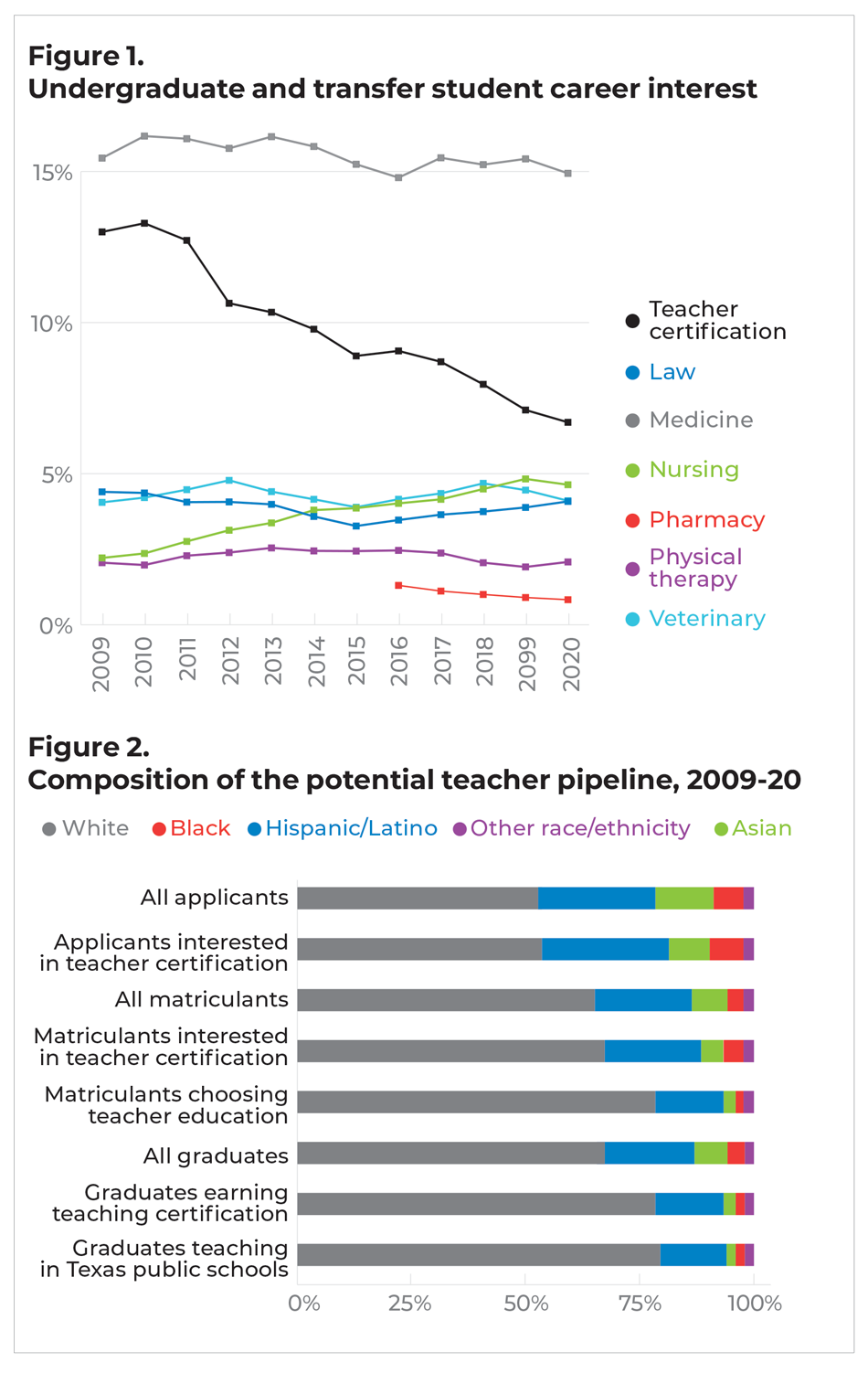
Interest in teaching among undergraduates plummeted by nearly 50% over a decade. Not only was teaching one of the few professions to see a decline in interest, but its decline was massive (see Figure 1). Before panicking, however, it is important to note that the small percentage of individuals remaining interested in teaching is still more than enough to increase enrollment in local preparation programs.
We also considered who is interested in teaching and found that the racial composition of individuals interested in teaching is in fact diverse. Of the individuals interested in teaching, approximately 45% were non-white (see Figure 2). The shortage of teachers of color is not because of a lack of interest, as some have theorized.
The winnowing of teacher diversity
Despite diverse interest in teaching, the biggest challenge comes afterward. At each step from initial interest to teacher certification, we see declines in diversity. Black and Hispanic/Latino applicants were nearly as interested in teaching as white applicants, but they were less likely to be admitted, to enroll, and then to enter teacher education. Individuals of color are not becoming teachers in part because they are not getting equal opportunities to go to college, a situation that could get worse since the Supreme Court decision that removed race as a factor for college admissions (Howe, 2023). The restrictions appear to occur at every early juncture on the path to becoming a teacher.
We also found that individuals of color are more interested in becoming secondary school teachers than elementary teachers. In many states, undergraduates who want to be secondary teachers major in their subject area first, then get their teaching credential. As these prospective teachers take multiple courses in their major, they may be enticed into other careers that those disciplines offer, especially if they start at salaries vastly higher than in public education. So, diverse individuals interested in teaching are instead drawn away by other professions.
Solutions to diversify the profession
What is the education profession to do? Knowing why there are fewer teachers of color allows us to consider ways to address it. We offer two potential solutions:
- We need to strengthen the pipeline from high school into college, particularly for students of color. There needs to be consistent advising in high school and higher education about college-preparation coursework, navigating admissions, and understanding majors and prerequisites for teacher preparation.
- Teacher preparation programs need to be intentional about recruiting and marketing to people of color. Programs need to explicitly outline how to major in education or obtain a teaching certification, particularly for secondary teachers. This would reduce opportunities for interested individuals to deviate to another career. Programs could also offer recruitment events or informal teaching opportunities (e.g., tutoring, camp counseling) that could facilitate interest before students need to apply for admission to the teacher education program.
Multiple programs exist to strengthen the pathway into college for students interested in education. Educators Rising, for example, provides scholarships and other resources, and more than half of its student members are students of color. The Breakthrough Collaborative similarly addresses opportunity gaps for students, beginning in the middle school years, and introduces college students to careers in teaching to build a diverse and talented educator workforce.
Notably, the teaching certification question on the Texas college application on which we build our study came from a 1995 bill passed by the Texas legislature. The goal was to promote teacher workforce diversity and excellence by identifying students interested in teaching and developing programs for them. Thirty years later, the lack of diversity among teachers persists. If we are serious about improving student outcomes, we need to start with diversifying the teaching workforce. If we don’t take steps now, the status quo will remain.
References
Bartanen B. & Kwok, A. (2023). From interest to entry: The teacher pipeline from college application to initial employment. American Educational Research Journal, 60 (5), 941-985.
Goldhaber, D., Theobald, R., & Tien, C. (2019). Why we need a diverse teacher workforce. Phi Delta Kappan, 100 (5), 25-30.
Howe, A. (2023, Jun. 29) Supreme Court strikes down affirmative action programs in college admissions. SCOTUSblog.
Redding, C. (2019). A teacher like me: A review of the effect of student–teacher racial/ethnic matching on teacher perceptions of students and student academic and behavioral outcomes. Review of Educational Research, 89 (4), 499-535.
This article appears in the November 2024 issue of Kappan, Vol. 106, No. 3, p. 54-55.

ABOUT THE AUTHORS

Andrew Kwok
Andrew Kwok is an associate professor in the Department of Teaching, Learning & Culture at Texas A&M University, College Station.

Brendan Bartanen
Brendan Bartanen is an assistant professor of education policy at the School of Education and Human Development at the University of Virginia, Charlottesville.