
A research-based approach includes families and community members in finding lasting solutions.
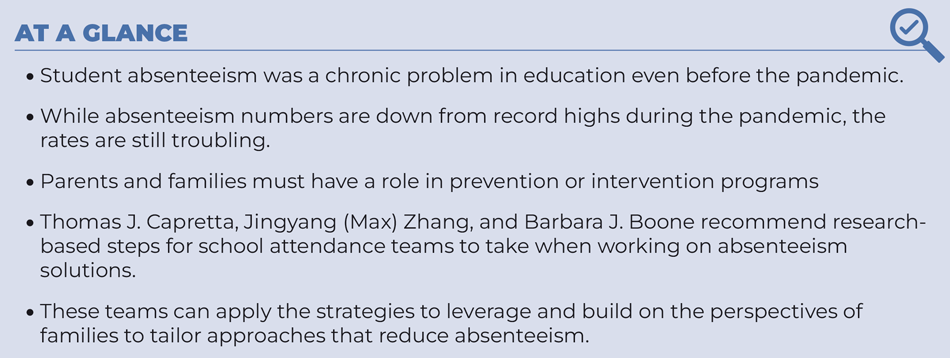
Absenteeism has long been a chronic problem in education, even before the pandemic pushed it into the national spotlight. Though some schools and districts have worked to maintain high levels of student attendance, many have not found lasting solutions.
In the 2018-19 school year, the percentage of chronically absent students nationally was 16.2% (Attendance Works, 2023). A few years later, the COVID-19 pandemic recentered and intensified educators’ focus on attendance and absenteeism while raising public awareness of the issue. During the first full school year of the pandemic, 2020-21, absenteeism increased to 20.5% and peaked at 29.7% in the 2022-23 school year.
National and state initiatives continue to improve awareness of the importance of regular attendance. Yet, there are critical partners that are underrepresented in these conversations: families. An NPR/Ipsos poll earlier this year asked members of the public, including parents of school-age children, to identify what they are most worried about when it comes to K-12 education. Only 5% of parents and of the general public identified chronic absenteeism as a concern (Carillo, 2024). A recent Kappan article likewise reported a disconnect between what parents perceive regarding their children’s attendance and what experts are finding in the data (Rapaport & Saavedra, 2024).
Why does chronic absenteeism matter?
The U.S. Department of Education (2019) defines chronic absenteeism as missing 15 or more days in a school year. Students who are chronically absent have a greater risk of dropping out and lower academic achievement than their peers (Gottfried & Ehrlich, 2018; Sheldon, 2003). When students miss school, they miss opportunities for learning that they may not be able to easily recover through makeup lessons (Premo, Pilarz, & Yen, 2023; Santibanez & Guarino, 2021). When students come to school, they not only acquire academic knowledge and skills but also develop important values, relationships, and behaviors (Panev, 2020).
An insidious aspect of chronic absenteeism is that it often affects students already underserved in schools (U.S. Department of Education, 2019). In Ohio, for instance, students from families identified as economically disadvantaged, students with disabilities, and English learners all had rates of chronic absenteeism greater than the state average in each of the last three school years (Ohio Department of Education and Workforce, 2024).
Chronic absenteeism data can also illuminate how connected students and families feel to school. Even in early grades, a school’s instructional climate, which includes classroom management practices, instructional practices, classroom support for students, and norms for teacher collaboration (Jacob et al., 2015), forecasts how often students attend (Ansari & Gottfried, 2020). A foundational first step to creating equitable access to opportunities for all students is ensuring that they get to school. Better relationships with families is key to accomplishing this.
The importance of family involvement
A growing body of literature indicates that teacher trust in families is correlated with higher levels of collaboration between home and school (Tschannen-Moran, 2014). Families’ desire to engage in their child’s education is enhanced when school staff “recognize parents as partners in the educational development of their children,” and this partnership can “positively impact student achievement” (Tschannen-Moran, 2014, p. 63, 64). Building trust with families — by showing that schools have their child’s best interests in mind and are preparing them for the future — is essential to bringing student attendance back on track.
A recent report by Learning Heroes and The New Teacher Project (2023) suggests that “schools with stronger family engagement before the pandemic experienced better-than-expected attendance, achievement, and school climate outcomes” and that such positive effects “applied to a diverse range of schools” across geographical settings, grade ranges, and socioeconomic statuses (p. 10). But, as the NPR/Ipsos poll shows, too few families are engaged enough to even be aware of the pressing nature of the absenteeism problem.
A foundational first step to creating equitable access to opportunities for all students is ensuring that they get to school. Better relationships with families is key to accomplishing this.
Many districts have attendance teams made up of administrators, teachers, school nurses, and other staff who are responsible for monitoring attendance data, identifying root causes of absences, coordinating the implementation of strategies to improve attendance, and ensuring that these strategies meet student and family needs (Attendance Works, 2018). Students, families, and community members should be on these teams as well. Including families will enable teams to build on their perspectives and form tailored approaches that reduce absenteeism.
Throughlines of addressing absenteeism
Our team at the Ohio Statewide Family Engagement Center has identified four ever-present principles or throughlines that schools should consider when planning for, implementing, or evaluating strategies for improving attendance. We do not recommend implementing these throughlines in sequence, nor should schools consider some more important than others. Instead, they should take account of these throughlines from the beginning of their partnership efforts with parents, using them as topics of meetings and incorporating them into all their plans.
Collaborative approach
No one person knows everything about a student’s experience at any given moment. Attendance teams must access the skills and experiences of those outside school, especially students and families. Research on student participation in school improvement efforts through youth participatory action research indicates a significant and positive impact on attendance (Voight & Velez, 2018). Additionally, while families are experts on their own children, their perspectives as caretakers and community members can inform solutions that benefit all children (Moll et al., 1992).
Much of the conversation around absenteeism is about intervention: Chronic absenteeism is a problem, and we must intervene to address it. While strategic interventions are necessary, prevention is important, too.
Community organizations are often well-positioned to connect with students and families in places schools might not. School-community partnerships can help reinforce messages across family, community, and school, as is the case with initiatives like Ohio’s Stay in the Game Attendance Network (https://stayinthegame.org). Collaborators in this network share one galvanized message about the importance of attending school. Developing a collaborative approach that includes students, families, and community partners supports schools to tailor attendance solutions that address the underlying causes (Childs & Grooms, 2018).
Diversity and setting
Considering the diverse students and families that make up a school community is a key step to addressing absenteeism (Grooms & Bohorquez, 2022). In a school, there might be a variety of races, ethnicities, faiths, languages, and socioeconomic statuses. Families from different groups provide unique insights into their beliefs about education and why their children might not attend school regularly, which can inform the development of solutions (Sheldon, 2007).
School setting is also important (Childs & Lofton, 2021). The challenges of an inner-city school district might be significantly different from those of a rural district or even another urban community. A school’s specific context might explain some challenges students experience getting to school and what solutions exist, including which community partners can help (Childs & Grooms, 2018).
Intervention or prevention
Much of the conversation around absenteeism is about intervention: Chronic absenteeism is a problem, and we must intervene to address it. While strategic interventions are necessary, prevention is important, too.
Attendance patterns students develop early on can impact their literacy and academic achievement at age 15 (Ansari & Pianta, 2019). Knowing that habits around attendance are formed early (Schoeneberger, 2012; Spencer, 2009) and that strong family engagement practices can affect attendance (Learning Heroes & The New Teacher Project, 2023; Rogers et al., 2017; Sheldon & Epstein, 2004), we offer the following questions for attendance teams to consider:
- What shared expectations have been developed and/or expressed between home and school?
- Are there opportunities for building relationships with families of future kindergartners when children are three, four, and five years old?
- How do early learning programs in your area communicate about attendance?
Multitiered approach
No single factor causes students to miss school, which presents a challenge to addressing absenteeism. To navigate this complexity, consider a multitiered approach to organizing and deploying strategies. A multitiered framework includes all families by building supports, opportunities, and communications based on specific interests and needs (Bachman & Boone, 2022). The tiers include:
- A universal tier to provide all students and families with what they need (e.g., all families receive an up-to-date attendance policy at the start of the school year; student absences are identified clearly on quarterly reports or other academic records sent home).
- A targeted tier that focuses on interventions useful to specific groups of families and students (e.g., providing a crossing guard for a neighborhood with unsafe walking conditions or connecting a student to a peer attendance group).
- An individualized support tier of personalized strategies that support a unique student and family whose needs aren’t addressed at the other levels (e.g., a student and family participate in an individualized student success plan).
Leveraging a multitiered approach can help ensure strategies are in place to support all students and families.
Strategies for addressing absenteeism
Keeping the four throughlines in mind, school attendance teams can use these research-based strategies to ensure that all students are getting to school as often as possible.
Strategy 1. Focus on the early years
Attendance habits and family expectations about attendance begin early and often require intervention to change (Ansari, 2022). On average, chronically absent kindergarten students perform worse academically in both kindergarten and future grades (Ansari & Pianta, 2019), while students who attend out-of-home preschool are less likely to be chronically absent in kindergarten than their peers (Gottfried, 2015). It is crucial for schools to collaborate with families and community partners to build positive and sustainable attendance habits early.
Put it into practice
-
- Partner with early childhood educators and the families they serve to develop attendance awareness early, reinforce expectations, and present shared messages about attendance.
- Identify community spaces where families and their children gather, such as doctor’s offices, grocery stores, libraries, and worship spaces. Garner the support of people in these spaces to speak with families about regular attendance.
- Engage the families of current students about attendance at the end of the school year or in the summer, providing information, support, and resources to start strong the next school year.
Strategy 2: Practice effective and predictable two-way communication
Communicating effectively, predictably, and in a way that invites feedback and input from families is foundational to combating chronic absenteeism (Rogers et al., 2017; Sheldon & Epstein, 2004). We consider the best communication to be proactive, understandable, positive, and accessible to families. Listening to families improves trust between home and school (Tschannen-Moran, 2014).
Predictable communication means limiting how many places a family needs to check for communication. In many places, notifying families after a certain number of absences is required. Teams should consider if these messages are accessible and use understandable language.
Put it into practice
-
- Consider using artificial intelligence to write and refine messages to parents. AI for Busy Readers (https://writingforbusyreaders.com/ai) developed by Todd Rogers and Jessica Lasky-Fink (2023) converts messages into clearer, more concise test.
- Reflect on what works and what could be improved in your messages using the tool in the Ohio Statewide Family Engagement Center’s (2024) Build Trust with Families Through Attendance Letters policy brief.
- Send attendance postcards following the guidelines from Harvard’s Proving Ground Network (2020) to establish positive, predictable, and understandable communication about a child’s absences.
- Ask families directly at parent-teacher conferences or in a survey about their preferred means of communication.
Strategy 3: Engage families in equitable and collaborative leadership opportunities
Families can fulfill the following roles to address absenteeism, with the support of schools:
- Providing support through activities like helping their child get ready in the morning and sharing their expectation for attendance with their high schooler.
- Receiving support from schools, such as tips for talking with children about the importance of getting to school or a mentor to check in with about their teen’s attendance pattern.
- Initiating support by creating committees, town halls, and surveys or suggesting ways for families to help prevent and address absenteeism.
- Co-designing programs to organize and participate in family advisory groups, serving on attendance teams, or helping design non-punitive attendance plans.
- Providing feedback on prevention and intervention efforts through surveys or focus groups.
Equitable leadership and collaboration requires schools to respect families’ funds of knowledge — the cultural practices and bodies of knowledge behind their daily practices and routines (Moll et al., 1992). These funds of knowledge can inform and strengthen school approaches and policies.
Put it into practice
-
- Identify roles families might fulfill in supporting school attendance both in and out of school. Ensure that all families have access to these roles.
- Identify how to engage and build on a family’s funds of knowledge when seeking opportunities to improve attendance. The Funds of Knowledge Toolkit developed by the Washington Office of Superintendent of Public Instruction can help.
Strategy 4: Develop community partnerships informed by family interest
Families have a variety of concerns that impact how they perceive schools. Schools can help address those concerns by developing reciprocal relationships with community partners (Childs & Grooms, 2018). These partnerships can aid in the development of shared expectations and language across sectors, streamlining the messaging around school-based initiatives like improving attendance (Childs & Grooms, 2017). These partnerships have shared goals and require mutual contributions (Valli, Stefanski, & Jacobsen, 2014).
Partnerships should be developed with family and student input. In addition, students and families should be part of the ongoing evaluation of any partnerships through surveys and focus groups (Bachman & Boone, 2022).
Put it into practice
-
- Engage families in forming community partnerships to improve attendance.
- Create a feedback system for families to evaluate school-community partnerships.
Strategy 5: Establish data systems
Every strategy we share requires access to data (i.e., on attendance, family engagement, transportation, demographics, and the effectiveness of partnerships and interventions). Knowing what to collect and how to present it is critical. However, the existing school data systems may not include metrics beyond basic attendance data, and they rarely include family engagement data.
Addressing these data challenges requires a shift toward a “greater focus on unique local conditions and student/family circumstances” (Kearney & Childs, 2022, p. 265). With more useful data systems in place, attendance teams and their collaborators can select measurements that reflect the outcomes they hope to achieve. Families not only will be counted in these data systems but can also inform the data being collected and receive updates on it.
Put it into practice
-
- Identify and reach out to staff members who may be overlooked as sources of attendance data, such as school nurses (Rankine et al., 2021) or cafeteria workers.
- Consider ways to generate more specific data with families and community partners.
- Consider how your team shares data with students, families, and the community: What would you like them to do with this data? How can families provide data or feedback on the data you have shared?
Strategy 6: Include chronic absenteeism in staff professional learning
Staff professional development can help schools carry out these strategies. Kevin Gee and his co-authors (2024) note that schools and teachers can unknowingly exacerbate chronic absenteeism through school climate and approaches to learning. Successful professional development programs provide long-term support, involve teachers as collaborators, and recognize them as knowledge generators (Abadiano & Turner, 2004).
Put it into practice
-
- Before implementing a new strategy, plan professional learning for those staff who will be involved.
- Give staff members a chance to identify potential barriers to implementation and work together to determine approaches to overcoming them.
- Include teachers in strengthening student belonging and offering a relevant curriculum.
The key to prevention and intervention
Collaborating with families is key to preventing and intervening in student absenteeism and improving school attendance. Families are too often left out of schools’ absenteeism prevention efforts. We hope that by leveraging these research-informed strategies while considering the provided throughlines, schools can create innovative, organized, and sustainable processes and environments conducive to students’ learning and well-being, supporting students in coming back to and staying in schools.
References
Abadiano, H.R. & Turner, J. (2004). Professional staff development: What works. The NERA Journal, 40 (2), 87-91.
Ansari, A. (2022). Absenteeism in elementary school has wide-ranging consequences, especially for minoritized children. The Ohio State University Crane Center for Early Childhood Research and Policy.
Ansari, A. & Gottfried, M.A. (2020). Early childhood educational experiences and preschool absenteeism. The Elementary School Journal, 121 (1), 34-51.
Ansari, A. & Pianta, R.C. (2019). School absenteeism in the first decade of education and outcomes in adolescence. Journal of School Psychology, 76, 48-61.
Attendance Works. (2018). School attendance teams overview.
Attendance Works. (2023). Rising tide of chronic absence challenges schools.
Bachman, H.F. & Boone, B.J. (2022). A multi-tiered approach to family engagement. Educational Leadership, 80 (1), 58-62.
Carrillo, S. (2024, June 10). With ‘chronic absenteeism’ soaring in schools, most parents aren’t sure what it is. National Public Radio.
Childs, J. & Grooms, A.A. (2018). Improving school attendance through collaboration: A catalyst for community involvement and change. Journal of Education for Students Placed at Risk (JESPAR), 23 (1-2), 122-138.
Childs, J. & Lofton, R. (2021). Masking attendance: How education policy distracts from the wicked problem(s) of chronic absenteeism. Educational Policy, 35 (2), 213-234.
Gee, K.A., Gottfried, M.A., Freeman, J.A., & Kim, P. (2024). Explaining disparities in absenteeism between kindergarteners with and without disabilities: A decomposition approach. Early Childhood Research Quarterly, 67 (2), 295-306.
Gottfried, M.A. (2015). Prekindergarten and kindergarten center-based child care and students’ early schooling outcomes. Teachers College Record, 117 (11), 1-28.
Gottfried, M. & Ehrlich, S.B. (2018). Introduction to the special issue: Combating chronic absence. Journal of Education for Students Placed at Risk (JESPAR), 23 (1-2), 1-4.
Grooms, A.A. & Bohorquez, D.G. (2022). What’s your excuse? Sensemaking about chronic absenteeism in a rural, Latinx high school. Journal of School Leadership, 32 (4), 384-405.
Jacob, R., Goddard, R., Kim, M., Miller, R., & Goddard, Y. (2015). Exploring the causal impact of the McREL Balanced Leadership Program on leadership, principal efficacy, instructional climate, educational turnover, and student achievement. Educational Evaluation and Policy Analysis 37 (3), 314-332.
Kearney, C.A. & Childs, J. (2022). Improving school attendance data and defining problematic and chronic school absenteeism: The next stage for educational policies and health-based practices. Preventing School Failure: Alternative Education for Children and Youth, 67 (4), 265-275.
Learning Heroes & The New Teacher Project. (2023). Investigating the relationship between pre-pandemic family engagement and student and school outcomes.
Moll, L.C., Amanti, C., Neff, D., & Gonzalez, N. (1992). Funds of knowledge for teaching: Using a qualitative approach to connect homes and classrooms. Theory Into Practice, 31 (2), 132–141.
Ohio Department of Education and Workforce. (2024). Stay In the Game!
Ohio Statewide Family Engagement Center. (2024). Build trust with families through attendance letters.
Panev, V. (2020). Theoretical basis and models for developing students’ values in primary education. International Journal of Cognitive Research in Science, Engineering and Education (IJCRSEE), 8 (1), 81-91.
Premo, E., Pilarz, A.R., & Lin, Y.C. (2023). Pre-kindergarten teachers’ family engagement practices and English language learners’ attendance and early learning skills: Exploring the role of the linguistic context. Early Childhood Research Quarterly, 63, 1-14.
Proving Ground Network. (2020). Reduce absences in early grades with personalized postcards: A step-by-step guide for districts. Center for Education Policy Research at Harvard University.
Rankine, J., Goldberg, L., Miller, E., Kelley, L., & Ray, K.N. (2023). School nurse perspectives on addressing chronic absenteeism. The Journal of School Nursing, 39 (6), 496-505.
Rapaport, A. & Saavedra, A.R. (2024). What do adults know about public education? Phi Delta Kappan, 106 (1), 8-14.
Rogers, T., Duncan, T., Wolford, T., Ternovski, J., Subramanyam, S., & Reitano, A. (2017). A randomized experiment using absenteeism information to “nudge” attendance (REL 2017-252). Regional Educational Laboratory Mid-Atlantic.
Rogers, T. & Lasky-Fink, J. (2023). Writing for busy readers: Communicate more effectively in the real world. Penguin.
Santibanez, L. & Guarino, C.M. (2021). The effects of absenteeism on academic and social-emotional outcomes: Lessons for COVID-19. Educational Researcher, 50 (6), 392-400.
Schoeneberger, J.A. (2012). Longitudinal attendance patterns: Developing high school dropouts. The Clearing House: A Journal of Educational Strategies, Issues and Ideas, 85, 14-17.
Sheldon, S.B. (2003). Linking school-family-community partnerships in urban elementary schools to student achievement on state tests. The Urban Review, 35, 149-165.
Sheldon, S.B. (2007). Improving student attendance with school, family, and community partnerships. The Journal of Educational Research, 100 (5), 267-275.
Sheldon, S.B. & Epstein, J.L. (2004). Getting students to school: Using family and community involvement to reduce chronic absenteeism. School Community Journal, 14 (2), 39-56.
Spencer, A.M. (2009). School attendance patterns, unmet educational needs, and truancy. Remedial and Special Education, 30, 309-319.
Tschannen-Moran, M. (2014). The interconnectivity of trust in schools. In D. Van Maele, P. Forsyth, M. Van Houtte (Eds.), Trust and school life. Springer, Dordrecht.
U.S. Department of Education. (2019). Chronic absenteeism in the nation’s schools.
Valli, L., Stefanski, A., Jacobsen, R. (2014). Leadership in school-community partnerships. Procedia – Social and Behavioral Sciences 141 (August 2014), 110-114.
Voight, A. & Velez, V. (2018). Youth participatory action research in the high school curriculum: Education outcomes for student participants in a district-wide initiative. Journal of Research on Educational Effectiveness, 11 (3), 433-451.
Washington Office of Superintendent of Public Instruction. (n.d.). Funds of Knowledge Toolkit.
This article appears in the November 2024 issue of Kappan, Vol. 106, No. 3, p. 13-18.

ABOUT THE AUTHORS

Thomas J. Capretta
Thomas J. Capretta is a researcher and project coordinator at the Ohio Statewide Family Engagement Center in the Center on Education and Training for Employment at The Ohio State University.

Jingyang (Max) Zhang
Jingyang (Max) Zhang is a graduate research associate at the Ohio Statewide Family Engagement Center and a doctoral student in educational psychology in the College of Education and Human Development at The Ohio State University.

Barbara J. Boone
Barbara J. Boone is the director of the Ohio Statewide Family Engagement Center, Columbus.