District leaders share what factors contribute to their decisions to add or eliminate school librarian positions.
For over a decade, school librarians have been gradually disappearing from K-12 schools. In 2009-10, the 50 states and the District of Columbia reported more than 52,500 full-time equivalents (FTEs) of school librarians; by 2022-23, those FTEs had dropped to just over 39,300 — a 25% decrease (National Center for Education Statistics, n.d.). By 2022-23, more than a third of local school districts reported having no school librarians. Another three out of 10 have only one full- or part-time librarian for an entire district. Although just under half of states require schools to employ librarians, they do not always enforce such regulations (Kachel & Lance, 2021, p. 4). The data also reveal that smaller districts with fewer students are less likely to have librarians. Among the 71% of U.S. school districts that have fewer than 1,000 students, only 18% have a full- or part-time librarian (Lance & Kachel, 2021, p. 44).
Notably, however, school librarians are not disappearing everywhere. As U.S. school districts began to recover from the COVID-19 pandemic, 15.4% added librarians, while 15.9% lost them (Lance, Kachel, Breevoort, et al., 2023, p. 75). What leads some school leaders to add or restore librarian positions, while others choose to reduce, eliminate, combine, or reclassify them?
This question raises further questions that could influence leaders’ decisions. How do school leaders perceive school librarians? What do they believe about what librarians teach, and who else is involved in that teaching? What factors and priorities influence leaders’ decisions, and how are those factors related to each other? And do leaders’ previous experiences with school librarians affect their decisions?
Interviewing school leaders
Under a three-year federal grant, our research team based at Antioch University Seattle studied the changing status of school librarians in U.S. public schools. The SLIDE (School Librarian Investigation: Decline or Evolution?) team began by examining National Center for Education Statistics (NCES) data at national, state, and district levels and surveying library leaders about conditions affecting school librarian employment in their states.
Decision-makers’ previous experiences working with librarians as either administrators or teachers influenced their decisions about librarian staffing.
In the final year, we recruited and interviewed 49 school decision makers from districts that either increased or decreased school librarian staffing between 2015 and 2023 (Lance et al., 2023). Most interviewees were superintendents, although there were other district-level administrators and principals, from a total of 30 states and the District of Columbia. A majority of interviewees represented larger districts (5,000+ students) and urban or suburban locations. Districts spending less than $12,000 per student and those with more than 35% of students eligible for free and reduced-price meals were underrepresented, as were majority non-white districts and those with a majority of Hispanic students.
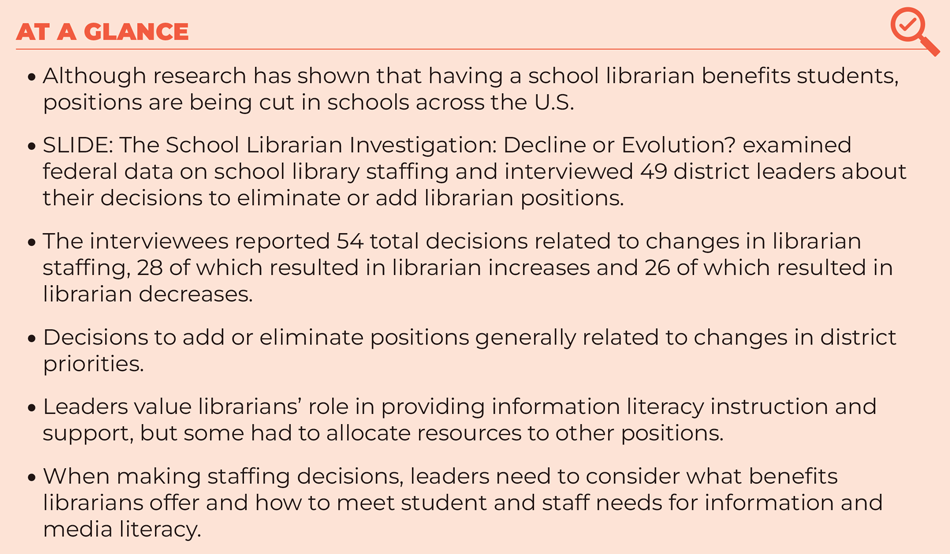
The 49 interviewees reported 54 total decisions related to changes in librarian staffing, 28 of which resulted in librarian increases and 26 of which resulted in librarian decreases. Some interviewees reported both types of decisions. We asked interviewees what motivated their staffing decisions; who teaches information literacy, media literacy, and digital citizenship in their districts; and what positive or negative interactions they’d had with school librarians.
Factors contributing to librarian increases
The most frequent reasons for adding school librarians had to do with districtwide strategy shifts:
- Change in district priorities or goals.
- Need for librarian instruction in their areas of expertise.
- Need for more student access to librarians.
For some administrators, adding librarians became a priority because teachers needed librarians to assist and collaborate with them on design and delivery of instruction or to provide coverage for teachers’ planning time. For example, one leader said that with a full-time librarian on staff:
Teachers who want a co-teaching partner no longer have to worry about whether or not the librarian will be in their building on a particular day. Professional teacher librarians set a different tone than the paraprofessionals principals used to cover lunch duty or other assignments.
In some cases, adding librarians resulted from new funding, opening a new building, or increased student enrollment. In a few cases, administrators cited needing to meet a state staffing requirement.
Librarians were hired to develop curricula and teach students in their areas of expertise, such as digital citizenship or makerspaces. Some administrators reported that they valued librarians as instructional partners for their classroom teachers and acknowledged that the curricula librarians teach is critical to student success:
As a principal, you can choose to have a librarian or another teacher. A lot of schools in the district got rid of the librarians. Those principals were not thinking about what the library of the future can provide students. We redesigned the whole approach and call it a future-ready library, a huge makerspace combining everything together.
Factors contributing to school librarian losses
The most frequent reasons for reducing or eliminating school librarians were:
- Budget constraints.
- Change in district priorities or goals.
- Need for more classroom teachers or other specialists.
- Moving a librarian into a classroom position.
- Declining enrollment or closure of a building.
Interviewees often indicated that they had to reduce librarian staffing to have a teacher in every classroom, to hire a technology teacher, or to have staff in key interventionist positions. One leader said:
I couldn’t cut interventionists, because data showed students, especially after the pandemic, weren’t learning virtually. I knew the interventionists would need to do as much catch-up work with those students as possible; so I had to cut librarian positions.
Sometimes, instead of cutting positions entirely, they kept their librarians but had them spend part of the day teaching classes, thus reducing the staff in the library during the day.
In some cases, administrators seeking a certified librarian were unable to find and recruit one. A Fall 2020 SLIDE survey of states found that 30 states had only one or two universities that prepared school librarians, and five states had none (Kachel & Lance, 2021, pp. 9-10). Many states require a school librarian to have a master’s degree, and some require several years of successful teaching experience. This makes it extremely difficult for some districts to find qualified candidates. Small districts located in remote areas, far away from universities preparing school librarians, face exceptional challenges. One leader told us:
If I were to add someone right now, I would need somebody really strong, someone with a vision of what the library could be. Our current librarian operates an old-fashioned library — the kind I had growing up in the ’70s and ’80s. We need somebody more up to date; a 21st-century librarian who has vision and leadership skills.
Some district decision-makers said they felt librarians were obsolete and no longer needed. For example, one said:
Demand for library spaces and librarian expertise has been declining. Circulation of library materials was falling, and librarians were spending less time teaching students and collaborating or supporting their classroom colleagues. That was not their fault: Teachers have become more comfortable working with online resources and databases. These usage trends led us to cut one librarian and have the other split her time between two schools.
A variety of competing priorities threatened the library position in some districts. Leaders mentioned the addition of full-day kindergarten, the need for STEM teachers, and standardized testing pressure as higher priorities. In some cases, it was as simple as needing teachers for core subjects:
Unfortunately, if I have to make a decision between library and math or language arts, those are tested areas. That’s why I had to cut a librarian position.
COVID and librarian staffing
During the COVID-19 pandemic, most schools pivoted from face-to-face to partially or totally online instruction, and librarians took on new roles. Whether librarians were maintained or cut depended on how administrators envisioned their role during this crisis.
Some librarians were able to prove their technology and information resources skill sets, and their leaders made it a priority to keep them:
Library media specialists were critical in helping the district pivot from in-person to fully remote and then hybrid because they worked continually with students, teachers, and parents. They also provided basic technical support to ensure that students were able to use technology for learning.
However, fallout from the pandemic meant some districts had to sacrifice a librarian to provide other supports for struggling students:
During COVID, we had to save some money and, with kids not in school, we didn’t need a librarian. Mental health support was vital. We had to make the new counseling position full-time. It’s difficult to hire a half-time counselor. People want a full-time job, so they can receive benefits.
Information literacy and librarians
Most interviewees recognized the need for instruction in information literacy, educational technology, use of the library, and digital citizenship. In fact, several states, including California, Delaware, New Jersey, and Texas, have passed legislation requiring instruction in information and media literacy (Merod, 2023).
We asked leaders who they saw as the person responsible for providing this instruction. Most interviewees identified multiple instructor types, most often including librarians, all teachers, and educational technology staff. Although leaders saw teachers as playing a role in teaching these topics, they recognized that librarians are especially helpful for guiding students in these areas:
Our teachers have classroom libraries, but that’s nothing compared to having a librarian in a library — with so many more options — helping students understand how to verify and analyze sources. Some of that happens in our English classrooms; but this loss definitely has had a negative impact on our district and its students.
Almost all of those who increased librarian staffing identified them as teachers of these information literacy skills. More than half also identified all teachers and educational technology staff as teachers of those topics. Those who decreased librarian staffing were more likely than those who increased staffing to identify all teachers and educational technology staff as instructors of these topics, although, intriguingly they still mentioned librarians most frequently (Lance, et al., 2023, p. 34).
Previous experiences with librarians
In addition to all of these factors, decision-makers’ previous experiences working with librarians as either administrators or teachers influenced their decisions about librarian staffing. Most of the reported experiences were positive ones, indicating that the school leader had witnessed exemplary librarians who demonstrated their potential impact.
Some of these experiences focused on librarians as instructors:
I just completed a unit observation with the library media specialist, watching our 2nd-grade students get excited about coding. Only 7 or 8 years old, they learned terms like algorithms! Whatever the topic, the library media specialist is elevating student learning, helping them learn concepts that are going to help them in math, science, and other classes. I think it’s a huge success.
Leaders had observed librarians serving students and educators with different needs, from starting research projects to finding complex biomedical data and even searching for a prom dress. Some had found librarians to be a valuable resource in their own work, as was the case for one leader who was fielding parent complaints about a book:
There was a book on one of our reading lists that some parents thought [was] controversial. Our librarian was integral to the conversations about how you choose a book with your child, and why these books are published. Kids need to see themselves in different types of literature. Her expertise needed to be there. Your library becomes a living place instead of a book repository because of that person.
Interestingly, of the few negative experiences reported, most did not have to do with the librarians themselves but with difficulties getting teachers and administrators to make use of what the librarians had to offer:
Administrators have to learn about libraries and librarians on the job, whether formally or informally. They don’t get any training in academic classes on the impact of libraries and librarians on learning. That’s something that needs to start happening at the university level.
Weighing priorities in school staffing
It is impossible to generalize from 49 self-selected district leaders why decision-makers choose to cut, retain, or add librarian positions. However, we did see some common threads in our interviews that may warrant further study and discussion, especially in light of federal data regarding staffing trends.
Although the leaders we interviewed often identified budget constraints as a driving factor in the decision to cut librarian positions, NCES data show that schools have maintained and added other staff positions, sometimes at the expense of school librarians (Lance & Kachel, 2021, pp. 5-7). When we analyzed NCES data, we found that while school librarian positions decreased from 2010-11 through 2017-18, school administrator positions increased and instructional coordinators dramatically increased. We also discovered between 2015-16 and 2018-19, districts most likely to have consistently employed librarians were those spending the most — and the least — per pupil (Lance & Kachel, 2021, p. 59). This suggests factors beyond school finances affected which staff positions were or were not funded.
The most frequent reasons for adding school librarians had to do with districtwide strategy shifts.
Put simply, not all districts with low per-pupil funding cut librarian positions. And not all districts that cut librarian positions were making across-the-board staffing cuts — some were increasing staffing in other areas. So the question is why do some leaders prioritize librarians when making decisions about which positions to fund, and why do some leaders prioritize other positions? In other interviews, both the leaders who added librarians and those who cut them said that a change in priorities, often accompanying a change in administration, determined school librarian staffing.
When we asked if previous experiences with school librarians impacted their decisions, both groups of decision-makers shared similar kinds of positive interactions with librarians. However, leaders who worked with librarians as administrators, particularly in a supervisory capacity, were more likely to support having librarians. Thus, the values and priorities of district decision-makers, including previous work experiences of administrators with librarians, impacted the direction of librarian staffing in their districts.
Considerations for information literacy staffing
Administrators face difficult staffing choices to ensure that all students have access to learning resources that enable them to master critical lifelong skills in multiple literacies. Budget constraints, district strategies, students’ needs, staffing priorities, the availability of trained professionals, and sometimes government mandates emerged as reasons for their decisions in our interviews of 49 district administrators.
Even though there is an abundance of research supporting the value of a certified school librarian in improving students’ academic achievement in reading, writing, critical thinking, and even graduation rates (Lance & Kachel, 2018), full-time certified school librarians are not always possible in every school. Decision-makers must weigh the overall benefits of employing trained librarians versus having other educators handle responsibilities that typically fall to librarians. They need to consider:
- What curriculum districts and schools need to ensure that they have a clear K-12 sequence of competencies in library, information, media, and technology.
- How to track that all students have access to library and technology resources.
- How to assess students’ mastery of identified skills in information literacy.
- Which educators are the best-qualified and available to deliver the curriculum.
- Whether full-time or part-time librarians can satisfy instructional needs and provide sufficient learning resources and technology for all students and teachers.
- Whether they should assign librarians differently among district schools to meet the needs of more marginalized learners.
- What special expertise librarians might offer in terms of selecting print, non-print, and online resources, particularly when controversies arise.
K-12 students today need to become competent in evaluating information that bombards them daily. The 49 district administrators we interviewed shed light on the realities of staffing school library instructional programs. Many school leaders shared their own experiences of working with and having to make decisions about school librarians. Making staffing decisions isn’t easy, but it’s essential that leaders carefully consider how they can ensure students build information and media literacy and the role of school librarians in addressing that priority.
Note: Visit https://libslide.org for more information on SLIDE: The School Librarian Investigation: Decline or Evolution?
References
Kachel, D.E., & Lance, K.C. (2021, January 26). Contexts for school librarian employment. SLIDE: The School Librarian Investigation—Decline or Evolution?
Lance, K.C. & Kachel, D.E. (2018). Why school librarians matter: What years of research tell us. Phi Delta Kappan, 99 (7), 15-20.
Lance, K.C. & Kachel, D.E. (2021). Perspectives on school librarian employment in the United States, 2009-10 to 2018-19. SLIDE: The School Librarian Investigation—Decline or Evolution?
Lance, K.C., Kachel, D.E., Breevoort, L., Gerrity, C., & Ellis, D. (2023, August). Voices of decision-makers: How district & school leaders decide about school librarian employment. SLIDE: The School Librarian Investigation—Decline or Evolution?
Merod, A. (2023, November 15). California joins small, growing number of states requiring K-12 media literacy. K-12 Dive.
National Center for Education Statistics. (n.d.). Elementary/secondary information system [Data set]. U.S. Department of Education.
This article appears in the November 2024 issue of Kappan, Vol. 106, No. 3, p. 42-46.

ABOUT THE AUTHORS

Keith Curry Lance
Keith Curry Lance is a research consultant to the School of Information at San José State University, San José, CA, and the principal investigator for SLIDE: The School Librarian Investigation: Decline or Evolution?
Debra Kachel
Debra Kachel is affiliate faculty for the School of Education, School Library Endorsement program, Antioch University, Seattle, WA. She was the project director for SLIDE: The School Librarian Investigation: Decline or Evolution? and is a core team leader of the Philadelphia Alliance to Restore School Librarians (PARSL) and a member of the Pennsylvania School Librarians Association’s Advocacy Committee.
Caitlin Gerrity
Caitlin Gerrity (caitlingerrity@suu.edu) is an associate professor of library science at Southern Utah University, Cedar City.