
Schools can intentionally build cultures that emphasize kindness and calm.
“We see the world, not as it is, but as we are — or as we are conditioned to see it.” — Steven Covey
What kind of world do you see? Are people driven by fear? Is the world a dangerous place? Or are people driven by kindness? Is the world safe?
And, how about students? What kind of world do they see? What kind of world are we teaching them to see?
Young people are bombarded with gloom and doom media images and messaging. Information has never been more accessible — or more toxic. Stress and associated health challenges are no strangers to children, adolescents, or the teachers and caretakers charged with shepherding them from childhood to adulthood.
What if schools could create a different narrative? What if school cultures embraced gratitude and abundance instead of competition and scarcity? What if students were accepted and embraced for who they are and where they are developmentally instead of forcing them to become what a standardized measurement thinks they should be?
Fortunately, such schools already exist. These are schools where teachers are intentionally working to create safe, empathetic learning environments.
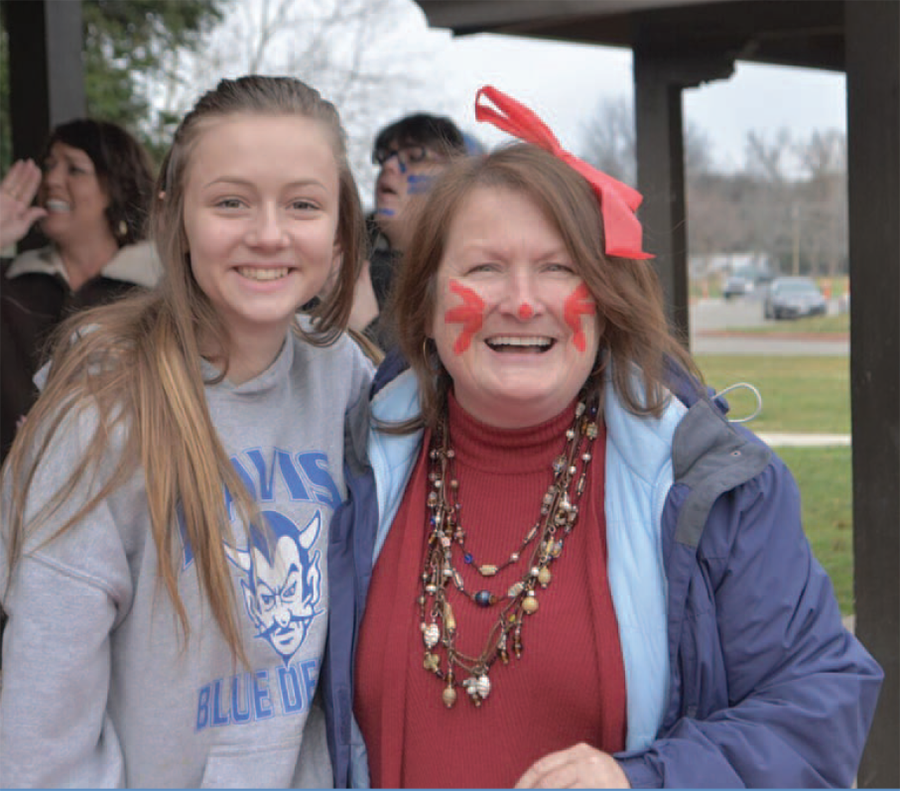
Natalie and teacher Laura Bowie celebrating during a teambuilding event at Chrysalis Charter School.(Photo courtesy the author.)
Chrysalis Charter School: A culture of kindness
Palo Cedro, Calif.
Just reading the mission of Chrysalis Charter Schools lets you know that it’s a bit different from other public schools: “Chrysalis Charter School is a community of kindness, respect, and love of learning which encourages the light within each student to shine brighter.”
Even the accreditation report issued by the Western Association of Schools and Colleges recognizes the unique culture of this school: “[T] he culture is one of the school’s strongest points helping the school . . . Parents know their children are immersed in something very rare and deeply nurturing to the spirits of their beloved ones.”
For the past two decades, teachers at Chrysalis, a K-8 teacher-powered charter school in northern California, have been deliberate about developing a community of kindness. Third-grade teacher Crystal Padilla said teachers are at the core of creating this culture through the language they use and the behaviors they model. Their actions are constant reminders to students about their own language and decisions.
Over the past 20 years, Chrysalis, a charter school in northern California, has created a culture of kindness by consciously working on it.
In most schools, teachers act on their own, taking sole responsibility for the environment they create in their classrooms. Since its inception, however, the priority at Chrysalis has been to maintain shared norms of kindness and respect among all teachers, students, and parents. The teachers designed it that way from the beginning of the school, making “buy-in” unnecessary.
To perpetuate the school’s unique culture of kindness, staff pay extra attention to the teachers they hire. Teacher candidates spend a day at the school and teach a 45-minute lesson. Several staff look at the quality of the lesson, but they also observe the ability of the teacher to emotionally connect with students by watching body language, listening for tone of voice, and watching how they correct students. Staff want to know if the teacher has the emotional skill to act kindly, compassionately, and with a genuine affect even in the face of stress. The school employs about 11 full-time teachers plus three part-time teachers.
While the staff role is important in shaping the school’s culture, everyone in the community shares responsibility for maintaining the culture at Chrysalis. Students, parents, and teachers are expected to speak up if their feelings get hurt, if they are bullied or teased, or if someone is unkind or rude to them or to others. For example:
- Parents are encouraged to give feedback directly to teachers as soon as they sense that their child is having a problem.
- Students are encouraged to speak to their teacher, the counselor, or administrator if they are having difficulties with anyone in the community.
- Teachers have partner mentors regardless of how long they have been teaching, and they regularly give each other feedback on classroom culture.
- Administration is constantly moving in and out of classrooms, as are teammates. Teachers and students get quick feedback, both positive and negative, by peer mentors and other community members.
- The school community does a weekly assembly that include kindness/unkindness role plays.
- The school community also does a twice-a-year survey where all 200 students rate their teachers on the 7Cs — caring, controlling, clarifying, challenging, captivating, conferring, and consolidating. (See tripoded.com).
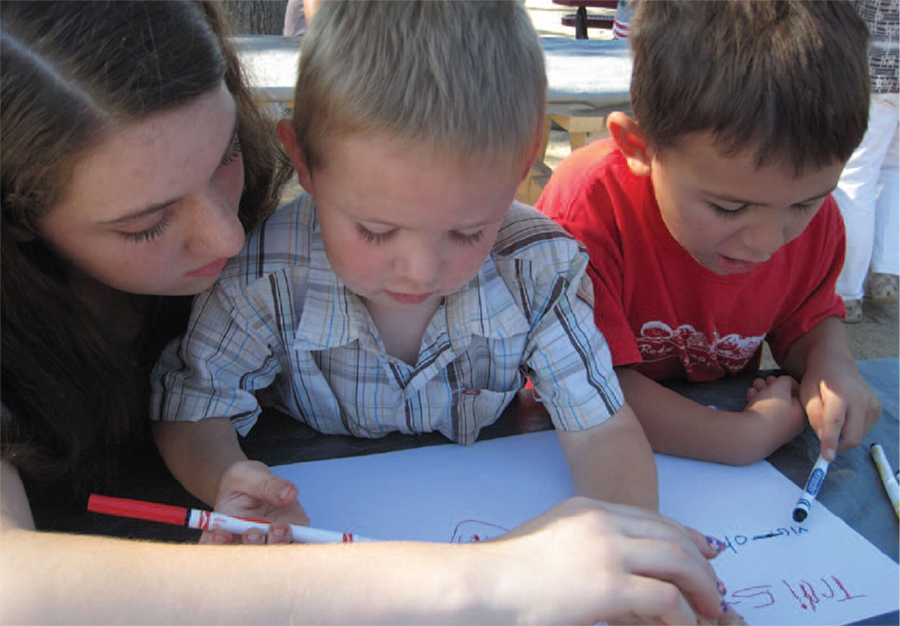
Eighth-grader Paige works with her kindergarten buddies, Tristan and Victor, on their letters. (Photo courtesy the author.)
Developing a culture of kindness is not easy when confronting a popular culture that celebrates quite different values. On television, insults and put-downs get laughs; when comedians or public figures mock people who are different from them, they get applause; and when musicians boast about greed and violence, they get rich. So how can teachers push back against a constant flood of unkind, often brutal, behavior? What does it take to create a culture of kindness where everyone can grow and prosper emotionally, and where it becomes the norm to tend to those who are hurting, to confront teasing and bullying, and to accept those who are different? At Chrysalis, teachers pursue five main strategies:
#1. They celebrate differences.
Students are encouraged to dress and express themselves as the unique individuals that they are. If challenging behavior needs to be addressed, teachers do so with kindness and see this as an opportunity to learn. For example, a student was preparing to give a presentation on a favorite character in a book and decided to wear a homemade costume. Students laughed and pointed at him as he entered the classroom. The teacher immediately named the behavior in an even voice, “Ladies, that was unkind.” She moved to stand behind the boy, reassuring him with her touch. She then asked the girls to look at the boy’s face and asked gently, “Look at his face. Did that laughter make his light shine?” The girls had to admit that it did not. They immediately apologized, no longer smiling. Shielding the boy from the class view, the teacher quietly asked if he would be willing to share how that whole incident made him feel using “I” statements. He was willing and told the now-quiet class how it felt when he walked in the door. The teacher asked him if he felt he could give his presentation now or if he needed to do it later. He did it later in the day. The girls had been reprimanded with kindness and had to feel from the boy what their unkindness had created. They learned a lesson, and the boy was supported.
If challenging behavior needs to be addressed, teachers do so with kindness and see this as an opportunity to learn.
#2. They watch their language.
Teachers are extremely mindful of the tone that they use with students, parents, and each other, and they emphasize the positive, rather than threatening students with bad grades or punishment. Put-downs are not tolerated, and bullying is taken just as seriously as physical violence and other major infractions.
#3. They teach for understanding.
Rather than asking students to memorize facts, teachers plan a course of study that emphasizes depth over breadth, giving students opportunities for the sorts of aha moments that bring joy to the mind. Students receive oral and written feedback on how they are progressing, rather than grades. The school issues written progress reports twice per year in a parent conference along with student work samples and assessment data. However, students are still assessed in traditional ways in math and reading as part of the state’s accountability expectations.
#4. They build community.
Schoolwide assemblies are frequent, as are cross-age activities, such as talking circles that pair older students with younger ones. Students are encouraged to speak up about unkind behavior so that it can be addressed immediately, and, when conflicts arise, they are asked to work together to devise positive solutions.
#5. They hold parents to the same standards.
Parents receive and sign the Parent Code of Ethics, which defines clear expectations for parents to be kind and use the same sorts of thoughtful, appropriate language as their children, whether they face a problem with a teacher, another parent, or a student other than their own child. If a parent does not live up to these agreements, they have a conference on the issue with the involved parties and the administrator. A child is never removed from the school due to parent misbehavior, but a parent can be required to appear before the executive board or required to limit their contact with students or teachers. It rarely goes that far.
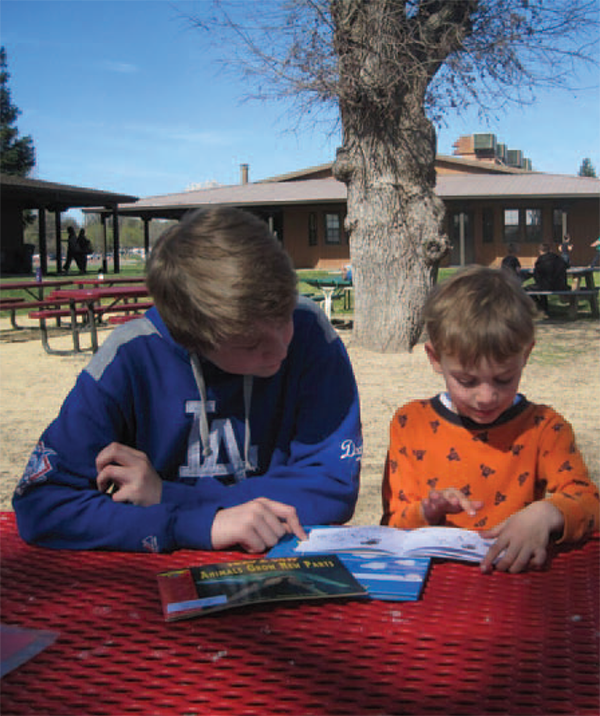
Travis helps his kindergarten buddy, Caden, work on his reading every week. (Photo courtesy the author.)
Over the past 20 years, Chrysalis has created a culture of kindness by consciously working on it. The kind culture is the primary reason parents enroll their students after they visit the school and have their child spend a day. One of the most common things heard from visiting students and their families is, “The kids here are so nice, they welcomed me right in.” “The playground feels fun, and there are many people laughing.” Individual kids may be unkind to each other within the community, but the staff is vigilant about noticing and proactively addressing issues as they arise so that the whole school culture can return to equilibrium.
For example, recently the school community was upset by graffiti in the boys bathroom saying “Irene sucks” (referring to the school administrator). Many children saw the marks and reported them to teachers. A few older boys volunteered to scrub the walls to remove the marks. The next day, the 4th to 8th graders assembled to talk about the problem. Most students said that the graffiti made them feel sad. They were especially upset that someone had attacked an adult who was respected by students. One student said, “Whoever you are, I am sorry you were so angry you had to do that.” Several students hugged Irene. After telling students that police would be called to investigate if graffiti appeared again at the school, Irene suggested students heal their bad feelings by making the bathrooms beautiful. She invited students to select posters that could be put up in the bathroom. Students eagerly worked alongside teachers to put up the posters. And, in days following the incident, students and staff ensured that the boy who was suspected of doing the deed got some extra hugs and support. The graffiti has not reappeared.
Learn more about Chrysalis Charter School at www.chrysalischarterschool.com
Minnesota New Country School
Jon Kabat-Zinn, who introduced mindfulness-based stress reduction in the 1970s, describes the practice as the act of “paying attention in a particular way, on purpose, in the present moment, and nonjudgmentally.” While secular, the approach incorporates various techniques that have long been used in yoga and Buddhist meditation, such as relaxed breathing and sitting silently for short periods of time. According to personal testimonials and medical research, people who make a regular habit of pausing to meditate and relax in such ways tend to experience physical and emotional health benefits, including decreases in stress, anxiety, and depression.
The Minnesota New Country School has embraced mindfulness practices to support students’ social-emotional needs, reduce staff stress, and create a healthier approach to learning.
The K-12 charter school’s interest in mindfulness grew out of a teacher’s diagnosis of high-blood pressure and his subsequent decision to enroll in a mindfulness course. Pleased with the results, he asked the school to fund a similar course for staff members. Eventually, 10 teachers took a mindfulness course through the Mayo Clinic, and others learned mindfulness techniques through online study.
As the initial group of teachers developed their own understanding and practices around mindfulness, interest spread throughout the school, which is southwest of Minneapolis. Teachers began introducing practices to their classes and sharing lessons and resources with colleagues.
Now, mindfulness practices have become a regular part of the culture at the 200-student New Country School. Depending on the grade, elementary students practice mindfulness once or twice a week; high school students have optional mindfulness practice twice a week. Students also work with an outside facilitator two times each month.
“Mindfulness helps me get into my work. Sometimes I use it to refocus when I feel myself getting distracted. I use my breath or even closing my eyes. I notice that I approach situations differently. Before when I was fighting with my brother, we would say negative things to each other. Now, I can feel myself getting upset and remove myself from the situation,” said one student.
Another student who is dyslexic has found that the mindfulness practices helps her focus. “I used to get really irritated when I would mix up a letter. Now, I am just confusing b’s and d’s. I use my breath to refocus when I need to. It helps me at school because I am able to clear my mind and just focus on the task we are working on (math, writing, reading, etc.) where before I would let thoughts interrupt my work.”
Still another student said mindfulness “helps me relax and get rid of anxiety. It also helps me focus and not to dwell on negative thoughts. At night, to wind down, I use deep breaths. I also like to take time to be silent and still, both inside and outside, to clear my mind.”
Students aren’t the only ones who benefit from mindfulness practices. Teacher Aaron Grimm said mindfulness training has been crucial in helping him model positive ways for students to take care of their emotions. “My mood and reaction with students has taken a 180-degree turn (since introducing mindfulness practices). I don’t react as quickly as I used to. I respond instead. It is something that I needed.”
New Country School teachers also see mindfulness as an antidote to the constant emphasis on competition. Competition forces people to be judged as winners and losers, which forces them to dwell on past mistakes and worry about future performance. By contrast, New Country School believes mindfulness encourages students to focus on what’s happening now, in their thinking and behavior. By appreciating the present moment, adherents of mindfulness believe students are better able to concentrate on what they are learning right now.
“We deal with students as human first rather than testable widgets first (as much of traditional schooling does),” Grimm said. “Students have to be mentally and physically healthy if you want them to achieve. We want to see them develop into whole human beings who are happy and mindful.”
A parent of a New Country School student said the school avoids making students “into pegs to fit a predesigned hole . . . . [That’s] revolutionary in an age of narrowly defined standards and cold, simplistic curriculum.”
The regular practice of mindfulness has had a positive effect on the culture of the school, with the number of disciplinary incidents falling and teachers in grades 4 to 6 reporting that classes are less chaotic.
Learn more about Minnesota New Country School at https://newcountryschool.com/
Taking action
Schools that want to build cultures of kindness and calm begin by understanding the connection between social-emotional and academic learning and clearly communicate those connections to everyone in their learning community. Such schools deliberately create cultures that help students and staff develop skills that will help them cope with stress and challenging situations. These schools create safe spaces where students can learn to be kind, stay in the moment without judgment, and advocate for themselves.
How might you get started on creating a similar sort of environment in your school?
LEARN
Create opportunities for members of your school community to learn about different ways to create emotionally safe learning environments and why it is important. Some useful resources include: Mindful Schools (www.mindfulschools.org), Conscious Discipline (www.consciousdiscipline.com), and Love and Logic (www.loveandlogic.com/educators)
ELEVATE
Provide space and autonomy for teachers and other members of the school community who are passionate about this topic to be able to lead the work. People will own what they help create. For instance, schools could create a working group and engage in self-directed learning to investigate approaches to improving social-emotional learning in the school. Provide time during the school day for the team to meet and learn together and then perhaps lead colleagues in learning.
DESIGN
A team of teachers can develop a plan to address the specific needs of students and adults in the school and then plan to do a test case or pilot before implementing schoolwide. For example, a team of teachers who are committed to mindfulness practices could implement these practices in their classrooms, collect data, and share results with the broader school community before encouraging schoolwide adoption. Starting small also enables teachers to experience problems with implementation and develop responses to those.
Learning and teaching our young people to be kind and mindful is an essential part of preparing students to be successful in the 21st century. Fortunately, many schools, such as Chrysalis and Minnesota New Country School, have taken on this work already and have lessons to share.
Originally published in March 2017 Phi Delta Kappan 98 (6), 25-30. © 2017 Phi Delta Kappa International. All rights reserved.
ABOUT THE AUTHORS

Lori Nazareno
LORI NAZARENO is a National Board Certified Teacher who leads work on school redesign at the Center for Teaching Quality, Carrboro, N.C. She lives and works in Denver, Colo.
Alysia Krafel
ALYSIA KRAFEL is founder of Chrysalis Charter School, Palo Cedro, Calif., and a teacher-powered schools ambassador for CTQ.