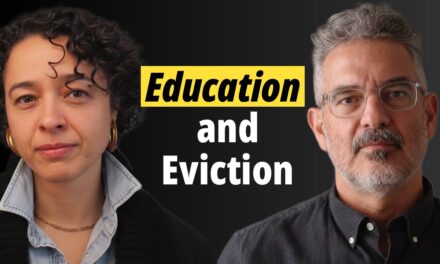
Schools often play the good guy in stories about juvenile justice, but as Nashville Public Radio’s Meribah Knight explains, their role can be much more complex than that.
By Alexander Russo
Titled Black Children Were Jailed for a Crime That Doesn’t Exist. Almost Nothing Happened to the Adults in Charge, Meribah Knight’s recent blockbuster tells the story of how students have been locked up for made-up crimes – sometimes with the complicity of school administrators.
A collaboration with ProPublica’s Ken Armstrong, it opens with a school principal in an excruciatingly difficult position: “Three police officers were crowded into the assistant principal’s office at Hobgood Elementary School, and Tammy Garrett, the school’s principal, had no idea what to do. One officer, wearing a tactical vest, was telling her: Go get the kids. A second officer was telling her: Don’t go get the kids. The third officer wasn’t saying anything.”
In the following Q and A, Knight advises that other reporters and editors who might be interested in exploring what’s going on in their coverage areas look for lawsuits and talk to lawyers, as well as find out if there’s any data on juvenile justice cases that’s tracked by the courts. She also explains the complicated role educators play in some juvenile justice proceedings.
“There were so many failures along the way,” she told me. “So many people who turned their heads, or when they didn’t and tried to speak up, they were silenced.”
This interview has been edited for clarity and length.

Above: Knight and Armstrong’s blockbuster piece, Black Children Jailed for a Crime That Doesn’t Exist.
Why did you decide to open the story with the scene of officers pressuring Principal Garrett to deliver her students to them?
MK: We decided to open the story in this chaotic moment because it was so compelling. So fast paced, and so riveting, we figured it wouldn’t lose any readers. Plus, it puts the children right at the center, which they absolutely should be. We chose to use Garrett as the main perspective because she was the one adult who touched almost every moment of this incident — from gathering the children to watching them get taken away in handcuffs. Also, she was the one who was most concerned about the children, she was their principal.
What’s been the biggest response/reaction to your piece — and how does it compare to previous stories you’ve done?
MK: The response has been overwhelming. In a good way. Emails have flooded our inboxes. This is by far the biggest reach I’ve ever had with a story. But what is most striking to me is that we’ve gotten NOT ONE negative email. No one criticized the work or told us we had it wrong. It’s been all support and outrage over the story. Which is striking to me in this day and age. I found it fascinating and hopeful that readers were united on this story, and no one felt we were unfair or slanted.
“What is most striking to me is that we’ve gotten NOT ONE negative email. No one criticized the work or told us we had it wrong.”
How did you get onto the story in the first place, and what made you decide to make it into a big project?
MK: I’ve covered this story in drips and drabs since 2017. But it started to coalesce when I began talking more with the lawyers, as they were slogging through contentious settlement negotiations with the county. These lawyers were behind a lot of the lawsuits and the big class action suit over arrest and detention practices. As I talked more with them and sifted through the hundreds of court filings, I began to see a clear narrative and accountability story in one. That is a rare and wonderful thing to find. There was a single incident that led to tons of lawsuits, that led to lawyers digging in, figuring out the systemic failures. It had all the ingredients for a good story!
What aspect of your reporting was most striking or surprising to you, given all your previous reporting?
MK: I couldn’t believe how many systemic failures there were along the way. And the audacity of so many of the adults in charge — who didn’t consult state law before crafting policies. We focus on the judge at the top of the system, but when you read carefully, you see there were so many failures along the way — at every level of the system. So many people who turned their heads, or when they didn’t and tried to speak up, they were silenced.
“There were so many failures along the way — at every level of the system. So many people who turned their heads, or when they didn’t and tried to speak up, they were silenced.”
In what ways were schools – educators, administrators, board members – part of the systemic failure you uncovered?
MK: Crystal Templeton, a school resource officer from another school, was the main instigator of the arrests. Meanwhile, the SRO assigned to that school didn’t want them to happen, but he never made his position clear at the time. The schools’ principal tried her hardest to push back against the arrests, but she was worried she too would be arrested. Another district administrator was also there the entire time and never meaningfully stepped in to stop it but felt this shouldn’t be happening at school. And the director of schools felt she had no recourse to stop the arrests, so she had asked that it happen before school was let out. Most school officials were not on board with this course of action, but they all felt powerless to stop it.
What do education journalists need to know about educators’ roles and responsibilities when it comes to law enforcement (i.e., referrals, charges, access to students)?
MK: I think it really comes down to relationships and communication and everyone — school admin, officers — rowing in the same direction for the children. In this story you have a few SROs that care so deeply and do not want this arrest to happen. These officers have good relationships with school administration and that shows. However, they didn’t speak up or were not listened to for one reason or another. And when they don’t have good relationships, when there is a breakdown in communication, as was the case with Crystal Templeton, the ramifications can be immense. We also asked Templeton for an interview, but she declined as well.
I think it’s important to lean into the complexity of perspectives in law enforcement and school administration. In this story, the principal doesn’t want the arrests to happen. Some officers don’t want this to happen. But for reasons I mention above and that we outline in the story they are unsuccessful in stopping it. People are complex and one of the most interesting parts of this story is just how divided law enforcement is on whether these arrests at the school should happen.
I wish the principal had more of a voice. I wish she wasn’t scared and didn’t feel as though she might get arrested herself. What a sign of a broken system that isn’t working together!
“I wish the principal had more of a voice. I wish she wasn’t scared and didn’t feel as though she might get arrested herself.”

|
ABOUT THE AUTHOR

Alexander Russo
Alexander Russo is founder and editor of The Grade, an award-winning effort to help improve media coverage of education issues. He’s also a Spencer Education Journalism Fellowship winner and a book author. You can reach him at @alexanderrusso.
Visit their website at: https://the-grade.org/