In this week’s newsletter: School districts prepare for mass deportations that may or may not happen. Firestorms in LA result in destroyed buildings and disrupted learning. Algebra for all falls flat in Minnesota. Elon Musk weighs in on teacher certification. And: school reform standup comedy? Yes, please.
MASS COVERAGE OF AN
IMPROBABLE EVENT
The big education story of the week
The big education story of the week is the massive media coverage of school systems’ preparations for a mass immigration sweep by the incoming Trump administration. Many consider that improbable.
The president-elect has promised to deport record numbers of immigrants and give federal authorities wide latitude to arrest people — and communities are bracing for disruption, including ICE agents showing up at schools (New York Times, AP, The 74, Minnesota Public Radio).
However, Trump made good on fewer than half of his first-term campaign promises, and there’s little specific information that’s been reported on preparations for mass deportations. It’s a speculative narrative driven largely by advocates, lawmakers and school district leaders in blue states such as California, Oregon and Colorado (LA Times, CalMatters, Oregon Public Broadcasting, Boulder Weekly).
Many outlets are simply telegraphing the fear that students, families and educators face amid the uncertainty of Trump’s ascension (LA Times, NY Carib News). More helpfully, a few outlets are guiding readers and listeners to resources and providing context (Berkeleyside, KQED). In a new interview, ProPublica alumnus Dick Tofel tells THE GRADE that journalists should try to avoid exaggerating “performative” deportations into mass deportations.
Other big education stories of the week include Los Angeles wildfires, disruptive snowstorms in the nation’s capital, and Elon Musk’s thoughts on teacher certification standards. Check out @thegrade_ for each day’s most important education news.

DEBUNKING THE
ALGEBRA ‘CURE-ALL’
The best education journalism of the week
The best education journalism of the week is the Hechinger Report’s One state tried algebra for all eighth graders. It hasn’t gone well, which holds a magnifying glass to a popular but floundering approach to improving kids’ math skills.
In it, New York-based freelancer Stephen Yoder travels to a tiny town an hour north of Minneapolis to check in on a 19-year-old effort to require all Minnesota eighth graders to take Algebra I. In 2006, the law was widely seen as creating a universal path to calculus, a gateway course for selective colleges and well-paying STEM jobs.
Minnesota’s law was just one of many that have sprung up nationally in an effort to help U.S. competitiveness. But Yoder crunches the numbers and finds that things haven’t worked out as planned. The state actually dropped from sixth to 10th place nationally. And its eighth-grade NAEP scores fell from second place to eighth.
As incisive and revealing as Yoder’s data are, the story really shines when he sits in on classrooms and talks to students. Many tell him they just weren’t ready in eighth grade to tackle Algebra I’s abstract concepts. “I was just really immature and didn’t pay attention,” one junior says. And he visits classrooms, watching as students lose focus, play computer games and tune out, much to their teachers’ frustration.
It’s a laser-strike of a story that punches a very large hole in a sacred cow.
Other stories we liked this week include a faltering post-pandemic push to re-engage forgotten teens and young adults (Chalkbeat), stark disparities in special ed integration (NPR), and a non-journalist digging into charter school applications in search of the truth about “teacherless” AI schools (Mathworlds).

SILENCE & SECRECY
IN K-12 SCHOOLS
Our latest columns and commentary
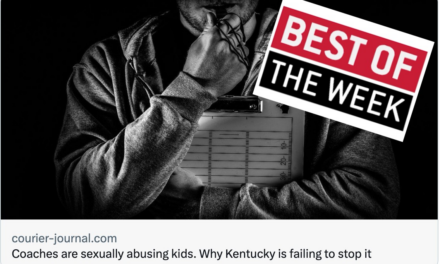
To start off the new year, THE GRADE is launching a new series on covering sexual abuse in schools. First off is an interview with the Louisville Courier Journal’s Stephanie Kuzydym, who uncovered more than 80 coaches who have been accused of sexual assault — usually shielded by confidentiality agreements (and paid for by district insurance policies).
A former sports reporter, Kuzydym found a surge in trusted sources who didn’t want to talk, school districts that denied that they had a sexual abuse problem — and a trail of confidentiality agreements and school liability insurance policies that suggested otherwise. She also came to understand her parents’ protectiveness when she was a teenage athlete. “Every Sunday after church, I would have tennis lessons,” she recalls. “And every Sunday while I had my tennis lessons, my dad would sit there and watch.”
Confidentiality agreements are much more common than NDAs, according to a recent EdWeek survey. The year’s just started and we’re already starting to see our first stories about school sexual predators. In Part 2, coming next week, one of the nation’s most prominent school sexual abuse experts describes educators’ reluctance to report possible grooming or abuse that they see.

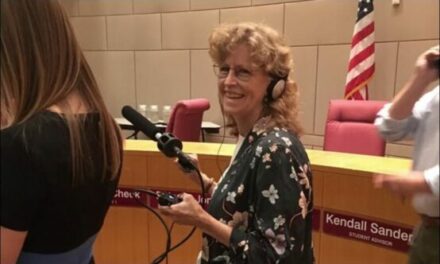
Above: Some of the Hechinger Report’s editorial and operations staffers.
PEOPLE, JOBS, & EVENTS
Who’s going where and what’s happening
📰 Events & segments: Politico education editor Delece Smith-Barrow will interview NPR’s Ayesha Rascoe about her book on HBCUs in DC on January 21. WBUR ran a segment on Black parents who help each other win special ed services for their children.
📰 New reports and research: A new study revealed that only a very small number of teenagers have received gender-affirming care (NPR, Axios). A new survey showed that most US parents support kids joining sports teams based on biological sex (Baltimore Sun). There are 4.2 million young adults who are not in school or in the workforce (Chalkbeat). There are an estimated 733,000 unauthorized school-age children in the US (Migrant Policy Institute via AP).
📰 Books: Former NYT education reporter Jenny Anderson is out with a new book on disengaged teens, co-written with Brookings’ Rebecca Winthrop. Check out their NYT oped. And see Anderson’s “major pinch-me moment” as Oprah’s Book Club says everyone with a teen in their life should read their book.
📰 Job changes and kudos: The Atlanta Journal Constitution’s Maureen Downey penned her last words on education. Kudos to Detroit News’ Jennifer Chambers and her colleagues for their dogged coverage of the investigation of the Oxford school shooting response.
Quotable:
🔊 “The risk of being gunned down in public or in school is overstated,” says gun violence expert James Alan Fox in a recent Boston Globe op-ed. “As a result, we’re getting bad policies that make us less safe.”
🔊 “I think you’re missing the point,” the SF Chronicle’s Jill Tucker told me in a recent Twitter exchange about ProPublica’s coverage of private school choice. “The coverage of public schools is a near constant, because taxpayer dollars are being spent and therefore there are laws requiring access to information.
THE KICKER
We saved the best for last.

“Dying is easy. Math is hard.” — Ronnie Chieng (Netflix)
That’s all, folks. Thanks for reading!
Reply to this email to send us questions, comments or tips. Know someone else who should be reading Best of the Week? Send them this link to sign up.
Using Feedly or FlipBoard or any other kind of news reader? You can subscribe to The Grade’s “feed” by plugging in this web address: http://www.kappanonline.org/category/the-grade/feed/.
Read more about The Grade here. You can read all the back issues of The Grade’s newsletter, Best of the Week, here.
By Alexander Russo