|
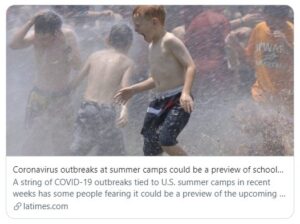
Above: The speculative, fear-amplifying headlines just keep coming. This one is from a recent Associated Press story that later on notes that summer camps are likely to be much more risky than school. Thanks to Anthony LaMesa for flagging it.
📰 THE BIG SCARE CONTINUES: While too much media coverage continues to emphasize the risks, we keep being reminded here and there that in-person schooling has been relatively safe — sometimes even safer than the surrounding community — and that the risks of keeping kids out of school are substantial. Two recent pieces that get at the mismatch between perceived risks and relative benefits include NY Magazine’s The Kids Were Safe the Whole Time and the NYT’s When School Is Voluntary. “Among 900K in-school pupils learning in North Carolina last fall, researchers would have expected, based on local transmission rates, about 900 cases of COVID,” notes New York Magazine. “There were, it turned out, only 23.” Or, check out one NYC parent advocate’s lamentable experience participating in a news segment about school reopening, in which she concludes that NBC News “should be ashamed” for spreading misinformation. “The story that sells is one of fear and panic.”
📰 DEBATE OVER LOCAL MATTERS: There was a LOT of pushback against my recent call for more aggressive accountability reporting from education reporters. “What I love about the Local Matters newsletter is the dogged focus on making public agencies (and those who work for them) more accountable to the communities that they are supposed to serve,” I wrote. “I would love to see more of that aggressive accountability journalism on the education beat.” But that didn’t fly with folks like Bethany Barnes, the former Oregonian education reporter who helps run Local Matters (and still writes great pieces set in schools): “As one of the people who does this newsletter and every week reads news from across the country — I disagree! Education reporters are out there holding people accountable. Often.” Others who disagreed included Politico CA’s Mackenzie Mays, who described my critique as sexist (and generic), and the Detroit Free Press’s Lily Altavena, who tweeted that my view “disregards the work of dozens, maybe hundreds, of local education journalists who are already used to being ignored by national media critics.” One issue about which everyone seems to agree is that there aren’t enough education reporters to cover such a massive beat. But I’m not just concerned about local coverage, and I a handful of others believe that more resources won’t solve the problem.
📰 TOP-DOWN ARP COVERAGE FROM THE NYT: The latest NYT education story about how schools are going to spend their ARP money is heavily focused on the state and district perspective. And that’s too bad. Focusing on admins and other officials is the traditional approach reporters have been trained to take, but over the years it’s become clear that it tends to favor those in charge of the system rather than those whom the system is supposed to serve. It’s a coverage approach that I find increasingly frustrating. For more on this, check out Beth Hawkins’ observations about how powerful it can be to take a community-, kid-, or parent-focused approach. Or read my recent piece about putting parents (and other caregivers) front and center in education news. There’s still room for official quotes and coverage of plans, but it might be good to try starting with a focus on kids and caregivers’ preferences and experiences.
📰 THE MEDIA’S WEINGARTEN PROBLEM: The media’s woes covering AFT head Randi Weingarten in a journalistically respectable way continue again this week with a softball interview from Morning Edition’s Steve Inskeep. More folks seem to be noticing the pattern, including the NY Post columnist Karol Marcowicz, who calls out Politico and the Washington Post for helping Weingarten whitewash her role in keeping schools closed for so long. At the beginning of June, Rebecca Bodenheimer contributed a column to The Grade about the ongoing media failure to hold Weingarten accountable. So far, at least, Weingarten is undaunted, tweeting recently that “millions of Floridians are going to die” because of Republican Governor Ron DeSantis.
📰 REFLECTING ON NCLB — AND THE FRUSTRATIONS OF THE EDUCATION BEAT: Former education reporter Libby Nelson was on Vox’s The Weeds podcast not too long ago, talking about No Child Left Behind — and why she left the beat. “A question that kind of drove me away from the education beat is ‘What are schools for?’” Nelson observes at the very end of the segment, describing it as a “philosophical question that people aren’t spending a lot of time answering.” Listen to the whole segment — Nelson, Matthew Yglesias, and Dara Lind go back into the details of NCLB’s rise and fall, a story that still hasn’t been fully told. Then if you’re in the mood, go back and listen to or read my 2008 On The Media segment, in which I describe how NCLB media coverage veered from incredibly naive to excessively critical.
Did someone forward you this newsletter? You can sign up here. |