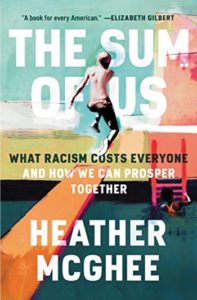
 The Sum of Us: What Racism Costs Everyone and How We Can Prosper Together by Heather McGhee (One World, 2021).
Is life a zero-sum game where I win only if you lose? The polite answer is no, but The Sum of Us details how the zero-sum mentality often drives public policy in America, where laws tend to suppress the potential of Black people while giving economic advantages to the white middle class. Unapologetically partisan in her outlook, Heather McGhee — a Democrat, lawyer, and expert in economic policy — draws on a wealth of data to show how racially biased public policies devastate communities of color but inevitably end up crushing the white citizenry, too. For example, the predatory mortgage loan scheme disproportionally targeted Black and Latinx citizens, but when this “canary in the coal mine” was ignored, it resulted in millions more white families losing their homes in the housing market crash of 2008. McGhee finds similar outcomes resulting from laws governing illegal drug use, crumbling public infrastructure, and the current student loan crisis; they initially hurt marginalized racial groups before overtaking the mainstream (i.e., white people).
This zero-sum mentality is also prevalent in education: In 2017, a prominent white education pundit tweeted that supporting Black education leaders was like “suicide” for white men like him. If the COVID-19 pandemic has taught us anything, we should know that we, regardless of our skin color, are all dependent on and interconnected to each other. This is no less true for the pandemic of racism: It oppresses the underclass first, but it won’t stop until it corrupts the soul of us all.
Marilyn Anderson Rhames’ latest in Kappan:
ABOUT THE AUTHOR

Marilyn Anderson Rhames
Marilyn Anderson Rhames is a Ph.D. student in education policy at the University of Arkansas, the executive director of the nonprofit KuriosEd, and the founder of the nonprofit Teachers Who Pray. She is the author of The Master Teacher: 12 Spiritual Lessons That Can Transform Schools and Revolutionize Public Education.