Many CTE programs enable students to obtain professional certifications, but do these certifications make a difference for students’ future success?
In 2022, I wrote a report on industry-recognized certifications (IRCs) for the Thomas B. Fordham Institute (Giani, 2022). After its release, I had the opportunity to speak with Matt Kirchner, host of The TechEd Podcast. Matt was the CEO of multiple manufacturing companies for nearly two decades before pivoting into the world of education. He founded LAB Midwest, a company that provides curriculum, e-learning, and hands-on training to prepare students for opportunities in a variety of career and technical education (CTE) fields.
For the majority of the interview, Matt ceded the microphone and allowed me to discuss the findings of my report and the implications for educators and policy makers. But when the topic turned to whether employers truly recognize the value of IRCs, he briefly mentioned how much he wished he had known about IRCs when his companies were hiring.
“You mean, you didn’t know which applicants had earned IRCs?” I asked.
“No, I didn’t even know they existed,” he replied (Kirchner, 2022).

IRCs explained
Enabling students to earn IRCs while in high school is an increasingly prominent strategy for ensuring that CTE programs develop knowledge and skills that are aligned to the workplace. Businesses (e.g., Microsoft); industry groups (e.g., the National Center for Construction Education and Research); or state certifying entities (e.g., the Texas Department of Licensing and Regulation) design and confer these credentials to individuals who demonstrate a sufficient level of knowledge and skills in a particular domain, often through one or more assessments. They are intended to prepare both students who plan to enter the workplace directly after high school and college-goers who want to build on their skills. For business and industry groups, the goal is to ensure potential employees have the prerequisite skills for a position.
IRCs are distinct from both the CTE coursework students complete in high school and any postsecondary certificates they might earn in community colleges, technical schools, and other institutions. The underlying logic is that IRCs should provide value beyond the curriculum students complete.
More than half of states have policies in place that allow students to earn credentials through CTE coursework (Pechota, Keily, & Perez , 2020), and 42 out of 45 states (93%) that responded to a national CTE survey in 2019 reported that their students could earn IRCs during high school (Advance CTE & College and High School Alliance, 2022). In many states — such as Texas, where I conducted my research — students who earn IRCs are considered career-ready within school accountability systems, and schools can even receive “bonus funding” for the number of students who earn IRCs. But despite the rapid expansion of policies that enable students to earn IRCs in high school, it’s unclear to what degree IRCs actually are valued in the labor market and how they impact students’ postsecondary outcomes.
Reviewing the evidence in Texas
To learn more about the value of IRCs, I analyzed data from more than 1 million students who graduated from Texas public high schools from 2017 (the first year Texas began collecting data on IRCs) to 2019. Roughly 60,000 students in the sample earned at least one IRC, with health care and business (mostly Microsoft Office) certifications being the most common. In addition to examining how student, school, and regional factors influenced who earned certifications, I estimated the effects of earning an IRC in high school on students’ college attendance and persistence, employment, and first-year earnings. I also spoke to a dozen high school students enrolled in CTE programs that offered opportunities to earn IRCs.
Like many states, Texas reimagined and expanded its CTE programs following the passage of the federal Carl D. Perkins Career and Technical Education Act of 2006 (Perkins IV). Critical to this transformation was passage of House Bill 22 in 2017, which directed the Texas Education Agency (TEA) to factor students’ receipt of approved IRCs into the state’s public school accountability system and publish a list of approved IRCs that are industry-recognized and valued by employers (Texas Education Agency, 2022).
The TEA solicited extensive feedback from employers, workforce boards, postsecondary education institutions, and school districts to determine which IRCs most closely aligned with high-wage, in-demand occupations. It released a preliminary list in 2016-17 and a final one in 2017-18. This list is revised every two years, so the IRCs approved in 2019-20 are in use until 2022-23. (The revision process was delayed by a year for this cycle due to the pandemic.) Texas students who complete any IRC are now considered college-, career-, and military-ready in school accountability ratings.
Schools and districts were required to collect and report data on students’ acquisition of IRCs using the preliminary list in 2016-17. An estimated 2.7% of the roughly 350,000 high school graduates that year — nearly 10,000 students — earned an IRC before graduating (Texas Education Agency, 2018). The rate roughly doubled the next two years, to 4.8% in 2018 and 9.9% in 2019, and has been above 10% in all subsequent years. The increase in the IRC rate in Texas is likely due to both expanded opportunities for students to earn IRCs and better data collection by school districts.
Key takeaways from Texas IRC data
Using these data, I was able to analyze factors that predicted students’ earning of IRCs and the relationship between earning an IRC in high school and postsecondary outcomes. I hope this research will stimulate discussion, CTE program development, policy change, and future research.
In general, IRCs are weakly related to increases in short-term employment, but a few specific IRCs are positively related to increases in short-term earnings.
After accounting for CTE coursework and student characteristics, most IRCs add little to students’ employment prospects. Students who earned IRCs were no more and no less likely to be employed compared to “observably equivalent” students who did not earn IRCs.
However, on average, receipt of any IRC is related to a roughly 9% increase in annual earnings for the full sample of high school graduates, controlling for college enrollment. The IRCs linked to the highest earnings increases were in education, cosmetology, and transportation (although education IRCs were too rare to generate reliable estimates). Those linked to the lowest increases were in agriculture, business, and arts and audio/visual (A/V). Notably, the only IRC with an expected earnings loss was arts and A/V.
The relationship between IRC receipt and first-year earnings is consistently positive across demographic groups. These increases in short-term employment and short-term earnings mostly appear among students not attending college and part-time college students making active use of their IRCs.
In general, IRCs are linked to higher college enrollment and persistence, but results vary depending on the IRC earned.
Earning an IRC is modestly but positively related to students’ enrollment in college, including four-year degree programs. The link is stronger when it comes to college persistence. In fact, students who earn IRCs are about 3 percentage points more likely to continue in college for a second year than those who do not earn an IRC.
This result is likely driven by the fact that business and health science (and, to a lesser degree, agriculture and information technology) make up the majority of IRCs and are positively associated with college-going and persistence. Students who earn IRCs in architecture and construction, hospitality and tourism, cosmetology, manufacturing, and transportation have lower odds of college enrollment in general and enrollment in four-year colleges in particular. Students who earn hospitality and tourism and transportation IRCs are also less likely to persist in college.
Only a handful of IRCs are related to overall success beyond high school.
So far, there appears to be a trade-off between certifications that facilitate the transition into postsecondary education and those that provide immediate labor-market value, which leads to the following question: Which IRCs best promote postsecondary success overall?
For the purposes of this question, I define postsecondary success as either being enrolled in college or earning wages of at least 200% of the federal poverty level. After controlling for subject-specific CTE coursework (in addition to other student factors), just four IRCs meet that definition: information technology, health science, business, and arts and A/V. The cosmetology IRC generally reduces students’ chances of hitting this mark. And the education IRC has too few students for a reliable estimate. Importantly, even when IRCs are significantly and positively related to students’ first-year earnings, the vast majority of students who do not attend college are still earning close to the poverty line, no matter what IRC they earned.
The majority of students who earn IRCs are not employed in the industry or pursuing a college major closely aligned with their credentials.
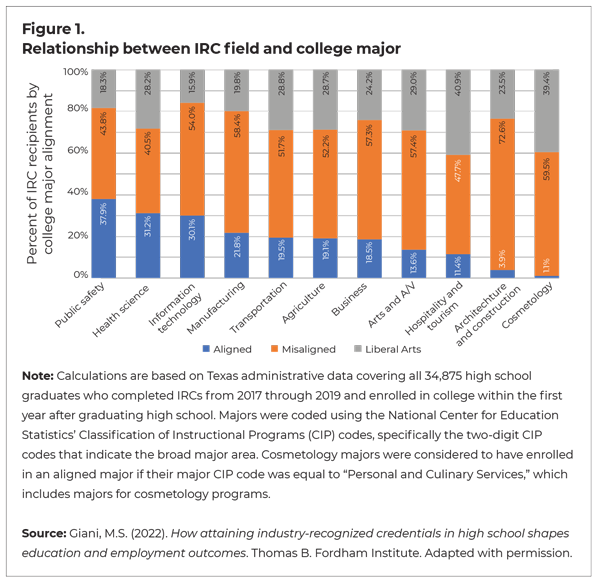
The subject of the IRC earned by a student is not tightly aligned with either their industry of employment or their choice of college major, suggesting that the vast majority of students will go on to work or study outside their IRC field. Among students who earn IRCs and then attend college, few pursue majors aligned to their IRC (see Figure 1). Public safety, health science, and information technology were the certifications most likely to be connected to college-going students’ majors.
Likewise, students who enter the workforce are unlikely to start jobs that align with their credentials (see Figure 2). Cosmetology and health science were the IRCs most likely to be connected to their recipients’ employment. In general, recent high school graduates were more likely to be employed in retail positions or in accommodation and food services than in their area of certification. While some employment opportunities in accommodation and food services could be aligned with a hospitality and tourism certification, it is unclear from the available data how frequently high school graduates with those IRCs are employed in positions where they can put their certification to use.

The lack of alignment between IRCs and students’ post-high-school pursuits does not mean that IRCs lack value. On the contrary, when considered alongside other outcomes, it suggests that IRCs may have educational value even if students follow fields other than ones related to their certifications. Still, opportunities clearly exist to better align K-12 CTE pathways with postsecondary education programs and industry opportunities.
Schools are by far the most important factor in shaping which students earn IRCs.
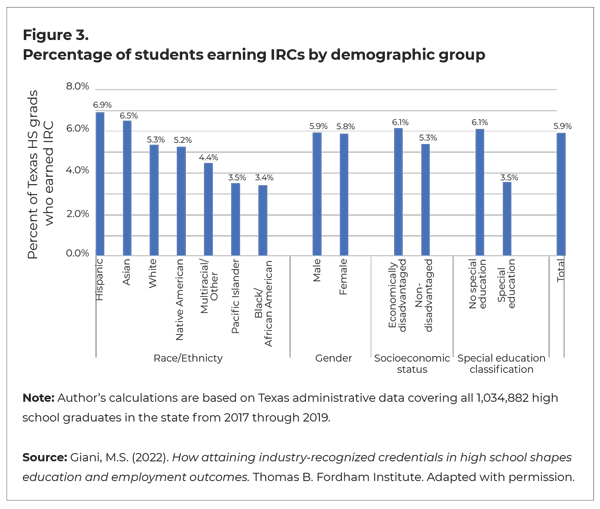
Perhaps unsurprisingly, students who concentrate in CTE are most likely to earn IRCs, but interesting patterns emerge when looking by student demographic groups (see Figure 3). Hispanic and Asian students are the most likely to earn IRCs, whereas multiracial, Pacific Islander, and Black students are the least likely. There is virtually no gender difference in IRC receipt, with 5.8% of girls and 5.9% of boys earning certifications. Interestingly, I also found that students earning IRCs are significantly higher achieving than students who don’t, a finding largely at odds with a considerable literature showing that students who pursue vocational education or CTE are lower achieving, both in the U.S. and around the world (Chmielewski, 2014; Ozer & Perc, 2020).
The school that students attend is by far the best predictor of whether they will earn an IRC. In 41.8% of Texas public schools, not one student earned an IRC, but the top 1% of schools (roughly 20 of them) had an IRC rate greater than 30%. These “high-IRC” schools weren’t just vocational centers. In fact, whether a high school had a specific college- and career-readiness school model (such as being an early college high school or STEM academy) was not a good predictor of whether many students earned IRCs. Similarly, the demographic and academic characteristics of the school as a whole were not strongly related to the IRC rate. Thus, while schools matter more than any student-level characteristic in shaping which students earn IRCs, I was not able to identify specific school-level factors that seem to matter.
Students appreciate their CTE coursework but vary in their understanding and appreciation of IRCs.
The high school CTE students I spoke to for this research overwhelmingly reported positive experiences of their CTE coursework and valued the hands-on, practical learning experiences. Yet many were unfamiliar with the IRCs presumably embedded in their CTE programs. Even students who were familiar with the certifications were often unsure of whether they would earn the certification or use it in the future.
One student in the construction program loved the work, but his father repeatedly pressed him to pursue an occupation where he didn’t have to work outside all day. A student in the automotive technology program came from a family of mechanics and never wanted to pay someone else to fix her car, but she aspired to be a veterinarian. Another student hoped he could use what he was learning in the construction program to renovate houses when he went into real estate but couldn’t see himself working in construction. After speaking with these students, I was not surprised to see the patterns in the data showing that the majority of IRC recipients go on to work or study in a field misaligned with the subject of their IRC.
Even when IRCs are significantly and positively related to students’ first-year earnings, the vast majority of students who do not attend college are still earning close to the poverty line, no matter what IRC they earned.
Where do we – and IRCs – go from here?
Given the increasing emphasis on career-readiness in state and federal K-12 policy combined with the growing prominence of certifications in a variety of fields, it is unsurprising that states continue to pass legislation enabling and encouraging high school students’ completion of IRCs. I would not say that this is a bad idea. After all, I found that many IRCs are positively related to first-year earnings, do not (necessarily) divert students from higher education, and are valued by the students who earn them. Nevertheless, I haven’t been able to fully allay two concerns. First, as Matt Kirchner’s (2022) lamentation underscored, do employers actually recognize these credentials? Second, are students who earn IRCs actually career- and college-ready?
On the first point, it is clear many industries recognize IRCs, particularly in fields where certifications or licenses are required for employment. This may explain why cosmetology certifications resulted in the greatest earnings boost out of any field and why health care IRCs were positively related to earnings. But school leaders and policy makers should maintain a healthy skepticism about whether these certifications are actually providing industry-recognized value to students, particularly given the wide variety of stakeholders and their diverse motivations (including financial) for promoting students’ receipt of IRCs. Certifications that do not provide value to students once they leave school likely should not be overly valued by schools.
On the second point, my feelings are much clearer: Students should not be considered career-ready simply because they earned an IRC, particularly given that many IRCs have little relationship to employment, earnings, or postsecondary enrollment. It may be tempting for schools to promote students’ receipt of IRCs given state accountability pressures and the challenge of ensuring all students graduate ready for college-level coursework, particularly in light of the extreme educational disruptions over the past few years due to COVID-19. But IRCs are about career-readiness more than college-readiness. At a time when college enrollment rates have experienced a larger decline than at any point in modern history (National Student Clearinghouse Research Center, 2022), we must ensure that students are equipped with the knowledge and skills they need to thrive in postsecondary education as well as the workforce. This is especially true for low-income students and students of color, who bore the brunt of the deleterious impacts of the pandemic. IRCs may have value, but they are not, on their own, an indication that students are ready to grow and thrive in a rapidly evolving economy.
References
Advance CTE & College in High School Alliance. (2022). The state of CTE: Early postsecondary opportunities.
Chmielewski, A.K. (2014). An international comparison of achievement inequality in within- and between-school tracking systems. American Journal of Education, 120 (3), 293-324.
Giani, M.S. (2022). How attaining industry-recognized credentials in high school shapes education and employment outcomes. Thomas B. Fordham Institute.
Kirchner, M. (Host). (2022, October 7). How valuable are industry-recognized credentials? [Audio podcast episode]. In The TechEd Podcast.
National Student Clearinghouse Research Center. (2022). Overview: Spring 2022 enrollment estimates. National Student Clearinghouse.
Ozer, M. & Perc, M. (2020). Dreams and realities of school tracking and vocational education. Palgrave Communications, 6.
Pechota, D., Keily, T., & Perez, Z., Jr. (2020). Secondary career and technical education: Does state policy allow students to earn credentials through CTE coursework? In 50-state comparison: Secondary Career and Technical Education. Education Commission of the States.
Texas Education Agency. (2018, December). Texas academic performance report: 2017-18 state STAAR performance.
Texas Education Agency. (2022, January). Industry-based certifications: for public school accountability Frequently asked questions (FAQ).
This article appears in the March 2023 issue of Kappan, Vol. 104, No. 6, pp. 12-17.

ABOUT THE AUTHOR

Matt Giani
Matt Giani is a research associate professor in the Department of Sociology and a faculty affiliate in the Texas Behavioral Science and Policy Institute at the University of Texas at Austin.