
As a mother and grandmother, I’ve long known that middle school can be challenging in many ways. But as a math educator at the high school and college level, it’s only recently become clear to me just how difficult those years are for kids academically—particularly in math.
With glaring headlines and bad news at every turn, it’s a problem we can no longer afford to ignore.
The recent release of the NAEP Long-term Trend Assessment showed 13-year-olds’ math scores are stagnant and still way down from just before the pandemic hit in 2020 and from 2012, a high watermark year in student achievement. In addition, the percentage of 13-year-olds, who are typically in seventh or eighth grade, taking Algebra I also has declined since 2012. (National Center for Education Statistics, 2026). Having access to this critical course by the end of middle school is important because it serves as a gateway (NWEA, 2025) to advanced math opportunities in high school and post-secondary STEM pathways.
Today’s math declines are having a range of real-life consequences for high school graduates. A 2025 report published by the University of California, San Diego, got widespread national attention after it revealed that 1 in 8 freshmen had trouble doing middle school-level math and needed to take intensive remedial coursework. The downward trend in this critical subject is likely going to impact student’s future earnings too, according to research out of Stanford University (Hanushek, 2025).
To address this crisis, we must take a hard look at what’s happening in middle school math and make some changes.
Learning from elementary instruction
First, we need to look at what’s working in the upper elementary grades, where students, though not fully recovered, are rebounding from the pandemic. For example, fourth-grade math scores rose on the most recent Nation’s Report Card.
In elementary classrooms that I visit in my home state of Louisiana and others around the country, I frequently see concrete objects used to help students build number sense and a better understanding of concepts like place value, such as by using a group of cubes or discs to see how ones group together to make 10.
I also see students using hand-drawn models to help them better grasp math concepts. For instance, they might draw a tape diagram, or a rectangle drawing divided into parts, to cement their understanding of part-whole relationships and to help visualize operations like addition, subtraction, and division.
Students eventually move on to using the standard algorithm most of us used as kids when solving math problems. However, these additional strategies provide foundational understanding to fall back on if they get stuck.
This is a change—and an improvement—from past practices in which students generally just memorized formulas. But hands-on strategies like this rarely make their way up to middle schools. That’s a shame. There are plenty of ways that middle school teachers could extend the use of these approaches to their students if they knew how and why to do so.
For many middle school students, moving from an elementary school building to a middle school structure can seem like moving from one country to another. Going from the elementary model of a self-contained classroom to the hustle and bustle of changing classes with a different teacher for each specific subject is a huge adjustment. Similarly, “languages” (in this case, math vocabulary or phrasing) might be different from one school to another. The expressions and concrete model language you find in elementary schools today gives way to emphasis on algorithmic language without connections to each other.
What can be done to bridge the gap between elementary and middle school instruction and between school buildings to promote the continued development of strong math skills?
Helping middle school teachers see the value of earlier strategies
Part of the problem is how teachers are prepared. Teacher training rules vary by state, but in general, middle school math teachers tend to be licensed for middle and high school instruction. Those licensure programs don’t typically offer the kind of preparation elementary educators get in math, with a heavy emphasis on deepening students’ understanding of foundational math concepts, like algebraic ideas. Instead, middle and high school teachers are generally trained to teach math using abstract techniques and procedures aligned to the ways they learned math and currently think about math.
We should consider revamping those teacher preparation programs to include those early grade approaches to teaching foundational math skills.
At the same time, districts can create opportunities for elementary and middle school math teachers to come together for professional development. As an example, a session for consecutive grade-level teachers to collaboratively examine and share how particular strands of math—like operations, number sense, and fractions— appear in each grade can be helpful.
Middle school teachers tell us that instructional time is also a challenge. They often have less time to teach math than their elementary counterparts. In elementary schools, cross-curricular topics allow multiple subjects to be addressed throughout the day in addition to the dedicated time for a subject. Middle school administrators should look at schedules carefully and ensure they’re planning enough time for teachers to focus on building conceptual understanding of key math topics as well as procedural and numeracy skills.
Extending math models up the grades
When I think of math models educators might consider taking up to middle school from elementary grades, the first one that comes to mind is the tape diagram. It makes the connection between the visual aspect of drawing and the abstractness of equations explicit for students.
Many students enter middle school and begin working with expressions and equations without a strong concrete or visual foundation. Incorporating tape diagrams in K-8 would help build this foundation, preparing students for a deeper understanding of expressions, equations, and systems of equations (see examples below).
Grade 3
Problem: There are 6 apples in each bin in a store. If there are 4 bins, how many apples are there all together?

There are 24 apples.
Grade 5 – Tape diagrams extend to fractions or parts of a whole.
Problem: Jim read 3/5 of a 100-page book. How many pages did he read?

Grade 6 – Students use tape diagrams in ratios and proportional reasoning.
Problem: The ratio of trucks to cars in the parking lot is 2:3. If there are 20 vehicles in the parking lot, how many are cars?

Grade 8 – Students use tape diagrams to solve equations.
Problem: Twice a number plus 6 is 14. What is the number?

The thinking is the same whether students are using a model like you see above or writing a standard equation. They’re just drawing a picture in this case.
Another strategy to consider is using the number line. While it is used in early grades to teach basic operations, the number line also helps teach concepts such as comparing fractions and rounding numbers. When used effectively, middle school teachers can engage students with both vertical and horizontal number lines to preview the coordinate plane in middle school vertical number lines (y – axis) and horizontal number lines (x – axis).
Grade 5 – Fractions with different denominators on a number line
Problem: A ribbon for a costume is 1/2 m long. Another piece 3/8 m is needed for the headpiece. What is the total length of ribbon needed?

1/2 m = 4/8 m
4/8 m + 3/8 m = 7/8 m
The length needed is 7/8 m.
Grade 6 – Integers and rational numbers on a number line
Problem: Which is greater -3 or -7?
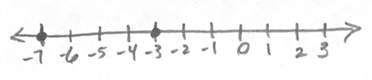
Larger numbers are further to the right on the number line. Therefore, -3 is greater than -7
Grade 7 – Integers on a vertical number line
Problem: A submarine is 7.5 meters below sea level. It rises 2.3 meters then dives 4.9 meters. What is its final position relative to sea level?
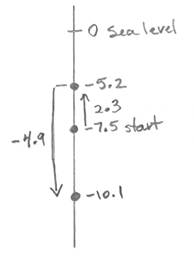
-7.5 m + 2.3 m = – 5.2 m
– 5.2 m – 4.9 m = -10.1 m
The submarine’s final position is 10.1 m below sea level.
I have a grandson in middle school. I know how important it is for adolescents to feel respected. They would balk at doing anything perceived as juvenile. With that in mind, it’s important to understand and convey that introducing an alternative strategy is not a reduction in rigor. Instead, it provides a different entry point and access to help kids understand and succeed in high-level math.
These are relatively small changes that are in our power to make. They require looking at professional development, confirming vertical alignment between grades, ensuring there is enough instructional time for math, and extending the life of strategies shown to work in earlier grades. Why not give them a try? We have little to lose and so much to gain.
References:
Hanushek, E.A. (2025). The pandemic in perspective: U.S. learning losses in the twenty-first century.
Long, D., Kuhfeld, M., & Peters, S.J. (2025). Unequal access to 8th-grade algebra: How School offerings and placement practices limit opportunity. NWEA.
National Center for Education Statistics. (2026). NAEP Long-Term Trend Assessment Results: Reading and Mathematics. U.S. Department of Education.
University of California, San Diego (2025). Senate-Administration Working Group on Admissions. Final Report.
ABOUT THE AUTHOR

Nell McAnelly
Nell McAnelly has taught mathematics at the high school and university levels for more than 30 years. She also served as co-director of the Louisiana State University Cain Center for STEM Literacy. McAnelly is the Mathematics Curriculum Founding Director and Board Chair Emeritus at Great Minds PBC.