Labor Day, 1979. I was at my parents’ house, sharing lesson plans and ideas for my first day as a bilingual teacher in the Boston Public Schools (BPS). As a recently certified bilingual teacher in elementary education and social studies, I had hoped to land a job in a Spanish bilingual program, but the district’s human resources department apparently assumed I could teach in Portuguese as well as in Spanish, so they had hired me to teach high school science in a Cape Verdean bilingual program, taught in Portuguese. Although I’d taken no science in college and only studied Portuguese for a semester, I knew how difficult it was to land a job in BPS, so all summer I prepared, poring over children’s science books and an old general science high school textbook. The phone rang just as I finished sharing with my parents my ideas for teaching cell division. I picked it up and heard an accent that would become familiar in years to come. “Is Linder there please? This is Jim Bruno calling from the Boston Public Schools.”
“Yes, this is Linda,” I said, careful not to imitate his heavy Boston accent.
“Welcome aboard,” Mr. Bruno went on. “I’m the principal of the E Middle School and I’m pleased you’ll be joining us as the newest math teacher in our Spanish bilingual program.”
“Excuse me?” I squeaked. “I thought I was teaching science at Madison Park.”
“A mistake,” Mr. Bruno interrupted. “You’ll be joining my faculty. Teachers report Tuesday 7 a.m. Students come Thursday. Homeroom is 7:20. We have two days of prep. You’ll get your schedule Tuesday. Look forward to meeting you. Welcome aboard.”
Click. And that was that. I didn’t know what to think. I had a job. But it certainly wasn’t what I’d prepared for, even though it was closer to what I wanted.
Meeting Carmen
Tuesday was a blur of people talking at the faculty: Do this. Don’t forget that. Here are class lists. Ms. DiMato has the key to the book room, but she’s out sick. Make sure your bulletin board has something about reading. Talk to Mrs. McCullen if you need help.
I was dizzy with directives. But when I finally found my classroom, I was delighted. The wooden floors had been waxed to a sparkling sheen and rays of sunlight danced on the floorboards. The desk sat on a raised pedestal. Thirty desks with chairs were arranged in three straight rows. Tall windows lined one entire wall. (I hadn’t yet noticed that most of the shades were broken.)
The next day, Wednesday, I parked in the large lot and entered the school through the cafeteria, as we had been instructed. I smelled the coffee before I noticed a long line of teachers. That’s where I met Ms. Carmen Torres. Not in line, but “on-line” as she said, her New York accent in stark contrast to the many Boston accents in the school. “You have to get here early, or the coffee runs out,” she told me. “Sometimes there’s toast.” Carmen was from Brooklyn, and her family was from Puerto Rico. She was about my age and had joined the school as a bilingual science teacher the previous year. She mentioned that she’d seen me at the faculty meeting and quipped: “Rough first day. Too much information flying at us. Not a lot of purpose.” I smiled and liked her immediately. “They think if they just tell us things it’ll happen. Hmmm . . .” Her eyes twinkled mischievously. “I’m right down the hall from you. Just let me know how I can help.”
I didn’t want to tell her that only two days ago, I was a high school science teacher, not a middle school math teacher. But she seemed to intuit my fear before I said anything. “You have a great assistant teacher. He’ll help you get settled. He knows the curriculum well.” She smiled a broad warm smile, and I could feel my confidence emerging. “I’ll introduce you.”
I followed Carmen up the stairs, watching her dark black hair sway elegantly, as we headed to the bilingual wing in search of my aide. I thought, “I’ve got a friend. I can do this job. Even if I’m not ready.”
Later that afternoon, Carmen stopped by my room while I was wiping down shelves, arranging books, and hanging posters that I had brought back from Puerto Rico, where I’d previously taught. “I love Roy Brown’s music. La Nueva Canción.” Carmen grinned at my poster. “Mi novio es músico. Trumpetista. He’s playing this weekend at 1369. You could go with me.” I loved that idea! “But, hey, it’s getting really late in the day. Debes irte. Ya es tarde.”
“I just want to finish cleaning these last shelves,” I told her.
When Carmen realized that I only lived a few blocks away from her in Jamaica Plain, she quickly said, “I’ll pick you up at 6:30 a.m.” And that began our friendship.
Learning from Carmen
My first weeks were hell. A very tall 7th grader, Damaris, tore up every math worksheet and broke pencils and threw them across the room hoping to hit a classmate. Scuffles would then erupt that usually ended up with someone being sent to the office. Gerardo ran a gambling ring during 8th-grade math, taking bets and using all his math skills for something other than the problems I was teaching. Students mooed loudly at Maritza, a large girl from a mountain village in Puerto Rico.
One day, Yolanda, one of my “good girls,” took me aside, “Missy, quizás debe ir al salon de Ms. Torres.” She urged me to see what Ms. Torres did in her classroom. Couldn’t I teach them the way she did? “And look at her blusa. And the belt over the blouse.” Was Yolanda really telling me how to dress?
Ms. Torres, dressed in a bright colored shirt with a perfectly cinched belt, had full command of her classroom. I observed how her kids paid attention. If anyone began to get out of line, she would give them an “eye” that instantly froze bad behavior. Everyone got their work done, loved science, and talked knowledgeably about the Krebs cycle — in Spanish or English. I was impressed. Slowly, with coaching visits to and from Ms. Torres, I began to learn how to teach. And even how to dress.
Carmen’s example continues to direct teachers to be calm, remember their why, and give all students a purpose for learning every day.
I adjusted my voice so I wasn’t always yelling; I found my peripheral vision so I caught aberrant behavior and could redirect a student before they acted out; I changed students’ seats whenever necessary. Classwork posted on the board as students entered occupied them while I collected and quickly reviewed homework. Carmen showed me how to vary my lessons, sometimes putting direct instruction in the middle of class instead of always the first thing. “Let them know that you assign groups Monday-Thursday, but on Fridays they can pick their own groups.” My students loved that idea.
“Get to know the kids,” Carmen told me. “Then, they will respect you.” I developed math word problems that were stories about my students, and they loved discovering themselves on my mimeographed sheets. Gerardo wanted to help write some of the problems, so he became an assistant teacher to me instead of running the gambling ring. Carmen suggested that I give everyone a job, so students rotated between pencil distributor, homework collector, bulletin board display maker, attendance taker, and notebook checker. As I slowly began to know my students, I could anticipate what would set them off. The classroom was calmer most days, and I began to breathe easier.
Carmen also taught me that parents were essential partners. “You can’t work well with young people if you don’t know where they come from: their families.” Over a three-year period, Carmen and I visited all our 150 families. Just for a cafecito and a chat. Those early visits sustained us for decades to come. We were known as “the Missys” who came for café.
Remembering Carmen
This was just the beginning of a 40+ year friendship and a lifetime of teaching and making creative trouble together. When Carmen died suddenly in April 2022, I was working on a memoir of my teaching life in which Carmen, naturally, has a starring role. I never had the opportunity to share this piece with her, but I’ve shared it with other teachers and school leaders. Some were inspired to use the story with their faculty, asking them to consider who their Carmen might be. Other leaders and teachers were inspired to be “the Carmen” for a beginning teacher. Even in death, Carmen is a leader. Her example continues to direct teachers to be calm, remember their why, and give all students a purpose for learning every day.
Carmen and I both loved the words of Antonio Machado “Caminante no hay camino; se hace el camino al andar” (“Walker, there is no path. The path is made by walking”). I am grateful that Carmen and I could travel and invent so many paths together for so many years.
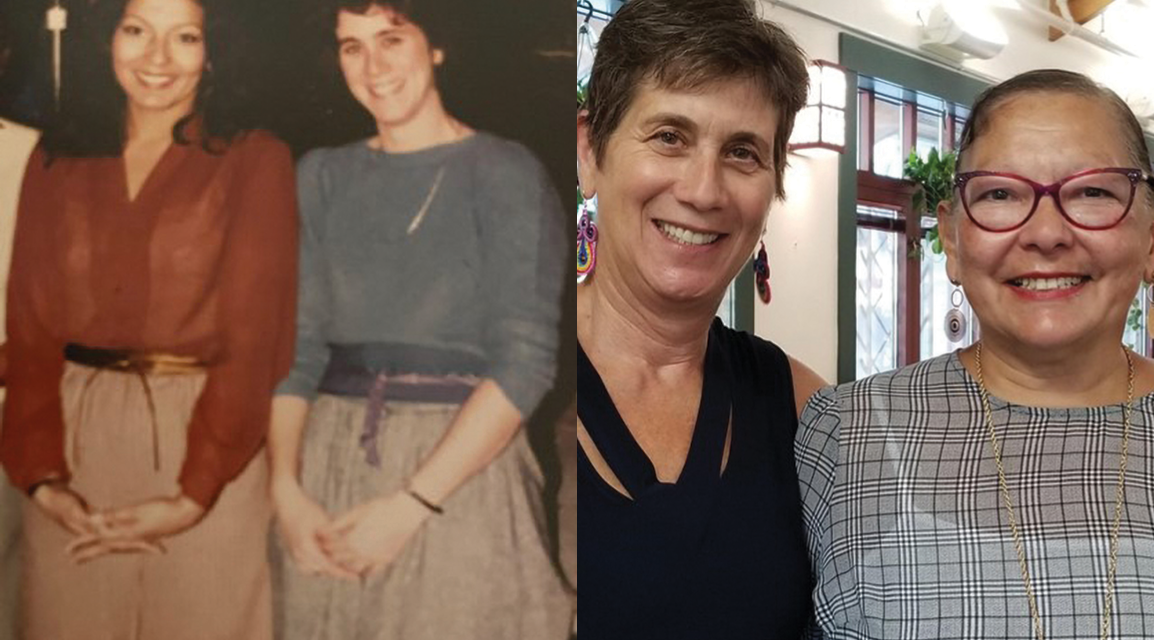
Photos courtesy of Linda Nathan
Watch a video about Linda Nathan and Carmen Torres’ professional partnership.
This article appears in the September 2022 issue of Kappan, Vol. 104, No. 1, pp. 56-57.

ABOUT THE AUTHOR

Linda F. Nathan
Linda F. Nathan is a leadership coach and a professor at the Harvard Graduate School of Education, Cambridge, Massachusetts, and Cambridge College-Puerto Rico.
Visit their website at: www.lindanathan.com