A critique of the Times’ recent story by an assistant principal with firsthand experience.
By Patrick Hunt
At this point, I do not know of a single educator who thinks it is a good idea for students to have cellphones in school.
And, in all of the recent admittedly giddy, it’s-morning-again coverage of cell phone bans — Washington Post, Times Union, Beacon Journal, etc. — there is not a single quote from any teacher or administrator questioning the decision to restrict or outright ban phones in the classroom.
The evidence and arguments in favor of banning phones from schools ha[ve] reached a near consensus.
And yet, a New York Times reader who is unfamiliar with how corrosive phones are to school culture and to a student’s ability to learn might walk away from a recent story with the notion that such bans are both anomalous and unwise.

At Timber Creek, the 3,600-student Orlando high school that is the setting for the story, a student who needs to call home “must now go to the front office and ask permission to use the phone,” — as if this isn’t exactly what generations of students did when they wanted to call home.
Other students, who now cannot check their class schedules on their phones during lunch in a school where apparently paper does not exist, find the ban “regressive” and “infantilizing.”
One student, who finds the ban “problematic,” felt unsafe because she could not immediately text her mom whenever she wanted.

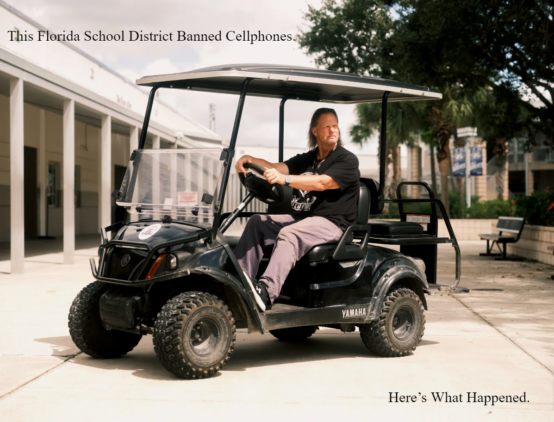
Above: One of the featured images in the Times story.
What contributes to the idea that Timber Creek is effectively a penal colony is the Times story’s focus on adults looking for kids sneaking looks at their phones.
With its scowling photos of school staff and its dystopian language, the Times piece is a cynical portrait of a school as a mini surveillance state.
The first photo accompanying the story tips its hand. A school security officer, shown in a photo squinting imperiously into the sunlight and gripping the wheel of a black off-road golf cart, is all but mocked later in the article as a mall cop.
He “patrols lunch period on a golf cart, nabbing students violating the ban,” Singer writes, and “monitor[s] school security camera feeds,” removing repeat offenders from class. (How else a school security officer would enforce this rule on a sprawling campus is not explained.)

Above: Another image from the Times story
A picture of the principal-as-warden is also included, a towering man with enviable biceps, photographed leaning against his desk with his arms crossed, glaring at the viewer like a boxer at weigh-in.
The article’s sub-hed describes enforcement of the cell phone ban as a “hunt.”
Meanwhile, there is not a single image of kids talking to each other at lunch or engaging with teachers in class.
“There is not a single image of kids talking to each other at lunch or engaging with teachers in class.”
Written by reporter Natasha Singer, the article also illustrates a tepid, “yes, but…” kind of journalism.
Every benefit of cell phone restrictions — more learning, less bullying, teenagers acting like human beings capable of speaking and maintaining eye contact — is paired with a perceived infringement on students’ and parents’ rights.
The all-day ban creates a “pastoral” atmosphere that is nevertheless “carceral” and “prisonlike.”
“Whether the potential benefits of banning cellphones outweigh the costs of curbing students’ limited freedom is not yet known.”
“More restrictive school cellphone rules could have benefits, such as boosting students’ focus on learning,” writes Singer. “But they could also increase surveillance of students or hinder crucial communications for teenagers with family responsibilities or after-school jobs.”
“Kids are already being surveilled intensely through their phones.”
Singer’s story reads as unaware of a few immutable truths that anyone who works in a school appreciates after about five minutes:
Kids love to break rules (in fact are supposed to try to break rules).
Monitoring student behavior is an important part of running an effective school.
Rules without enforcement are not rules.
There will always be objections to rules from students and parents.
Kids are already being surveilled intensely through their phones, by their parents and by the companies that track and serve ads to them.
Many schools have already instituted cell phone bans — or never allowed them in the first place.
“Many schools have already instituted cell phone bans — or never allowed them in the first place.”
In this piece, Singer underestimates the problem and misunderstands how schools function in order to create a culture of safety and learning.
It’s cynical to frame enforcement of rules as an aggressive form of surveillance — especially so given the severity of this problem. Cell phones are not chewing gum.
It is not enough to simply ask students to put their phones away.
In all of my years in education, the worst tantrums I’ve seen have been when we have attempted to take a students’ phone away or hold it to make them stay after school.
This fall in the New York City school where I work, kids’ in-school use of cell phones for non-school purposes has been . . . well, nothing.
We’ve never allowed phones in our school, just as hundreds of high schools in New York City never have.
The kids thrive.
Hunt is an assistant principal at a New York City high school.
Previously from The Grade
Cell phone restrictions, new effort to cover literacy, & an adorable throwback pic (10/6/23)
School refusal, phone bans, & secrets to in-school reporting (5/19/23)
The New York Times wrote a big story about online learning in Kansas. It didn’t go well. (2019)
ABOUT THE AUTHOR

The Grade
Launched in 2015, The Grade is a journalist-run effort to encourage high-quality coverage of K-12 education issues.