
First-year teachers make up a large and growing share of the teaching force. What does the research tell us about their characteristics and professional needs?
In recent decades, the K-12 teaching force in American public schools has become less and less experienced. Not only have schools seen steady increases in student enrollments (which has translated to a constantly growing demand for new teachers), but more and more teachers from the baby-boom generation have retired, while larger and larger numbers of early and midcareer teachers have been lost to attrition. As a result, in 2007, first-year teachers became the largest cohort in the profession, outnumbering those who’d been teaching for five, 10, or any other number of years (Ingersoll, Merrill, & Stuckey, 2014). And by 2017, according to our calculations, novices had grown to make up roughly 7% of the teaching force, or nearly 245,000 teachers out of 3.5 million — for context, novices made up just 3% of the teaching force in 1987.
To help each year’s huge crop of new teachers adjust to the demands of teaching (and increase the likelihood that they’ll stay in the profession over time), many school systems have expanded their induction and mentoring programs and other forms of professional support. To be effective, though, such programs must be responsive to those teachers’ specific needs, which vary widely, depending on the subject areas and grade levels they teach, the schools they work in, the students they teach, and their own backgrounds and experiences. To create high-quality supports, then, we have to begin by asking: What do we know about the characteristics of today’s new teachers?
When it comes to the demographics of first-year teachers, we see both stability and change over 30 years.
The purpose of this article is to provide an overview of some of the key changes in the demographic characteristics and preparation of new public school teachers over the last few decades (more specifically, between 1988 and 2018, the most recent year for which we have relevant data). Building off of our previous research on this topic (Redding & Nguyen, 2020), we draw on nationally representative data from the Schools and Staffing Survey and the National Teacher and Principal Survey, both of which are administered by the National Center for Educational Statistics (NCES). Together, these surveys offer a unique window into the profession, allowing us to see who’s going into teaching today and how they do or do not differ from their predecessors.
The characteristics of new teachers
When it comes to the demographics of first-year teachers, we see both stability and change over 30 years (see Table 1). For instance, the gender balance among new teachers has remained more or less the same; both in 1988 and 2018, roughly three-quarters of new teachers identified themselves as female. However, the racial/ethnic composition of the new teaching force has changed significantly, with teachers of color now making up a larger (if still relatively small) part of the whole. In 1988, 87% of first-year teachers identified as white (and non-multiracial, non-Hispanic), compared to 73% in 2018. As of 2018, 10% of beginning teachers were Black, 10% were Latinx, and 7% identified as Asian American, Native Hawaiian/Pacific Islander, American Indian/Alaska Native, and/or multiracial. It is also worth pointing out that while teachers of color now make up 21% of the overall public school teacher workforce, they make up 27% of first-year teachers (De Brey et al., 2021). Even with this increasing racial/ethnic diversity among beginning teachers, however, the public school teaching force continues to be much less racially diverse than the students who attend public schools.
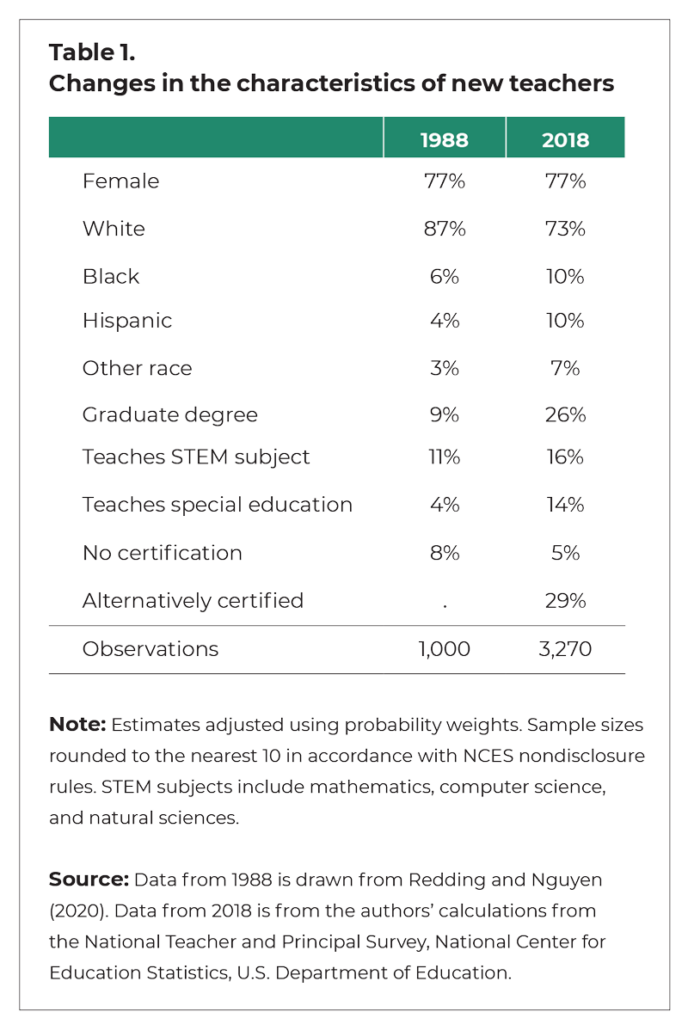
We also see notable shifts in new teachers’ educational preparation, subject-area assignments, and certification status. Notably, the fraction of new teachers with a graduate degree nearly tripled from 1988 to 2018 (from 9% to 26%), and a significant and growing share of today’s beginning teachers have a main teaching assignment in mathematics, computer science, natural science, or special education. In 2018, 16% of new teachers taught a STEM subject (compared to 11% in 1988) and 14% taught special education (compared to 4% in 1988). Why have these subjects become more likely to be taught by beginning teachers? The evidence suggests that many veteran teachers in these subject areas have been lost to persistently high teacher attrition, even while demand has increased overall for teachers with these kinds of instructional expertise (Billingsley & Bettini, 2019; Nguyen & Redding, 2018).
Finally, the fraction of uncertified teachers has decreased slightly, from 8% in 1988 to 5% in 2018. And, at the same time, the proportion of new teachers who’ve been certified through an alternative pathway has grown significantly. In 1988, alternative certification programs were not yet mentioned in the NCES surveys, but since those programs were still rare, we can assume that they accounted for very small numbers of first-year teachers. In 2018, however, fully 29% of new teachers reported entering teaching through an alternative certification program. That suggests a major shift in the nature of teacher preparation, and, perhaps, in the kinds of supports teachers require when they enter the classroom.
At which schools do new teachers begin their careers?
The distribution of new teachers has often been cited as a major source of inequity in public education. Historically, novices — i.e., teachers who have just begun to develop their instructional routines and classroom management skills — have been significantly more likely than experienced teachers to work in schools serving large numbers of students of color and students from low-income backgrounds (Goldhaber, Quince, & Theobald, 2018).
Our findings suggest that, since 1988, new teachers have only become more likely to work with historically underserved students. To illustrate this point, we’ve calculated differences in the average percentage of students of color in the schools in which first-year teachers and teachers with more than one year of experience worked (see Figure 1). When looking at trends from 1988 to 2018, we find that, in general, all public school teachers — both novices and more experienced — now tend to work in more racially diverse schools than in previous decades. (In 1988, teachers worked in schools with an average of 27% students of color; in 2018, they worked in schools with an average of 50% students of color.) However, novices continue to be significantly overrepresented at schools serving large numbers of students of color. By the 2016 school year, the average new teacher was working in a “majority-minority” school. And in the 2018 school year, the average new teacher worked in a school with 57% students of color, while more experienced teachers worked in schools with an average of 49% students of color.

Not only does being assigned disproportionately to the classrooms of novice teachers do a disservice to students of color, but these assignment patterns do a disservice to new teachers themselves. As we found in an earlier study (Redding & Nguyen, 2020), when new teachers work in majority-minority schools, they tend to leave teaching at a higher rate (by 4.3 percentage points) than do their counterparts at schools with fewer students of color. As other researchers have argued, this is likely due to the fact that schools enrolling large numbers of racialized minorities tend to be located in lower-income neighborhoods and have fewer resources, higher proportions of students who require more instructional support, and working conditions that make it difficult to provide that support (Simon & Johnson, 2015). New teacher retention tends to be higher in well-resourced schools with more supportive administrators, higher levels of teacher collegiality, a mentoring program, and other supports for beginning teachers (Redding & Nguyen, 2020; Ronfeldt & McQueen, 2017), but it tends to be more difficult for novice teachers to find jobs in such schools.
Implications for practice
In recent decades, as we’ve shown, new teachers have come to make up a larger and larger share of the U.S. public school teaching force; indeed, first-year teachers are now the largest cohort in the profession. At the same time, the characteristics of new teachers have changed in a number of ways, including their racial/ethnic composition, levels of educational attainment, subject-area assignments, certification status, and the pathways they’ve taken to enter teaching. All of these changes have significant implications for school systems, which must redouble their efforts to help teachers ease their transition into the job, so that they succeed in the classroom and choose to remain in the profession.
Thanks in part to a growing body of research into the needs of beginning teachers, school systems now tend to provide much more extensive induction supports than in previous decades (Redding & Nguyen, 2020), including new-teacher seminars, mentoring programs, and other services, which can be helpful in reducing attrition. Further, researchers have consistently found that school administrators play a central role in supporting new teachers. Not only does their position give them unique opportunities to help novices adjust both to the teaching profession in general and to the specific culture and norms of their school (Nguyen et al., 2020; Redding et al., 2019), but they also have influence over key organizational conditions — for instance, they can remove barriers that prevent mentors and mentees from meeting routinely, or from collaborating on instruction, lesson planning, and other parts of their work.
Since 1988, new teachers have only become more likely to work with historically underserved students.
Unfortunately, principals and other administrators do not always take advantage of these opportunities. Indeed, many new teachers report that administrators tend to be absent from their day-to-day lives (Kardos & Johnson, 2007). Often, they lack the subject expertise or time to focus on new teachers’ professional development, and they delegate the work to instructional coaches and mentor teachers from the given grade level or subject area. In such cases, it’s crucial that they make an effort, at least, to check in with new teachers more regularly, observe them in the classroom, provide constructive feedback, and otherwise help them feel that they belong to a professional community that values trust, open communication, and specific standards of practice.
Such efforts are complicated still further, though, by the fact that the social and professional needs of new teachers can vary widely (Johnson & Birkeland, 2003). For instance, special educators tend to be especially reliant on administrators to create structures that support collaboration with other teachers, given that they are often responsible for coordinating services across general and special education settings (Billingsley, Bettini, & Jones, 2019). As a result, principals should be especially cognizant of the need to help new special educators become fully involved in schoolwide prevention and intervention systems. Moreover, given the rapidly changing demands that special educators face, and given that new special education teachers tend to turn over at higher rates than their peers, principals should recognize that they may need particularly intensive supports as they begin their careers (Gilmour et al., 2020).
Similarly, school and district leaders should recognize that new teachers of color, particularly those in the numerical minority in their schools, may feel isolated from other school staff, and they may benefit from concerted efforts to promote various kinds of teacher mentoring and collaboration, as well as formal and informal opportunities to network with other teachers of color (Bristol & Shirrell, 2019). Also, the nearly 30% of new teachers who now enter teaching through alternative certification programs may require distinct kinds of support, particularly if they weren’t part of a strong peer cohort or mentoring system during their preservice preparation.
Attending to new teachers’ unique and varied needs will undoubtedly take significant time and energy from school principals and other administrators. But such efforts are critical to helping new teachers become full members of their school community. Supporting new teachers is particularly important in schools enrolling historically marginalized students, so as not to exacerbate inequities related to their assignment to inexperienced teachers. Moreover, these efforts are likely to induce new teachers to stay in teaching and in the school where they start their career.
Given that new teachers are especially likely to work in schools that enroll large numbers of students of color, it has only become more and more urgent that they be well prepared to teach in majority-minority schools. For many new teachers, a service orientation motivates their commitment to teach historically marginalized students (Ronfeldt, Kwok, & Reininger, 2016). And many urban teacher residency programs, grow-your-own programs, and alternative certification programs have made it their mission to recruit teachers who are committed to teaching for racial and social justice. Yet, despite this commitment, it remains to be seen the extent to which the current generation of new teachers is poised to enact culturally relevant instructional practices in their classrooms (Ladson-Billings, 2014). The success of these efforts will likely hinge not only on individual teachers, but also on the development of school communities committed to fostering more equitable and inclusive learning environments. Otherwise, efforts to place new teachers in hard-to-staff schools may not be sustainable, given high levels of teacher turnover (Redding & Nguyen, 2020).
Lastly, the importance of attending to the unique needs of new teachers will likely only increase in the wake of the pandemic. While it is still too early to understand the extent to which the pandemic will exacerbate teacher attrition, many suspect it will increase, particularly for older teachers and in hard-to-staff schools with challenging working conditions (Horace Mann Educator, 2020; Kaufman & Diliberti, 2021). Early survey data showed higher levels of teacher stress and longer working hours during the pandemic, and more teachers reported that they are thinking about leaving teaching than before the pandemic (Diliberti, Schwartz, & Grant, 2021; Loewus, 2021). If this exodus from teaching does occur, there will undoubtedly be a greater reliance on new teachers to fill teaching vacancies, and we’ll see a further greening of the teaching profession.
References
Billingsley, B. & Bettini, E. (2019). Special education teacher attrition and retention: A review of the literature. Review of Educational Research, 89, 697-744.
Billingsley, B., Bettini, E., & Jones, N.D. (2019). Supporting special education teacher induction through high-leverage practices. Remedial and Special Education, 40 (6), 365-379.
Bristol, T.J. & Shirrell, M. (2019). Who is here to help me? The work-related social networks of teachers of color. American Educational Research Journal, 56 (3), 868-898.
De Brey, C., Snyder, T.D., Zhang, A., & Dillow, S.A. (2021). Digest of Education Statistics 2019 (NCES 2021-009). U.S. Department of Education, Institute of Education Sciences, National Center for Education Statistics.
Diliberti, M.K., Schwartz, H. L., & Grant, D. (2021). Stress topped the reasons why public school teachers quit, even before COVID-19. RAND Corporation.
Gilmour, A.F., Nguyen, T.D., Redding, C., & Bettini, E. (2020). The shifting context of special education teachers’ work. Working paper.
Goldhaber, D., Quince, V., & Theobald, R. (2018). Has it always been this way? Tracing the evolution of teacher quality gaps in U.S. public schools. American Educational Research Journal, 55 (1), 171–201.
Horace Mann Educators Corporation. (2020). The hidden impact of COVID-19 on educators: Rising health concerns, lower risk tolerance and benefit gaps. Author.
Ingersoll, R.M., Merrill, L., & Stuckey, D. (2014). Seven trends: The transformation of the teaching force (CPRE Research Report No. RR-80). Consortium for Policy Research in Education.
Johnson, S.M. & Birkeland, S.E. (2003). Pursuing a “sense of success”: New teachers explain their career decisions. American Educational Research Journal, 40 (3), 581-617.
Kardos, S.M. & Johnson, S.M. (2007). On their own and presumed expert: New teachers’ experience with their colleagues. Teachers College Record, 109 (9), 2083-2106.
Kaufman, J. & Diliberti, M. (2021, January). Teachers are not all right: How the COVID-19 pandemic is taking a toll on the nation’s teachers. The Evidence Project at CRPE.
Ladson-Billings, G. (2014). Culturally relevant pedagogy 2.0: aka the remix. Harvard Educational Review, 84 (1), 74-84.
Loewus, L. (2021, May 4). Why teachers leave — or don’t: A look at the numbers. Education Week.
Nguyen, T.D. & Redding, C. (2018). Changes in the demographics, qualifications, and turnover of American STEM Teachers, 1988-2012. AERA Open, 4 (3), 1-13.
Nguyen, T.D., Pham, L.D., Crouch, M., & Springer, M.G. (2020). The correlates of teacher turnover: An updated and expanded meta-analysis of the literature. Educational Research Review, 31, 1-17.
Redding, C. & Nguyen, T. (2020). Recent trends in the characteristics of new teachers, the schools in which they teach, and their turnover rates. Teachers College Record, 122 (7).
Redding, C., Booker, L., Smith, T.M., & Desimone, L. (2019). School administrators’ direct and indirect influences on middle school math teachers’ turnover. Journal of Educational Administration, 57 (6), 708-730.
Ronfeldt, M., Kwok, A., & Reininger, M. (2016). Teachers’ preferences to teach underserved students. Urban Education, 51 (9), 995–1030.
Ronfeldt, M. & McQueen, K. (2017). Does new teacher induction really improve retention? Journal of Teacher Education, 68 (4), 394–410.
Simon, N.S. & Johnson, S.M. (2015). Teacher turnover in high-poverty schools: What we know and can do. Teachers College Record, 117 (3), 1-36.
This article appears in the November 2021 issue of Kappan, Vol. 103, No. 3, pp. 8-12.

ABOUT THE AUTHORS

Christopher Redding
CHRISTOPHER REDDING is an assistant professor in the School of Human Development and Organizational Studies in Education, University of Florida, Gainesville.
Tuan D. Nguyen
Tuan D. Nguyen is an associate professor at the College of Education and Human Development, University of Missouri, Columbia.