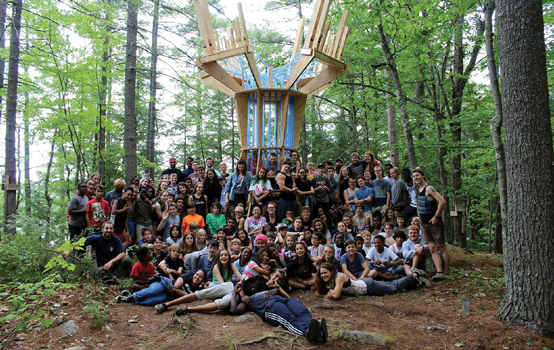
Above: Campers at Beam Camp with the Pipe Tree, a fully functioning human-operated pipe organ. Courtesy of Beam Center.
A world of learning possibilities exists outside schools, but bringing them into schools makes them subject to those schools’ structures and constraints.
A “digital poetry machine” displays students’ poems on a wall and posts them to Twitter. An enormous mechanical, solar-powered “flipbook” reveals animated images when a crank is turned. A giant graphing calculator uses lightboxes to display algebraic functions. . . These large-scale installations were designed and built by students, teachers, and artists working with the Beam Center, a nonprofit collective in Brooklyn, New York, that helps young people pursue creative projects that merge art and engineering. Meanwhile, staff at Atlantic Impact, a small organization based in Detroit, Michigan, have been taking students on excursions to their surrounding neighborhoods and destinations abroad. And in Singapore, a variety of government agencies, businesses, cultural institutions, and community groups have created interdisciplinary learning programs as part of a government-supported strategy to shift the entire educational system toward a more student-centered and holistic approach to teaching and learning.
Each of these efforts reflects the growing interest, both in the United States and overseas, in the learning that takes place outside of conventional school settings. To an extent, such programs provide an escape from the usual classroom routines, immersing young people in the sorts of engaging and personally meaningful projects that schools rarely offer (Bell et al., 2009; Mehta & Fine, 2019; Rogoff et al., 2016). In my latest book, I argue that while these kinds of teaching and learning tend to be defined as “extracurricular,” they can play a central role in the larger effort to transform K-12 education for the better (Hatch, Corson, & van den Berg, 2021).
Ironically, the lesson that school-based educators can learn from these programs has nothing to do with escaping the familiar constraints of classroom life. Rather, the point is to come to terms with those constraints, both to appreciate the kinds of teaching and learning that schools make possible and to find places where they allow for more flexibility than we tend to assume. By gaining a clearer understanding of the advantages offered by alternative educational settings, we can more clearly see why it is so hard to sustain and scale up unconventional teaching practices within conventional schools. More important, we can see ways for school-based educators to create some of the enviable conditions that after-school programs, summer camps, and other “niche” learning experiences tend to enjoy.
Conditions for learning inside and outside schools
To explain why school reformers have always struggled to achieve dramatic, lasting changes in K-12 education, David Tyack and Larry Cuban (1995) point to what they call “the grammar of schooling,” or the set of deeply rooted structures and practices that most people think of as normal features of life in school. For instance, most Americans take it for granted that high school students are supposed to take a set of yearlong classes, each one focusing on a discrete subject, taught in a “teacher-directed” manner in an “egg crate” building that groups together students of the same age and moves them through the curriculum at the same pace.
Every part of the educational setting opens doors to some opportunities and closes doors to others.
These deeply familiar and enduring characteristics of life in schools create what the psychologist James J. Gibson (1977) called “affordances,” referring to the things that our tools and environments make it possible (or “afford” us the opportunity) to do. For example, balls afford opportunities for throwing, rolling, and kicking, while books afford opportunities for reading (and, for that matter, elevating your computer to give you a better camera angle for a Zoom call). At the same time, the characteristics that make some things possible can make other things more difficult, or even impossible. For instance, dividing schools into individual classrooms makes it possible for each teacher to work with
a single group of students, yet separate classrooms also make it more difficult for teachers to collaborate with one another. Similarly, although multiple-choice tests afford standardization and quick machine-grading, they also promote a focus on fact- and recall-based questions.
Every part of the educational setting — from the building layout and the daily schedule to teachers’ employment guidelines and the state regulations that govern magnet schools, charter schools, and regular district schools — opens doors to some opportunities and closes doors to others. They can even shape what happens on campus in the evening and over the weekend, when the structures and policies that govern the regular school day do not apply. For example, extracurricular, after-school, and summer programs that take place inside school buildings have to accommodate themselves to the school’s layout and facilities. Moreover, the school environment and policies can even influence what goes on in programs outside the school building. For instance, a tutoring program held at a library or community center may come under pressure to help students prepare for the school’s upcoming round of standardized tests. Or it may simply be constrained by local assumptions about what “real” teaching and learning looks like (e.g., the teacher should do most of the talking, desks should be organized in rows, and so on; Metz, 1989).
These affordances can pose all sorts of challenges for people who create alternative learning programs, limiting when and where they can provide services, what facilities they can use, and what kinds of instruction they can offer. But those programs can also take advantage of “niches of possibility,” settings and situations where unconventional, student-centered, hands-on, and holistic approaches to teaching and learning are more likely to take off (Cohen & Mehta, 2017; Hatch, Corson, & van den Berg, 2021). And when people find or create these niches, they may be able to influence the local school system in ways that school leaders and reformers rarely can, in their efforts to implement a new policy or scale up an existing program.
Finding a niche for more powerful learning in schools
Founded by Brian Cohen and Danny Kahn, a pair of veteran music producers, the Beam Center started out in 2005 as a summer camp in New Hampshire. The general idea — to offer project-based learning opportunities in an environment far removed from a conventional classroom — was inspired by Cohen’s own childhood experiences at camp. But the specific approach to teaching and learning was based on Cohen and Kahn’s work in the music business, particularly their knowledge of the production process. “As record company people,” Cohen explained, “our whole lives revolved around talent and cultivation and management and respect.” As they saw it, the goal was to bring together design experts and young people and help them create and complete large-scale collaborative projects like a 20-foot-long creature that campers could pedal around a lake, or a “Pipe Tree” — a “fully functioning, human-operated pipe organ” nestled among (and shaped like) the trees in the forest.
From the beginning, Cohen and Kahn hoped to bring the “magic of camp” to students in schools, as well. But to fit those kinds of large-scale productions into the school environment, they had to confront the schools’ subject-based schedule and age-graded courses, the demands of a “mile-wide, inch-deep” curriculum and high-stakes tests, and assumptions about what a “real school” and “real learning” look like.
Beam found its niche at Brooklyn International High School, a school that was already challenging conventional structures and practices in several ways. Part of a network of 27 schools around the country, Brooklyn International serves immigrant students who have spent less than four years in U.S. schools. Instead of sorting students by age, grade, or academic or linguistic ability, the school creates heterogenous groups of students. And, as a member of the New York Performance Standards Consortium, the school had a waiver from the state to avoid mandated state testing and to skip most of the Regents exams required for graduation (only the exam in English Language is required). Instead, the school established its own graduation requirements based largely on a portfolio of performance-based tasks and presentations. Given all these conditions, Brooklyn International occupies a setting “on the margins” of the public school system and does not face all of the pressures that sustain the familiar grammar of schooling. All of this made the school a fitting home for a program like Beam.
But if Brooklyn International was good for Beam, so, too, was Beam good for the school. Its creative productions met the school’s need for activities that could engage students from many backgrounds and with varying experiences with formal education, giving them opportunities to collaborate on projects and then — during the celebrations that accompanied the public unveiling of their work — share them with their wider community.
When we try to improve educational opportunities and life outcomes by focusing solely on what happens in schools, we severely limit our ability to support children’s development.
As a nonprofit organization, Beam’s partnerships depend on donations, foundation grants, and earned revenue from city contracts. They use those funds to pay their experts and staff and pull together the needed materials and equipment. At schools like Brooklyn International, Beam helped create a Digital Fabrication Lab, trained a former student to manage the lab, and co-designed and co-led projects with teachers, providing professional development activities both at the school and at Beam’s own well-equipped headquarters.
Each project involved two 90-minute sessions per week (during the regular school day) for 8-12 weeks. Through these activities, Beam effectively boosted the capacity of its partner schools, enabling them to create projects and products that previously did not seem possible within a typical classroom setting. And because Beam could plug its activities into the regular school day, it didn’t require major changes to existing instructional practices or schedules. In short, Beam was able to meet important needs without creating additional burdens. Some teachers then attempted similar projects in their classes, but the primary goal of the partnership was to create new niches within the school where different kinds of learning experiences could exist, not to turn the entire curriculum into a series of projects.
Since launching its in-school efforts at Brooklyn International, Beam has been able to expand into a series of other schools in New York City, many with similar characteristics to the International schools. At the same time, Beam capitalized on what it was learning about schools’ needs by developing and installing FabLabs in 17 different schools. These self-contained labs include equipment like basic shop tools, laser cutters, electronics equipment, 3D printers, computers, and design software that students and teachers can use. They serve as a resource for Beam’s collaborative projects, but they can also operate independently, providing the equipment that teachers and students can draw on in regular courses, project-based electives, and after-school workshops. These FabLabs could easily be used to establish makerspaces or update existing libraries or computer labs, making it possible for some aspects of Beam’s approach to find a niche in more conventional schools even without a more extensive collaboration with Beam staff.
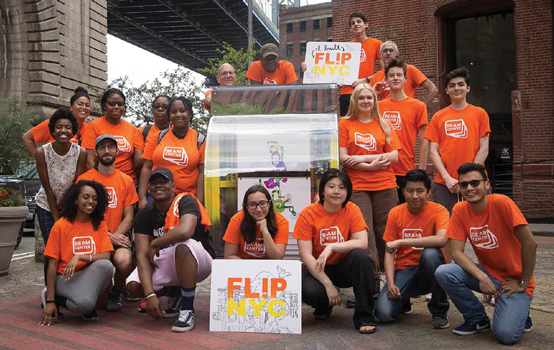
Beam program participants in Brooklyn with one of their solar-powered flipbooks. Courtesy of Beam Center.
Creating a pathway to learning outside school
As Beam worked to get large-scale learning productions into schools, Atlantic Impact developed ways to get students out of school to take advantage of “real-world” learning opportunities in workplaces, neighborhoods, and foreign countries. But getting beyond the expectations and affordances of conventional schooling took almost five years and a lot of trial and error.
Atlantic Impact’s founder, Anise Hayes, came to see the power of trip-based learning experiences in 2010 during an internship for Birthright Armenia, a nonprofit that enables young people of Armenian descent to return to Armenia to explore the language and heritage of their ancestors (much like programs run in Israel and several other countries). As Hayes explained, “I saw what happens when young people can walk through [a place], rather than someone just saying to them, ‘this is what life looks like.’ ” With that spark lit, in 2012 she launched Atlantic Impact in one Detroit public school to give students opportunities to learn through field trips and by traveling in their community and internationally.
Hayes quickly discovered that she had to find a way to fit the program into the school’s existing policies and requirements without diluting her experiential approach or her beliefs about what the school’s students can achieve. The first year, she decided to create and teach a course during the regular school day that would introduce students to the world of higher education, help them plan for and apply to college, and take them on trips to visit campuses. However, she found that while the field trips were as rewarding as she had hoped, she and her staff had a lot of time to fill between those trips, and this classroom time wasn’t nearly as interesting, engaging, or personally meaningful to students as the excursions were.
So, Hayes shifted gears. The next year, instead of teaching another course, she created an “advisory” session during the school’s lunch period, inviting students to join in if they liked. That is, rather than relying on the affordances of a conventional course, with daily lessons and regular assignments, Atlantic Impact began to reap the benefits that an informal gathering made possible. Students had the opportunity to participate in team- and skill-building activities, but they could come and go as they pleased, making the program feel more like hanging out with peers and program staff than going to class. In that context, the students were comfortable talking openly about their interests and goals. They freely shared ideas about what they wanted to learn and what kinds of trips they wanted to take, and they helped plan the sessions and trips themselves.
A number of students said that while they enjoyed the trips to see local colleges that were initially part of the program, they also wanted to visit workplaces that could introduce them to meaningful careers they might want to pursue. So, Hayes expanded the program to include excursions to local businesses and community organizations that could help students learn about various jobs and, if they were interested, get started on the certification processes those jobs required. To implement that plan, though, Hayes had to confront the school’s conventional focus on college preparation and the tendency to relegate career and technical education to separate, lower-level tracks. For instance, on the very first day of the new career-focused programming, she discovered that all of the students in the room had been labeled as having “special needs.” It turned out that the school’s counselors had encouraged these students to take advantage of the program because “trades are for people who are not academically prepared.” Clearly, it wouldn’t be enough for Atlantic Impact to fit itself into the school’s schedule, it also had to push back against prevailing assumptions about the status of career education and the learning needs of particular students.
In spite of these challenges, Hayes and her colleagues managed to raise funds from grants and donations and gradually established a series of informal, noncredit programs within the regular school day, including Our Town (which takes students on local field trips that provide entry points and employment preparation for in-demand skilled trades) and Our World (which connects young people with college student mentors and sends them on trips abroad). In the process, the program has gone from working with a small group of students in one Detroit high school to working with groups of students drawn from schools across the city. In 2019-20, Atlantic Impact offered almost 150 trips and more than 12,000 hours of programming, with plans to expand further once the coronavirus pandemic wanes.
Connecting in- and out-of-school learning environments
In Singapore, efforts to build on learning opportunities outside school go far beyond the work of individual entrepreneurs. These efforts have taken off in recent years, as part of a shift to support more student-centered teaching and holistic education goals that began with the “Thinking Schools, Learning Nation” campaign in 1997. When that initiative began, Singapore had already created a highly effective comprehensive education system out of the small collection of English, Chinese, Tamil, and Malay schools that existed when Singapore became self-governing in 1959. Although Singapore’s students had achieved some of the highest rankings on international tests like the Trends in International Mathematics and Science Study (TIMSS), there were concerns about the narrow academic focus of the curriculum and limited opportunities for students to develop their creativity and critical thinking. The Thinking Schools, Learning Nation campaign aimed to increase the quality of education for all students by differentiating the curriculum and giving students greater flexibility and choice. By 2011, Singapore began to broaden and diversify the curriculum even more by emphasizing opportunities to support students’ holistic development and 21st-century competencies (Goh & Gopinathan, 2008).
In conjunction with that latest shift, the Singapore government works systematically to take advantage of the affordances of learning experiences created by camps, sport teams, clubs, cultural institutions, government agencies, and community organizations, and actively aligns and connects work in this “outside of school sector” with efforts to expand the focus of learning in schools.
As part of this effort, the Singaporean government encourages many different organizations to use their resources and expertise to create projects, internships, and other learning opportunities that are more hands-on, authentic, and interdisciplinary than conventional school activities. These efforts include financing and support for required “co-curricular” activities such as physical sports, “uniformed groups” like the Boy Scouts and Girl Scouts, and visual and performing arts groups. (Singapore deliberately uses the term co-curricular instead of extracurricular to signal these activities are as essential as in-school activities.) On top of that, the government also supports learning outside of school by sponsoring field trips, guided walks on local heritage trails, “Learning Journeys,” and a five-day outdoor adventure camp required of all secondary students.
The Learning Journeys program, launched by the Ministry of Education in 1998, provides a good example of how Singapore systematically seeds and supports learning opportunities outside schools. Much like the excursions organized by Atlantic Impact, Learning Journeys touches on multidisciplinary themes, offering students opportunities to experience new cultures and environments. The government provides start-up funds for organizations to develop trips that address some aspect of the national curriculum, often including a focus on Singapore’s history, development, geography, and national identity. Many of these trips also introduce students to in-demand jobs and careers. For instance, the Energy Market Authority (responsible for maintaining Singapore’s energy supply) has established five different Learning Journeys events, such as “Gas It Up” and “Clean and Green,” which take students behind the scenes in local energy facilities so they can see how engineering concepts are applied in the world and consider seeking out a career in the power sector. The government requires that all students have a chance to participate in at least one Learning Journey event every year, and it provides funding for schools and a wide range of partners — such as public agencies, museums, and both for-profit and nonprofit organizations — to design and run programs.
At the same time, this government support comes with certain constraints that reinforce conventional school practices. For example, because Learning Journeys is required to teach material from the national curriculum and help students meet specific academic expectations, they don’t provide the sort of flexibility and fully interest-driven experiences that characterize what Shirley Brice Heath calls “voluntary learning” (Corson, 2021). Thus, while the Singapore government emphasizes the importance of holistic child development, conventional expectations about what school is supposed to do still hold sway. For instance, partner organizations are well aware that the most popular programs among students, parents, and teachers tend to be those most closely linked to academic topics in tested subjects.
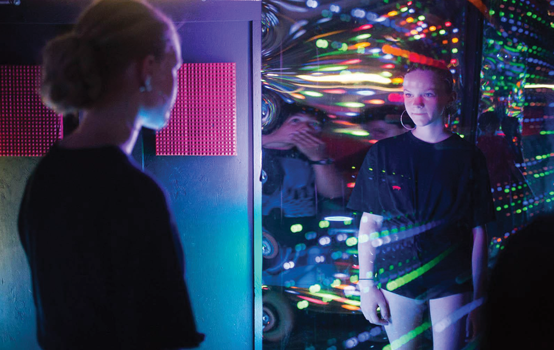
Beam Camp participants inside the Time Tomb, a hall of mirrors and lights they helped build in the woods. Courtesy of Beam Center.
Possibilities and constraints for scaling up
These examples illustrate both the possibilities and constraints that come with trying to take advantage of learning opportunities outside of school. On the one hand, large-scale efforts like those in Singapore can contribute to incremental changes that broaden and expand students’ learning opportunities over long periods of time. Those changes may take 30 or 40 years, but the success of Singapore’s systemic, decades-long efforts to create a comprehensive education system suggests that such deliberate, careful planning can indeed bear fruit over time. On the other hand, the work in Brooklyn and Detroit demonstrates ways that individuals and organizations working largely on their own can, in a relatively short span of time, find and create niches within conventional systems that support more student-centered learning experiences and the development of a much wider range of abilities.
These successes at developing new learning opportunities that fit the current conditions suggest a different theory of action from many large-scale reform efforts. Instead of trying to change instruction across all levels, subjects, and contexts, this approach concentrates on creating more powerful learning experiences in situations where those alternative experiences are most relevant and likely to take hold. For example, rather than trying to shift from teacher-centered to student-centered learning overall or from a narrow academic focus to a broader, more holistic focus, educators can find ways to make more powerful learning possible in a whole series of different situations, both inside and outside school.
In either case, whether making big transformations or finding small niches for change, creating conditions that support the kind of learning possible outside conventional classrooms requires us to stop equating education with schooling. When we try to improve educational opportunities and life outcomes by focusing solely on what happens in schools, we severely limit our ability to support children’s development. Supporting the development of every child depends on recognizing that success in life depends on far more than formal schooling; It depends on establishing educational systems that embrace and support the development of the whole child, for the whole day.
References
Bell, P., Lewenstein, B., Shouse, A., & Feder, M. (2009). Learning science in informal environments: People, places, and pursuits. National Academies Press.
Cohen, D.K. & Mehta, J.D. (2017). Why reform sometimes succeeds: Understanding the conditions that produce reforms that last. American Educational Research Journal, 54 (4), 644-690.
Corson, J. (2021, March 3). Ways with learning: Conversations with Shirley Brice Heath about nonformal education. International Education News.
Gibson, J.J. (1977). The theory of affordances. In R. Shaw & J. Bransford (Eds.), Perceiving, acting, and knowing: Toward an ecological psychology (pp. 67-82). Erlbaum.
Goh, C.B. & Gopinathan. S. (2008). The development of education in Singapore since 1965. In S.K. Lee, C.B. Goh, B. Fredriksen & J.P. Tan (Eds.), Toward a better future: Education and training for economic development in Singapore since 1965 (pp. 12-38). The World Bank and the National Institute of Education (NIE) at Nanyang Technological University.
Hatch, T. with Corson, J. & van den Berg, S.G. (2021). The education we need for a future we can’t predict. Corwin.
Mehta, J. & Fine, S. (2019). In search of deeper learning: The quest to remake the American high school. Harvard University Press.
Metz, M.H. (1989). Real school: A universal drama amid disparate experience. Politics of Education Association Yearbook, 75-91.
Rogoff, B., Callanan, M., Gutiérrez, K.D., & Erickson, F. (2016). The organization of informal learning. Review of Research in Education, 40 (1), 356-401.
Tyack, D.B. & Cuban, L. (1995). Tinkering toward utopia: A century of public school reform. Harvard University Press.

ABOUT THE AUTHOR

Thomas Hatch
THOMAS HATCH is a professor of education and director of the National Center for Restructuring Education, Schools, and Teaching at Teachers College, Columbia University, New York, NY. He is the author, with Jordon Corson and Sarah Gerth van den Berg, of The Education We Need for a Future We Can’t Predict .