A Look Back
Technology alone won’t transform teacher to facilitator
By Dennis McGrath & Monica Martinez
April 2014, pp. 41-45
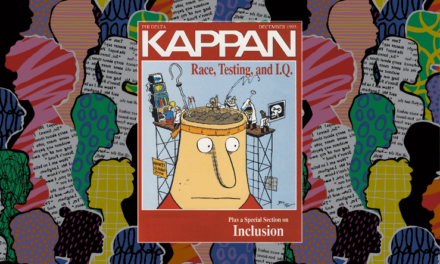
Although the tools are evolving, the modern era of education technology marks an inflection point for the teaching profession. In a 2014 Kappan article, educators Dennis McGrath and Monica Martinez reflect on the task of improving schools in a tech-saturated world. Their advice for educators? Adopt a more thoughtful approach to designing learning experiences and let technology serve as one tool among many to support the acquisition of knowledge.
“As facilitators, teachers become learning strategists who constantly plan ways to enable students to master complex content knowledge and develop their critical thinking, problem-solving, communication, and collaboration skills,” they write. “In this construct, technology has a small, disruptive, yet supportive function in changing the role of teachers.” A greater portion of a teacher’s work within the facilitator role happens before students ever set foot in the classroom. Educators prepare lessons that intentionally push students toward deeper learning and identify people and resources outside the school who could augment what’s taught in the classroom.
Educators in the facilitator role also create classroom systems steeped in inquiry and reflection. “(T)he technology-as-driver-of-change argument mischaracterizes how professionals restructure their work and redefine their roles,” McGrath and Martinez write. “Professional work is never fundamentally altered merely by external forces, and teacher roles won’t change by simply hooking up and connecting to the Internet. Instead, the new model requires empowering teachers to break out of their isolated roles.”
Conversation Piece
This issue of Kappan focuses on the use of artificial intelligence (AI) and other technologies in education. Use these questions to reflect on the topic with your colleagues:
- What is the most effective use of technology that you’ve seen in your school? What made it effective?
- What is the least effective use of technology that you’ve seen in your school? What would have made it more effective?
- What policies should schools put in place regarding the use of AI, cell phones, and other technologies?
- How have you used AI, either personally or professionally? What was your impression of its abilities?
- The authors in this issue present a variety of views about the use of AI. Where do you stand on the issue and why?
PDK members have access to discussion guides related to specific articles in each issue of Kappan. Log in to the member portal and access the discussion guides at https://members.pdkintl.org/PDK_PLT_Member_Discussion_Questions.
Research Notes
Survey: Teachers find device use problematic
Student cellphone use is disruptive to learning and teachers worry that constant contact with devices poses risks to the health and well-being of children, according to data collected by the National Education Association. In a 2024 survey of 2,889 U.S. teachers, 90% of educators working in schools that allow personal devices found the practice very disruptive to learning.
Educators overall also reported worrying that use of social media has led to cyberbullying and underdeveloped social skills among today’s kids, contributing to a rise in mental health concerns. “The NEA polling results are consistent with recent findings by the American Psychological Association (APA), whose own concerns about social media rest in part on youths’ neurological hypersensitivity and susceptibility to social media feedback, praise, and harmful content,” NEA researchers note in the report.
Source: National Education Association. (2024, August 14). Impact of social media and personal devices on mental health.
Survey: Young people have a nuanced view of AI
In a 2023 survey, 41% of young people reported they believed generative AI would likely have both positive and negative impacts on their lives over the next decade. The choice garnered the largest share of agreement among respondents, far outpacing the next most popular responses — the belief that AI’s effects would be mostly negative (19%) or mostly positive (16%). Those predicting positive personal impacts said they believed AI would help them with school and work, boost creativity, and create new opportunities for human advancement. Those anticipating mostly negative effects shared concerns about job loss, intellectual property theft, misinformation/disinformation, privacy, and an overall fear of AI “taking over the world.”
The survey included more than 1,000 young people between the ages of 14 and 22. This generation, researchers note, “not only serve as early adopters and influencers in the digital realm,” they also “stand at the forefront of grappling with its implications.”
Source: Hopelab, Common Sense Media, & The Center for Digital Thriving at Harvard Graduate School of Education. (2024, June 3). Teen and young adult perspectives on generative AI: Patterns of use, excitements, and concerns.
“ChatGPT cannot write. Generating syntax is not the same thing as writing. Writing is an embodied act of thinking and feeling.”
― John Warner, More Than Words: How to Think About Writing in the Age of AI (Basic Books, 2025)
New research to measure impact of ChatGPT on schools
ChatGPT arrived at the schoolhouse door in late 2022 and was put to use by students and teachers in fairly short order. But how efficient is this new tool in supporting learning? A collaborative project launched this summer by researchers at Stanford University seeks to answer that question. OpenAI, the creator of ChatGPT, has agreed to share data from real K-12 schools across the globe as researchers aim to determine how the large language model affects a range of student outcomes. Specifically, they hope to learn how students and staff use tools like ChatGPT and which factors drive AI usage up or down. Researchers also want to determine if certain types of AI use can improve student learning and investigate whether tools like ChatGPT can support deeper learning practices such as self-regulation and metacognition.
Source: Agnew, C. (2025, July 29). How is ChatGPT impacting schools, really? Stanford researchers aim to find out. Stanford Accelerator for Learning, Stanford University.
Career-readiness and AI fluency
Knowing how and when to use AI is a sought-after skill in the workforce, according to a new report from Microsoft. In the past year, the percentage of jobs on LinkedIn requiring AI literacy has increased more than sixfold. As students enter the workforce, today’s learners will need to know:
- How to use AI as a colleague/team member
- How and when to delegate tasks to AI, instead of a human worker
- How to think like a manager, “since everyone will be managing AI”
“My theory is that educational institutions are going to start to think about, how do we essentially produce early-in-career talent that works as well as mid-career talent used to?” muses Jared Spataro, chief marketing officer for Microsoft’s AI at Work team. “In other words, during their education, how do they learn to become the boss of agents, such that they are able to command a team, able to produce the same amount of work a medium- or large-size team would produce. And we expect that early-in-career folks will be able to do that work with the aid of these tools.”
Source: Microsoft Corporation. (2025). 2025 AI in education: A Microsoft special report.
Teens and AI companions
Nearly three out of four teens have used AI companions, with a third of all teens seeking out platforms like CHAI, Character.AI, Nomi, and Replika for social interaction and relationships. Those findings come from a spring 2025 survey commissioned by Common Sense Media of over 1,000 kids between the ages of 13 and 17.
Concerns about how teens interact with AI companions have increased as their use becomes more widespread. In 2024, a 14-year-old whose parents said he fell in love with an AI companion died by suicide seconds after chatting with the bot. In the months leading up to the Florida boy’s death, the chatbot had engaged in sexual conversations with the boy and continued to bring up the topic of suicide, even after the teen shared thoughts of self-harm.
“Current research indicates that AI companions are designed to be particularly engaging through ‘sycophancy,’ meaning a tendency to agree with users and provide validation, rather than challenging their thinking,” researchers note. “This design feature, combined with the lack of safeguards and meaningful age assurance, creates a concerning environment for adolescent users, who are still developing critical thinking skills and emotional regulation.” Although half of teens surveyed said they distrusted the information provided by AI companions, nearly a third of respondents reported finding AI conversations “as satisfying or more satisfying than those with real-life friends.”
The report includes advice for parents, policy makers, tech companies, and schools. Educators, in particular, can help teens by explaining that AI companions “are designed to create emotional attachment” and can help students differentiate between “AI validation and genuine human feedback.”
Source: Common Sense Media. (2025). Talk, trust, and trade-offs: How and why teens use AI companions.
“All of us as a society have the potential to level up the work that we do with the help of AI…We can help students level up their work as well, but teachers need that training to help them do it right.”
― Joseph South, chief innovation officer for ISTE + ASCD, quoted in an October 2025 EdWeek article on the rise of AI in schools
Classroom phone bans increase academic performance
A randomized controlled study involving nearly 17,000 college students confirms what many educators at all levels suspect: Banning phones from classrooms improves achievement. Researchers from the U.S., India, and Denmark found that mandatory phone collection led to higher grades, with the results especially pronounced among lower-performing, first-year, and non-STEM students. Random classroom observations showed fewer instances of student chatter and increased engagement.
Following the study, students in the affected classrooms were more supportive of phone-use restrictions. “The results suggest that in-class phone bans represent a low-cost, effective policy to modestly improve academic outcomes, especially for vulnerable student groups, while enhancing student receptivity to digital policy interventions,” the researchers note.
Source: Sungu, A., Choudhury, P.K., & Bjerre-Nielsen, A. (2025, July 25). Removing phones from classrooms improves academic performance.
As schools increase their use of AI, new risks to students emerge
Four emerging risks have surfaced as schools increase their use of AI, according to an October 2025 report from the Center for Democracy and Technology. Those risks include:
- Data breaches and ransomware attacks
- Tech-enabled sexual harassment and bullying
- AI systems that do not work as intended
- Troubling interactions between students and technology
One example given was related to so-called deepfakes, the term for videos, photos, or audio recordings that appear real but have been manipulated to make it seem as if a real person has said or done something they have not. In schools that use AI most frequently, 61% of students report having heard of a non-consensual intimate deepfake video or image depicting someone associated with their school. Conversely, only 16% of students from schools that use AI for “few to no reasons” reported the same experience.
“Identifying the concrete risks that accompany the use of AI in schools enables educators, school administrators, policymakers, and communities to mount prevention and response efforts such that the positive uses of AI do not inadvertently harm students,” researchers note in the report’s introduction.
The survey touched on a wide range of concerns. Other areas examined include the educational impacts of AI, student use of chatbots, the use of AI to construct IEP and 504 plans, and student activity monitoring. Also addressed were concerns that AI use by schools could put data related to a student’s gender identity or immigration status at risk.
Source: Laird, E., Dwyer, M, & Quay-de la Vallee, H. (2025, October). Hand in hand: Schools’ embrace of AI connected to increased risks to students. Center for Democracy & Technology.
AI considerations for students with intellectual disabilities
The dawn of AI offers great promise — as well as possible perils — for children with intellectual and developmental disabilities (IDD), according to 2024 survey of teachers and parents conducted by the Special Olympics Global Center for Inclusion in Education. One potential benefit is improved educational outcomes due to the ability of AI platforms to make “information more accessible for students with IDD by summarizing and simplifying it.” But parents and teachers who responded to the survey also worried the new tools have the potential to “decrease human interaction” — an especially daunting prospect for a population that already experiences marginalization. Other concerns include inequalities in access to AI tools based on income level.
Source: Special Olympics Global Center for Inclusion in Education. (2024). Attitudes towards education and AI. Special Olympics International.
This article appears in the Winter 2025 issue of Kappan, Vol. 107, No. 3-4.