A look back
Our Greatest Social Achievement
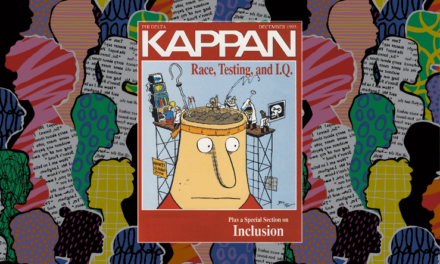
By Earle U. Rugg, November 1955, pp. 69-74.
The quality of U.S. schools has long captured the public’s attention and spurred debate, as this 1955 Kappan article illustrates. But for those conversations to be truly fruitful, those engaged in them must accept a few key notions, argues Earle U. Rugg. First, discussions about school quality should be couched in fact. And second, those engaged in debate must accept that change is inevitable.
When this article was written — nearly 70 years ago — a vocal portion of the public longed for a return to “the good old days” of education. But “too many Americans are very slow in recognizing social changes and more especially accepting them,” Rugg notes, paraphrasing a 1922 academic paper. He continues: “This cultural lag helps explain in part . . . stereotypes about public schools.”
Rugg also cautions against giving the loudest voices the most attention. “The negative critics would have you believe not only that their charges are based on fact but that they voice what most people believe,” Rugg writes. Yet public opinion polls from the time showed that a large proportion of Americans believed schools were better, or as good as, they had been 30 to 40 years earlier. “Now we literally teach all the children of all the people, in contrast to estimates 50 years ago that we taught only the upper 20 per cent,” Rugg reflects. “In spite of such obstacles, the public school is still the only common denominator of America’s greatest capital — children.”
Conversation piece
This issue of Kappan focuses on public opinion of schools. Use these questions to reflect on the issue with colleagues:
- What do you think the public gets right and wrong about your school and about schools in general?
- What do you think shapes people’s opinions about schools?
- Multiple articles in this issue cite a disconnect between Americans’ opinions about their local schools and about U.S. schools as a whole. What do you think is the reason for this disconnect?
- What’s the one thing that you most wish everyone understood about schools?
- What do you think schools could do to improve the public’s understanding?
PDK members have access to discussion guides related to specific articles in each issue of Kappan. Log in to the member portal and access the discussion guides at https://members.pdkintl.org/PDK_Member_Discussion_Questions.
“It should worry us that, as a nation, the United States seems to be invested in tearing down the enormous possibility and promise of public education. In retelling that our children’s opportunities have been irredeemably destroyed, we impair the possibility of collective inspiration for how to move forward.”
– Deborah Loewenberg Ball, “Why is the nation invested in tearing down public education?” Education Week, February 2024
Research connections
Public perceptions of U.S. schools
Roughly half (51%) of U.S. adults believe the country’s schools are going in the wrong direction, according to a Pew Research Center survey conducted in November 2023. Of those displeased, a majority of respondents said schools are not spending enough time on core academic subjects. Conservative Republicans were most likely to say that public education is going in the wrong direction, but respondents from a variety of ideological backgrounds voiced concerns about schools, though they differed in their reasoning. Democrats, for instance, were more likely to point to insufficient school funding and resources as factors negatively impacting school quality.
Source: Pew Research Center. (2024, April). About half of Americans say public K-12 education is going in the wrong direction.
Science standards
Adoption of the Common Core State Standards more than a decade ago was contentious in many corners of the country. But another set of learning objectives — the Next Generation Science Standards (NGSS) — yielded more positive feedback, according to a 2021 research paper. Measuring public sentiment on the social media network Twitter (now known as X), researchers found only 11 negative posts for every 100 positive posts about the science standards. More impressively, from 2010 to 2020, “as the NGSS were adopted and implemented, sentiment about them became more positive.” Researchers believe their findings show that a positive response to systemwide reform is possible, and cite the timing, timeliness, and strong research base of NGSS as key factors in their success.
Source: Rosenberg, J.M., Borchers, C., Dyer, E.B., Anderson, D., & Fischer, C. (2021). Understanding public sentiment about educational reforms: The Next Generation Science Standards on Twitter. AERA Open, 7.
School funding and teacher salaries
Substantial percentages of Americans believe increases are needed in teacher salaries (60.32%) and school funding (39.03%), according to a 2024 paper that also examined the factors influencing respondents’ perceptions. Only 8.4% of those surveyed thought teacher salaries should decrease, while 22.11% believed school funding was too high. The poll was conducted at the height of the COVID-19 pandemic in 2020-21, leading researchers to conclude “that citizens mainly remained convinced of the need for educational funding and an increase in teachers’ salaries, even at a time when schools and teachers could not contribute to their full potential.” Researchers also found that giving respondents additional contextual information could influence their views. They go on to suggest that the work of journalists, researchers, and policy makers could go a long way toward framing public perceptions on issues surrounding teacher pay and school funding.
Source: Willems, J. & Andersson, F.O. (2024). Public opinion on school funding and teacher salaries: The information gap explained? Educational Evaluation and Policy Analysis.
Framing and parental attitudes
Can the way educators promote specific programs influence parental perceptions? New research suggests yes. A 2023 paper by a researcher at Florida State University found evidence that the way career and technical education (CTE) is framed may influence parental attitudes, including their willingness to pay additional taxes to support CTE. Likewise, the paper posits, educators and policy makers who effectively listen to the desires of parents and students are better positioned to craft CTE programming and policies that address community wants and needs.
Source: Ecton, W. (2023). Framing parents’ attitudes toward career and technical education. Education Policy Analysis Archives, 31 (98).
“Nothing is perfect. Banks aren’t. Congress isn’t. And neither are our public schools . . . But only public schools have as their mission providing opportunity for all students. And by virtually any measure — conversations, polls, studies, and elections — parents and the public overwhelmingly like public schools, value them, need them, support them — and countless Americans
love them.”— Randi Weingarten, president of American Federation of Teachers, National Press Club, March 2023
This article appears in the September 2024 issue of Kappan, Vol. 106, No. 1, p. 5-6.