This fall has been exciting, with some national exposure for our Educators Rising program in Pennsylvania.
Thanks are due to the Pennsylvania State Education Association, which has taken the lead to address the teacher shortage in the state by establishing more Grow Your Own programs in districts, using Educators Rising. A three-year $750,000 grant from the National Education Association is helping to establish new chapters across the commonwealth.
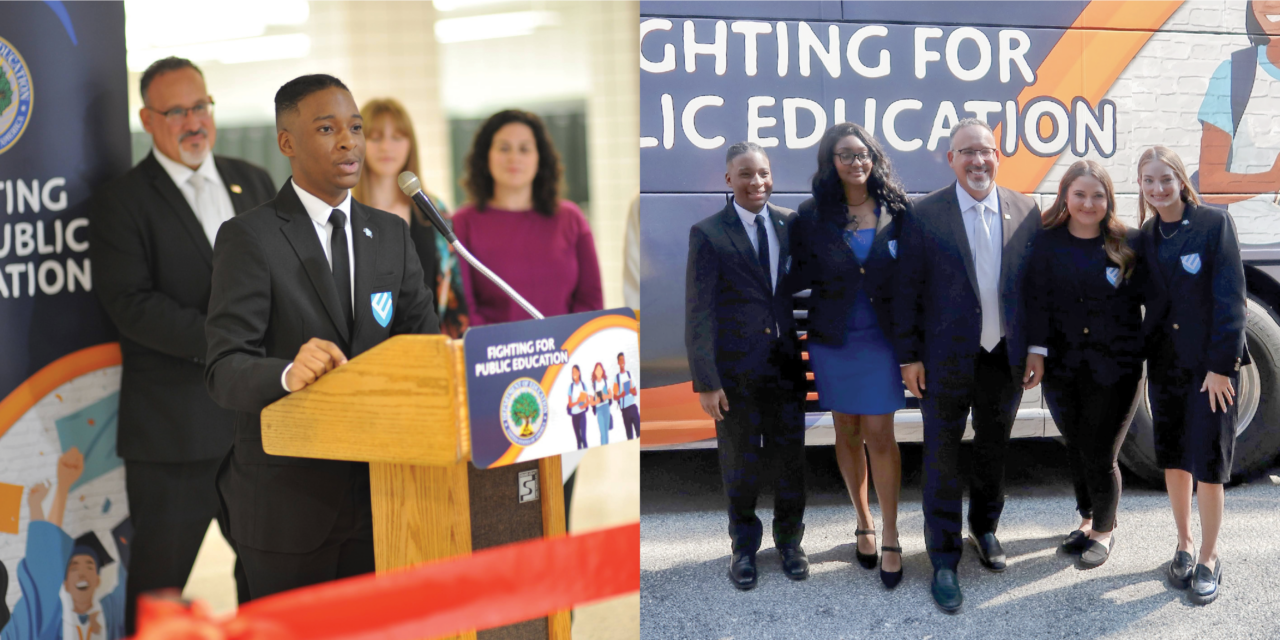
Secretary of Education Miguel Cardona stopped in Pennsylvania to help inaugurate a new Educators Rising chapter at Keystone Oaks High School in Pittsburgh. He performed a ribbon-cutting ceremony with the state secretary of education, Khalid Mumin, and U.S. Rep. Chris DeLuzio. All four of our Educators Rising national student officers went to Pittsburgh to participate in this ceremony. The district invited our national vice president of service, Char’Tayvious Edwards, to introduce Secretary Cardona. He used the opportunity to talk about how he came to Educators Rising and the program’s ability to develop his leadership capacity. His message resonated with everyone, including the secretary!
The story in Keystone Oaks is like many we hear, as communities look for solutions in addressing the reality that teaching is hard work that is too often undervalued. The 2024 PDK Poll told us as much, when we asked if parents would support their children going into the field. A majority (60%) said they would not, citing inadequate pay and benefits (33%) and lack of student discipline (27%) as the leading reasons. Despite this, our program is infused with positivity and optimism around what’s possible when you become an instructional leader in a classroom.
Our poll this year also asked Americans about their support for artificial intelligence (AI) use in education. We followed up on this by issuing a rapid response survey to our teacher audience. Some of you may have responded! With every major technology vendor planning and implementing integration of AI capabilities into their new phones and computer products, we know this phenomenon is not going away. Our PDK Poll of the general public saw mild support for the use of AI in educational settings, with 62% or more supporting its use for tutoring, practicing for standardized tests, and helping teachers design lessons. Support decreased to just 43% for helping students prepare homework.
Our rapid response survey echoed support for many AI uses. General support for AI use was similar to our 2024 PDK Poll, with 67% of teachers supporting its use of tutoring scenarios, 63% supporting it for practicing for standardized tests, and nearly 69% supporting it for helping them develop lesson plans. Teachers’ attitudes about the use of AI for homework preparation was 2.6% higher than the PDK Poll figure. The interesting part, however, was that “very strong” support for AI use was much higher among teachers, ranging from 24% to 28% for applications outside of homework versus 12% to 13% for the general American public.
Of our surveyed teachers, 1.6% self-reported being an expert at the use of AI tools such as ChatGPT or Google Gemini, 12% had significant experience and comfort with these tools, and 28.8% had no experience or comfort with these tools. And 28% reported having received or planning to receive professional development around using AI this school year. Finally, we asked teachers about policies regarding AI use in their schools: 30.4% of teachers reported having either formal or informal policies in place, 27.2% had no policies in place, and 42.4% reported being unsure about whether policies were in place or noted that the question did not apply to them, as they had left the classroom.
AI will continue to impact the ways we all work. We see opportunities to help provide our Educators Rising students and teacher leaders best practices in this space. While this technology is cutting edge, it is also very new and under continuous development. But it’s clear that at least some educators are seeing benefits around its use in planning and its integration into next-generation software applications with students.
Finally, I wanted to congratulate our programs team at PDK for launching a new lesson assessments product this year for our Educators Rising Curriculum users. Under development for more than two years, the product provides participating schools an online assessment platform aligned with our standards-based curriculum. The team is also introducing a new interactive student guidebook for our curriculum clients, providing a time-saving resource that students can use alongside our five units of lessons.
This article appears in the November 2024 issue of Kappan, Vol. 106, No. 3, p. 60-62.

ABOUT THE AUTHOR

James F. Lane
James F. Lane is CEO of PDK International.