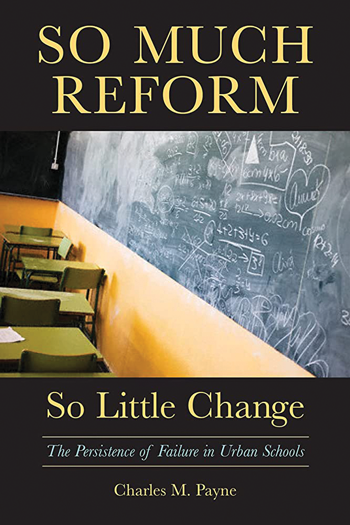
So Much Reform, So Little Change: The Persistence of Failure in Urban Schools
By Charles M. Payne (Harvard Education Press, 2008)
We live in a busy, busy time of short memories and endless spats over manufactured offenses. Add in schooling’s long history of faddishness, and you’ve got the recipe for a constant churning of unsuccessful reforms — all accompanied by little reflection and even less learning. Enter Charles Payne’s magnificent 2008 study of Chicago schooling, So Much Reform, So Little Change. This deep examination of why well-meaning efforts to improve schools so often misfire deserves to be studied by every practitioner and would-be reformer.
Payne is a roll-up-your-sleeves kind of scholar, and it shows. Explaining why reformers so often find themselves allied with marginalized zealots on the faculty, Payne notes, “Reformers from the outside, typically rejected by most staff because they are outsiders, are glad to find a receptive group talking their language.” This matters, he explains, because “Becoming involved with that group, typically a low-status social clique, immediately embroils the reform in pre-existing cleavages of race, cohort, and teaching philosophy, often before reformers are aware that such cleavages exist.”
Similarly obvious but oft-ignored insights stud page after page. A not-bad epigraph for the book is Payne’s observation that, “Virtually all reformers tout their work as ‘research-based.’ The term has been so debased that it is no longer clear that it refers to anything at all, but it clearly does not refer to research on the history of past reforms.”
This article appears in the April 2023 issue of Kappan, Vol. 104, No. 7, p. 69.

ABOUT THE AUTHOR

Frederick M. Hess
Frederick M. Hess is a senior fellow and director of Education Policy Studies at the American Enterprise Institute in Washington, DC. He is the author of The Great School Rethink and coauthor of Getting Education Right: A Conservative Vision for Improving Early Childhood, K-12, and College .