PLCs that have active and overlapping levels of accountability among members and between the PLC and school and district leadership as well as other stakeholders are likely to be more effective.
More than one building administrator has said that professional learning communities (PLCs) are a waste of time and money, calling them “gripe and gossip” sessions that take time away from teaching. More than one district administrator has complained that PLCs won’t focus unless they are required to work on a particular initiative, such as differentiation. More than one teacher has called PLCs useless, adding that they stoke endless discussions about what needs to be done and then create plans but fail to deliver anything of much help to students before the year is over.
What distinguishes effective from ineffective PLCs? Simply put, strategic accountability. Strategic accountability for PLCs is a highly nuanced approach to professional learning. Strategic accountability leads to actions that make a difference for student learning. Educators who ask themselves these questions are being strategic about accountability:
- What do we care about in our PLC?
- What are we passionate about?
- What do our data — qualitative and quantitative — tell us?
- What bothers us — or gives us pain — about students’ learning?
- What do we need to learn?
- What actions can we take on the basis of our learning to address our concerns?
- How will we know our actions have enhanced student learning?
- How can we continue to learn and work to increase student learning by being accountable ourselves?
Strategic accountability works when it comes from within a PLC and is tied to school and district missions, visions, goals, and action plans. Accountability imposed from outside a PLC — usually stemming from a top-down, albeit worthy, initiative — does not lead to the most effective PLCs.
Why should PLCs be accountable? To whom should they be accountable? For what should they be accountable? How should they be accountable? As Sinek (2009) states, start with the “why” question.
Why should PLCs be accountable?
PLCs have several reasons for being accountable. Here is a David Letterman-style countdown of the top five reasons:
#5. Parents and community members see enhanced student success when schools have effective cultures and teaching and learning processes.
#4. People who support PLCs with time, money, and other assistance feel confident that their support is reaping results.
#3. PLCs can deliver significant changes in classroom and school culture and teaching and learning processes.
#2. PLC members feel better about themselves and their colleagues when their PLC is accountable for results.
#1. Students win when classroom and school culture and teaching and learning processes lead to improved achievement and well-being.
As long as PLC members see strategic accountability as something they do to themselves, for themselves and others in the learning community, and not as something imposed from outside, they will embrace it. You can tell that strategic accountability is working when PLC members say, “Of course, we’re accountable. Why would we not be accountable?”

To whom should PLCs be accountable?
As Figure 1 indicates, PLCs should be accountable in both informal and formal ways to a variety of people:
- To themselves;
- To other PLC members individually;
- To the PLC as a whole;
- To other PLCs in the school;
- To the school as a whole;
- To the district as a whole;
- To students in the school; and
- To parents of students and community members.
For what should they be accountable?
Accountability can be both informal and formal. In informal accountability, PLC members are accountable to:
- Themselves for their own learning;
- Others in their own PLC for enhancing every individual’s learning and the learning of the group as a whole;
- Themselves and others in their own PLC for doing what they say they will do (taking actionand following through);
- People outside the PLC (other PLCs, the whole school, the district, parents, community, students) for learning and doing what they say they will do.
Informal accountability is a matter of integrity, honor, and values. Individuals may be motivated toward informal accountability by their desire to establish and maintain a positive self-concept. They may welcome accountability because of their values and beliefs, for example, in stewardship, responsibility, and service. If enough individuals within a PLC are moved to be informally accountable because of their self-concepts and values, the PLC as a whole may reach an accountability tipping point (Gladwell, 2002). When that happens, the PLC itself may become known for its focus on stewardship, responsibility, and service to education. When enough PLCs in a school are similarly moved to be informally accountable, a whole school may enact those values.
Conversely, formal accountability is based on the values that lead to informal accountability but driven by concrete outcomes. For example, PLC members and PLCs as a whole are accountable formally for these outcomes:
- Meeting goals/purposes set at the beginning of the year and documented through concrete evidence at the end of the year;
- Enhanced student learning and well-being, assessed through a variety of measures from observations, anecdotes, and surveys to test scores and student work samples; and
- Wise use of resources — both time and money.
Positive results of the first two validate the third. If a PLC sets worthy goals or purposes and achieves them in ways that result in enhanced student learning and well-being, then both time and money are well spent.
How should they be accountable?
PLCs use a variety of strategies for being accountable informally and formally.
Informal accountability
Norms (sometimes called working agreements) help both individual PLC members and whole PLCs be informally accountable. When PLC members work together to establish norms, they set up standards for behavior that lead to learning and taking action on learning to help students succeed and thrive.
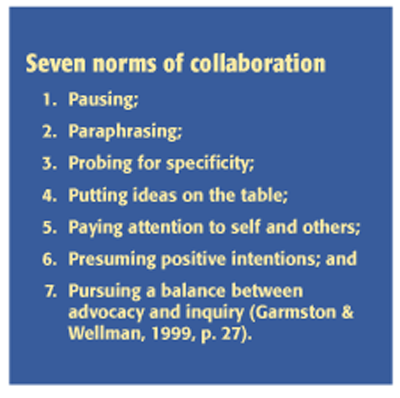
Garmston & Wellman (1999) describe seven norms of collaboration that are particularly suitable for PLCs. These norms help PLC members learn and take action on their learning to help students succeed and thrive. When individual PLC members adhere to the norms, they are being informally accountable. When they ignore or break the norms, they are not, and PLCs must have a plan for what to do in those situations.
Voice commitment to the norms at the beginning of a gathering and evaluation of how well the group did on norms at the end also can help PLCs be accountable for results. Individuals can rate the whole group as well as themselves on adherence to the norms. They can submit survey results to be tabulated and presented to the whole PLC before the next gathering.
Another way PLCs as a group and individual members can be informally accountable is by assessing how well they are doing what they say they will do. From a formal accountability standpoint, PLCs should expect to be asked about their progress. PLCs may accomplish this reporting function through check-ins and reports at PLC meetings as well as through casual conversation.
Imagine this hallway discourse:
“So, Denise, did you try that new strategy for scaffolding instruction?”
“Yes, but I’d love to have you tell me how it is affecting the learning of George and Deena.”
“Next Tuesday?”
“Super. And, how are you doing with that strategy?”
PLC members and the PLC as a group can be informally accountable to those outside the PLC in a variety of ways. They let others know what they’re learning and doing, pose questions, answer others’ questions, and solve problems through voicemail, email, blogging, or other media — even a graffiti board near the teachers’ workroom.
Some PLCs establish a portfolio system to keep track of what the group is learning and doing (Easton, 2011). One PLC member serves as archivist or librarian to collect artifacts of the PLC’s work. The PLC may collect agendas, check-in reports on progress, planning documents, process logs, lesson plans, student work, videos of classrooms in which new teaching strategies are being tried, and survey results.
When PLC members work together to establish norms, they set up standards for behavior that lead to learning and taking action on learning to help students succeed and thrive.
Periodically, the archivist should ask participants to reflect on particular artifacts and should include their reflections in the portfolio. The portfolio contents, therefore, should include both concrete representations of and reflections on the learning and work.
At least twice yearly — at the end of each semester — each PLC in a building should make a formal presentation about what they’ve learned and their progress toward their goals. They should use the portfolio materials and other artifacts they have continually collected and display them during the first part of the presentation (Easton, 2011). Following the display portion of the report, each PLC should present a 10-minute slide show to summarize what they have done and learned, followed by a five-minute Q & A period.
Another way to be informally accountable is by reaching out to other groups in a school as well as to the whole school. If PLCs are not organized around grades or subjects — instead, they could be interdisciplinary, multigrade, or focused on particular initiatives, such as student engagement — members might make short presentations at grade and subject-area meetings about their PLCs’ progress. The principal can set aside five minutes during each faculty meeting for reports from PLCs. These meetings can help schools coordinate their PLC efforts.
Accountability for change that benefits students is what happens in classrooms and the school as a whole, leading to academic improvement as well as classroom and school cultures that support learning.
Another informal PLC accountability measure is meeting with PLC delegates from other schools to share goals, progress, and outcomes, and to learn what PLCs in other buildings are doing. Finally, PLCs can be informally accountable by staying in touch with district administrators — including the director of professional learning or an assistant superintendent with that authority. Shooting this person an occasional email about what the PLC is doing establishes an informal mechanism for accountability and is beneficial to the relationship between the district, school, and PLCs in the school.
Formal accountability
Educators in PLCs can be formally accountable to themselves and others in their own PLC, other PLCs, and the school as a whole by broadcasting goals or purposes as well as progress toward achieving those goals or purposes. At the end of a school year, PLCs can share the results along with compelling evidence (artifacts, data, teacher and student work, including video) to show that they’ve achieved goals or purposes.
While sharing goals and progress toward them is important, sharing challenges and problems is equally important. Sometimes, PLC members want to brag and boast rather than reveal the bumps and bruises. True accountability means transparency about what is going on in PLCs. For example, schools participating in Learning Forward’s Learning School Alliance were expected to identify and work on a problem of practice themselves as well as present the problem to other schools to get feedback (Blundell, 2013; also see YouTube video 2013 Hord Award winner Santa Fe Junior High School, http://bit.ly/1YuqXKU). When they are working on a problem of practice, such as difficulty implementing a particular strategy, PLCs are doing what Phillip C. Schlechty (2002) called “working on the work.”
PLCs may work on the work with other PLCs in their building through tuning or other types of protocols (see McDonald et al., 2007). They may work with PLCs in other districts, states, and even countries using a variety of online protocols (see McDonald et al., 2012). The key to working on the work is establishing a healthy environment of inquiry.
Accountability for change that benefits students is what happens in classrooms and the school as a whole, leading to academic improvement as well as classroom and school cultures that support learning. PLC members invite others from within and outside their own PLCs into their classrooms and visit other classrooms, share teaching materials, and share student work. A sign that this type of accountability has taken place occurs when educators expect their school’s PLCs to operate more openly.
Finally, PLCs that are accountable engage in action research (Caro-Bruce & Klehr, 2015) and write reports and present or publish results.
Designing accountability
A design team is a mechanism schools can use for coordinating PLC efforts and fostering PLC informal and formal accountability. A design team (Easton, 2011) comprises delegates from each PLC and administrators in a building. The design team process helps delegates — and therefore PLCs —see the big picture and avoid competition. Delegates shouldn’t feel that they have to represent a grade level or subject area or even their PLC. They are not advocates for preserving a particular unit, set of materials, or strategy in any grade level or subject area. As communicators, they report on what their PLCs are doing, look for linkages among all PLCs, identify gaps and redundancies, check to be sure PLCs are aligned with school and district goals, and they communicate all of this back to their own PLCs.
Ultimate accountability
Ultimate accountability is, of course, student data — both quantitative and qualitative — that show improvement and well-being. Sometimes, improvement in student data takes a long time; turnaround is seldom instantaneous. Educators in PLCs must be relentless in striving for ultimate accountability, but, to get to that point, they must focus on interim accountability by being informally and formally accountable to themselves, their colleagues, their students, and their communities.
References
Blundell, R. (2013, Summer). Identifying problems of practice leads to cultural changes and student success. The learning principal. http://bit.ly/1UeXJjj
Caro-Bruce. C. & Klehr, M. (2015). Action research. In L.B. Easton (Ed.), Powerful designs for professional learning (3rd ed) (pp. 59-68). Oxford, OH: Learning Forward.
Easton, L.B. (2011). Professional learning communities by design: Putting the learning back into PLCs. Thousand Oaks, CA: Corwin.
Garmston, R. & Wellman, B. (1999). The adaptive school: A sourcebook for developing collaborative groups. Norwood, MA: Christopher-Gordon.
Gladwell, M. (2002). The tipping point: How little things can make a big difference. New York, NY: Little, Brown & Co.
McDonald, J.P., Mohr, N., Dichter, A., & McDonald E.C. (2007). The power of protocols: An educator’s guide to better practice (2nd ed.). New York, NY: Teachers College Press.
McDonald, J.P., Zydney, J.M., Dichter, A, & McDonald, E.C. (2012). Going online with protocols: New tools for teaching and learning. New York, NY: Teachers College Press.
Schlechty, P.C. (2002). Working on the work: An action plan for teachers, principals, and superintendents. San Francisco, CA: Jossey-Bass.
Sinek, S. (2009). Start with why: How great leaders inspire everyone to take action. New York, NY: Portfolio Group.
Citation: Easton, L.B. (2016). Strategic accountability is key to making PLCs effective. Phi Delta Kappan, 98 (4), 43-48.