
Telling students to study simply because they must or making narrow pitches to a subject’s future utility typically fail to generate student interest.
After teenage Sarah’s car went careening into another, she stood on the side of the road looking over the crumpled vehicles and processing what had just happened. She’d been traveling about 45 miles per hour when the other car had turned suddenly in front of her. Even as she jerked her foot onto the brake to decelerate, her car had been barreling along with too much momentum to stop and had slammed into the other car with enough force to make both bumpers fold like accordions. If she had been going faster or driving a heavier car, the damage would have been even more severe.
As scary as this incident was for Sarah, her reaction was every teacher’s dream as she called on her newly minted understanding of force and acceleration to interpret her accident. A week earlier, her physics teacher, Mr. Knowles, had used the scenario of a car accident while explaining force and acceleration. Ever mindful of her father’s insistence that she “drive carefully,” Sarah had been closely attuned to Knowles’ explanation of the physics behind car accidents. This was highly relevant information that could, in theory, help her stay out of trouble.
Disinterest and perceptions of irrelevance are major reasons students disengage in high school classrooms.
Even though her physics knowledge didn’t ultimately save the day, the possibility of an accident had helped Sarah process and internalize the key concepts of physics. Indeed, when a student perceives a topic in school to be relevant to her life or when a student takes an interest in a topic for its own sake, that student is more likely to invest the mental energy necessary for learning (Blumenfeld, Kempler, & Krajcik, 2006). Of course, the opposite also is true. Disinterest and perceptions of irrelevance are major reasons students disengage in high school classrooms (National Research Council, 2003).
Certainly, this is not new information. Most teachers can rattle off “rigor, relevance, and relationships” as critical components for student engagement. But beyond knowing that relevance matters, teachers don’t always know how to help adolescent students find that relevance. Quite frankly, they might not realize just how important it is to do so.
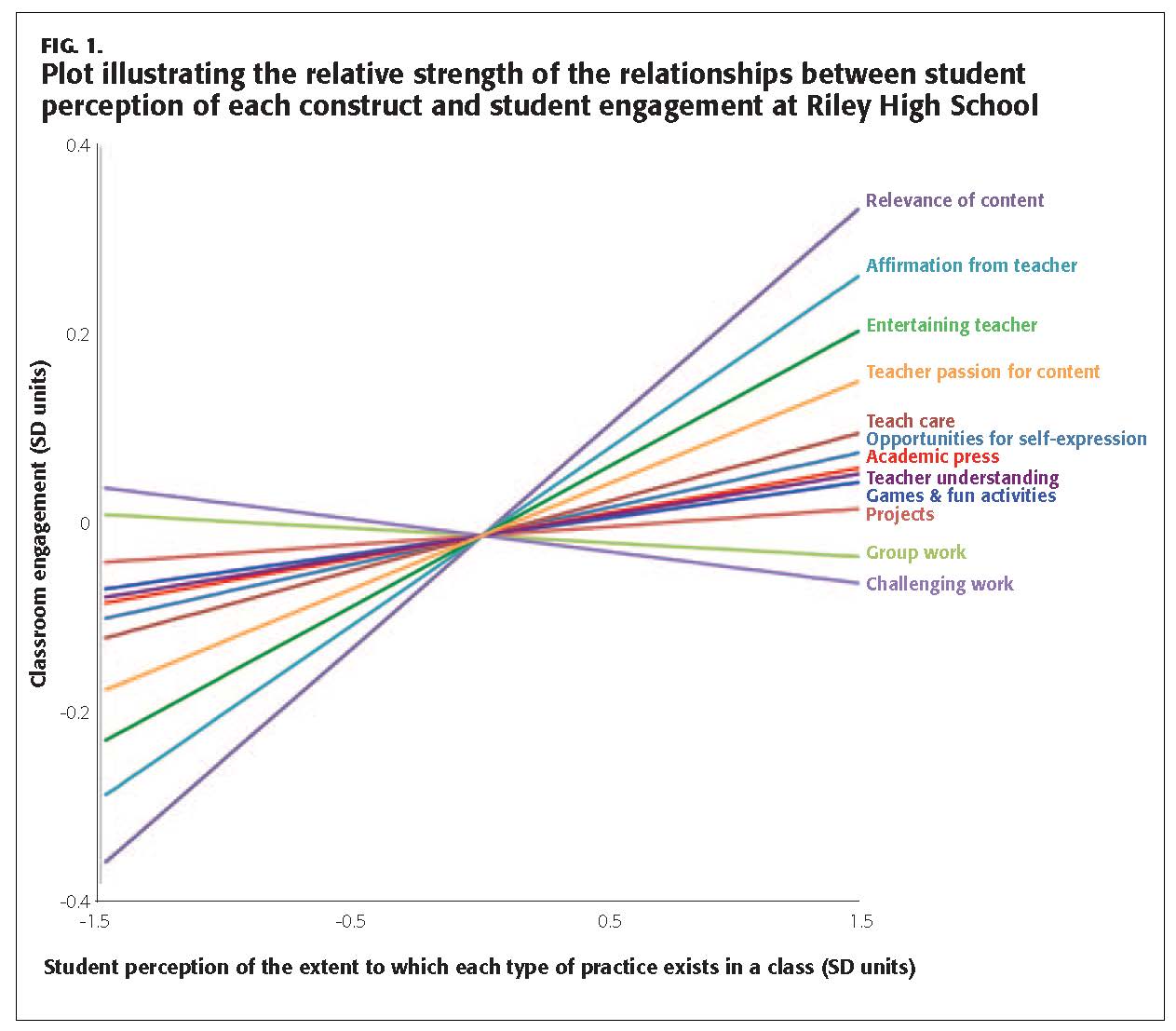
In a recent study, I examined student engagement at Riley High School, a large comprehensive high school in Texas serving a socioeconomically and racially diverse student body (44% Latino, 44% white, and 12% black) that was performing near the state average on academic achievement tests (Cooper, in press). I began by surveying 1,132 students (80% of the student body) about engagement and perceptions of teaching in each of their classes. The survey asked students to report on 12 facets of each class, including their perceptions of concepts like relevance, teacher care, and teacher passion along with the frequency of things like group work, projects, and challenging assignments. I then examined the statistical relationships between student perceptions of each construct and their levels of engagement. Figure 1 shows that student perception of relevance was the single strongest predictor of engagement. In follow-up classroom observations and interviews with students, I explored these dynamics in more depth. In doing so, I found interesting nuances in how students talked about relevance and interest in different classes, and their comments mapped closely on to research on student engagement. (All names in this article are pseudonyms.)
In talking with educators about these findings, I’ve identified six common mistakes that teachers make in regards to fostering relevance and interest among high school students. Research and theory suggest that these mistakes ultimately undermine student motivation and so should be avoided.
Mistake #1: “Because we have to”
Fundamentally, people need a defined purpose to engage with anything, and for most adolescents (who are developmentally primed for autonomy), the rationale “because we have to” is insufficient. Thus, when teachers overlook the need to define the purpose for a particular lesson and the broader subject domain, they are asking students to learn something that has no value for them. Doing so overlooks a basic requirement for human motivation and creates a barrier to student engagement right from the starting gate (Brophy, 1999; Eccles, 2005).
When the Committee of Ten convened content-area experts to define the American curriculum in 1892, they provided a rationale for including various subjects. Students were to study English “to understand the expressed thoughts of others and to give expression to thoughts of [their] own” and gain “acquaintance with good literature [and acquire] the means of extending that acquaintance” (National Educational Association, 1894, p. 86). History and civics were intended to “broaden and cultivate the mind,” “counteract a narrow and provincial spirit,” prepare students “for enlightened and intellectual enjoyment in after years,” and enable students to “exercise a salutary influence upon the affairs of [their] country” (p. 167).
When a school topic is relevant to a student’s life or when a student takes an interest in a topic for its own sake, that student is more likely to invest the mental energy necessary for learning.
Whether teachers adopt these purposes or define their own, they must communicate the instrumental value of each subject by illustrating how it is directly applicable to students’ life experiences and how it can help them enhance those experiences (Blumenfeld, Kempler, & Krajcik, 2006). At Riley High, many students described exceedingly high levels of engagement in Ms. Sanders’ English class. Tina explained how Sanders guided students to the instrumental value in literature. “She always teaches about how people work, and she doesn’t really focus on English grammar and stuff like that. She always wants to teach about human behavior . . . . She knows that we only care about high school. She will teach high school things, and she will make real things relate to high school.” Tina described how Sanders linked “Romeo and Juliet” to the high school experience by prompting, “Think about if you were Juliet, and you just had a kiss from a guy you only knew for two minutes, and now he wants to marry you. Think about that.” By connecting the events in “Romeo and Juliet” to students’ lives, Sanders illustrated how literature could help them understand relationships.
In many cases, teachers don’t take the time and mental space to convey such instrumental value to students. Many teachers themselves are uncertain how their content is relevant to the human experience or how it could be fascinating for adolescents to ponder in and of itself. Often people who choose to teach a subject find that content area intrinsically interesting, yet they can forget to take a moment to sell that content to their consumers. Time spent doing so could have immense payoff for student motivation.
Mistake #2: “Sorry, folks, it’s math”
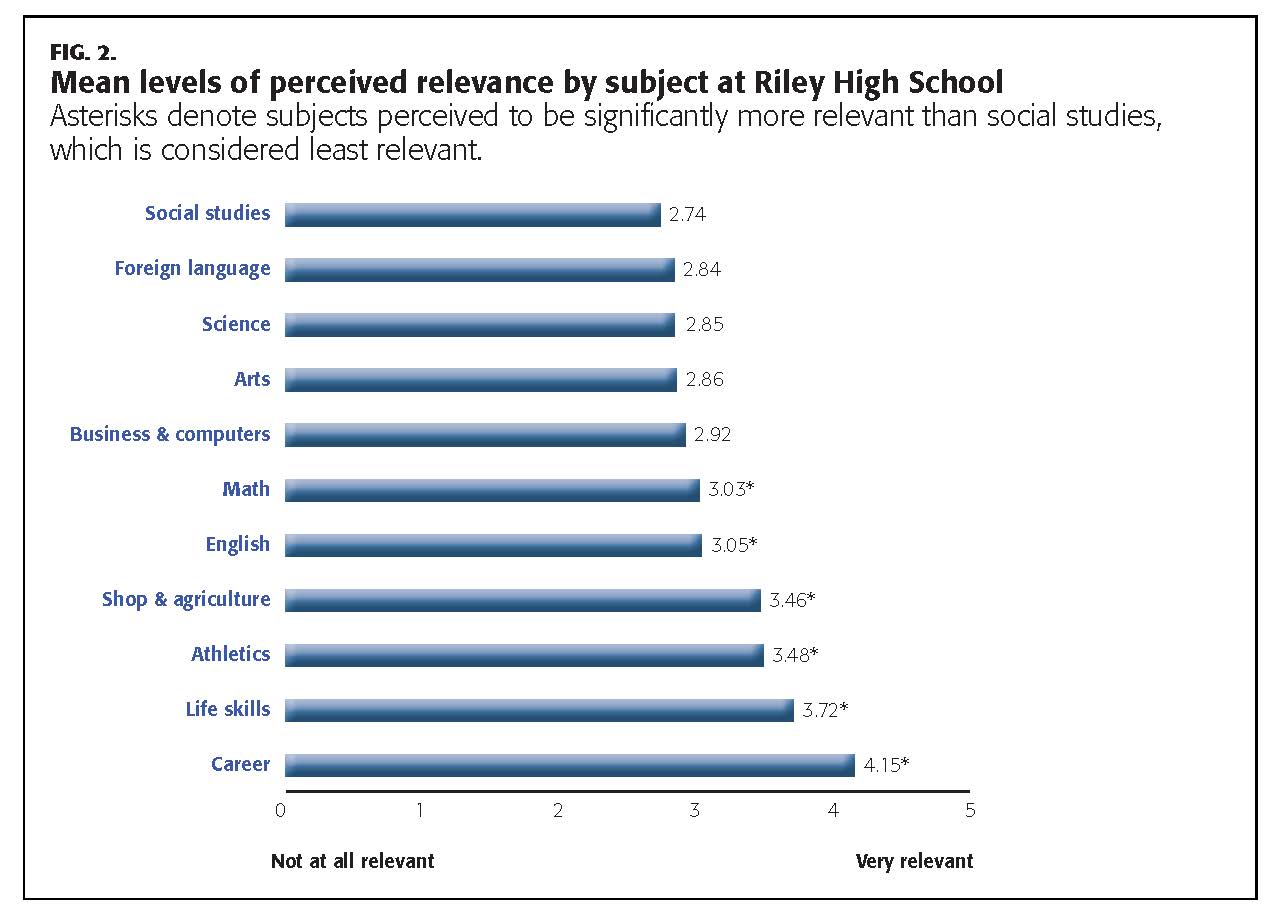
Some teachers presume they’ve been dealt an unlucky hand because they’re teaching a subject students don’t automatically find relevant. So they ask students to hang in there because learning the content is a necessary evil. Indeed, as shown in Figure 2, student perception of the relevance of their classes at Riley High School varied by subject area. But this doesn’t mean these variations are unavoidable. It means that teachers in some classes — such as social studies, foreign language, and science — have to work harder to help students see the value in their content. But that’s all the more reason for those teachers to make the effort.
In some cases, content might not be necessarily useful for navigating life. Indeed, not everything students study in school is going to be directly relevant. In some cases, content might simply be interesting and thus have intrinsic value so that learning about it fascinates the mind and is enjoyable to consider, ponder, or discuss (Blumenfeld, Kempler, & Krajcik, 2006). For example, Riley student Javier described his perception of physics. “A lot of people say if you are not going to be a scientist or nothing, then don’t learn it, but it has a lot of little things in it that just blow your mind, and you think like, ‘Oh, wow, this is how we get this.’ ” Marianne similarly commented on biology. “When we’re learning about DNA structure and genetics, I can understand why I look partly like my father and partly like my mother, and why, you know, some people might have this mutation. . . . I find it personally interesting.” The immediate goal for teachers attempting to foster interest is to help students see the element of the content that is unique or intriguing.
Mistake #3: “When you grow up”
Adolescents live in the now. So phrases such as “when you grow up” are more disengaging than engaging for this population. For this reason, teachers who focus on present utility as opposed to future utility convey higher levels of curricular relevance by helping students see how what they’re learning can be used immediately, rather than stored away for some possible future. Javier, for example, said, “Science has a whole scientific method. You think of a question, and then form a hypothesis. You can put that to use in life when you have a problem outside of school and a question comes up. You look at the possibilities, then you might experiment doing this this time and all that until you get to your solution.” Pete commented on his English class: “The story we read today hit me hard because I have done the exact same thing, like the mom situation and the whole running away thing and all of it. It all hit me hard. I was like, ‘Wow, that’s a book about me but not me.’” To the extent that teachers can keep the relevance focused on the now, they’re more likely to help students find a connection.
Mistake #4: “Architects use geometry”
Even if teachers find themselves emphasizing future utility for some content, they may err on the side of illustrating an extremely narrow application of content. This typically happens when teachers link a topic to a specific career. At Riley, most students reported clear career interests (e.g., nurse, fashion designer, soldier, psychologist, music teacher) and thus found a fair amount of what was covered in school to be professionally irrelevant. Whether they will ultimately end up in the careers to which they aspire is beside the point. There is simply no reason for teachers to alienate the majority of the room by pointing out the utility of information for a tiny slice of the population.
For this reason, students respond more strongly to material with life relevance for all people. Steve described how physics related to life: “When I’m driving, I do think about it, like when to slam, well, not when to slam on the brakes, but when to stop sooner or later, which is like velocity and all that . . . . When I’m throwing a baseball or any kind of ball, you know, how high do I have to throw it for it to land in a certain spot?” Importantly, Steve did not see physics as relevant to his anticipated career in business, noting, “Maybe my math class about investments and stuff like that but not so much physics.” Thus, if Steve’s physics teacher had focused on promoting the role of physics in certain careers, Steve would have seen less relevance to his own life.
Mistake #5: “You need to know this for college”
On this idea of future utility, some teachers might attempt to find life relevance by asserting that students must master a content area for college admission or success. In this regard, teachers not only miss an engagement opportunity by overlooking more compelling purposes such as present instrumental and intrinsic value, they err by alienating students who don’t see themselves headed for college.
Focusing on such attainment value can engage some students by supporting their visions of themselves as academically driven and successful (Blumenfeld, Kempler, & Krajcik, 2006; Eccles, 2005). However, Riley students typically discussed such value with little enthusiasm. For example, Brianna said physics was useful to her “to get through high school, yeah.” Ana’s response was “not really, unless you are going to be a scientist or a science teacher.” Brian commented on whether biology was useful by stating, “Not really. I think we just need to know it for school.” Claire remarked, “If you go to college, you’ll definitely have to know biology, just so you are educated.” The lack of enthusiasm around these comments suggested that students were willing to commit some effort to these classes, but their tone lacked the enthusiastic engagement reflected in the comments illustrating intrinsic value. For this reason, teachers who rely on attainment value are likely to miss the engagement benefits of more immediate intrinsic interest.
Mistake #6: “Let’s play a game”
Beyond just pointing out the relevance of content to students, teachers need to illustrate relevance through the academic tasks they assign. To this end, authentic academic tasks ask students to engage with content as though they were practitioners in that field — scientists, historians, mathematicians, etc. (Blumenfeld, Kempler, & Krajcik, 2006). Authentic tasks help students develop enduring interest in a subject area, rather than situational interest in one activity (Schraw & Lehman, 2001). When a teacher devotes a class period to a game of “history basketball” to review for an upcoming test, for example, they’re using a novel activity to generate temporary interest. But they’d generate more sustained interest by helping students develop an appreciation for history as a discipline. In this regard, a real-world project would have more sharply defined implications for helping students develop the enlightened and intellectual enjoyment described by the Committee of Ten.
In describing Sanders’ English class, Josh enthused, “She goes into your head, and she will introduce things that will actually bother you. . . . Like not bother you in a bad way, but like I mean you get thinking. . . . The stuff in that class, I mean you go home and think about it, and you’ll see it in everyday experiences.” In this way, Josh developed an enduring interest in literature as a way to think about the life he experienced every day, and his interest extended beyond the bounds of his English class. Similarly, Carmen recalled a physics lesson: “We did a lab, and we had to find out how many classrooms were in the school. It wasn’t accurate, but like we were learning about electricity, and he related it to outside, like how much you would pay for so many hours of light. And you’re going to use that your whole entire life, use light and everything. Our whole world is electronic.” By participating in a real-life application of class content to estimate an electric bill, Carmen described an engaging integration of life relevance, instrumental utility, and a growing enduring interest in physics.

The big takeaway
By helping students find meaning in their learning, relevance and interest can be critical tools for educators seeking to motivate students — if they can avoid these six common mistakes. To help teachers avoid these mistakes, the blue shading in Figure 3 denotes the most engaging forms of relevance and interest. As shown in the upper left quadrant, students are most engaged when they can relate class content to their daily lives in the present and when that content holds instrumental or intrinsic value — that is, when the content is immediately useful or interesting. Attempts to capture student interest have the biggest motivation payoff when teachers focus on enduring elements of the subject that can sustain student interest over the long term.
Students are most engaged when they can relate class content to their daily lives and when that content is immediately useful or interesting.
Teachers might argue that students need to come to the table willing to see the relevance and interest of topics, but I would argue that most students are already there. As Tina explained: “From the student perspective, if you can be a teacher and really teach me something that I know I will need — like chemistry, nuclear chemistry, I don’t know how in the world I’m going to learn all I’m going to learn and use that in the future. But, if somehow, you can relate it to me in any way possible, I will learn more.” Indeed, Sarah’s impulse to think about physics after her car accident, as described above, illustrates just how well her teacher’s ability to make physics relevant enabled her to understand force and motion in school and real life. Such informed application of content should be the ultimate goal of all high school teachers, and relevance and interest, used well, are key tools for making that happen.
References
Blumenfeld, P.C., Kempler, T.M., & Krajcik, J.S. (2006). Motivation and cognitive engagement in learning environments. In R.K. Sawyer (Ed.), The Cambridge Handbook of the Learning Sciences (pp. 475-488). New York, NY: Cambridge University Press.
Brophy, J. (1999). Toward a model of the value aspects of motivation in education: Developing appreciation for particular learning domains and activities. Educational Psychologist, 34 (2), 75-85.
Cooper, K.S. (in press). Eliciting engagement in the high school classroom: A mixed-methods examination of teaching practices. American Educational Research Journal.
Eccles, J.S. (2005). Subjective task values and the Eccles et al. model of achievement related choices. In A.J. Elliot & C.S. Dweck (Eds.), Handbook of competence and motivation (pp. 105-121). New York, NY: Guilford Press.
National Educational Association. (1894). Report of the Committee of Ten on secondary school studies. New York, NY: American Book Co.
National Research Council. (2003). Engaging schools: Fostering high school students’ motivation to learn. Washington, DC: National Academies Press.
Schraw, G. & Lehman, S. (2001). Situational interest: A review of the literature and directions for future research. Educational Psychology Review, 13 (1), 23-52.
Citation: Cooper, K. (2014). 6 common mistakes that undermine motivation. Phi Delta Kappan, 95 (8), 11-17.
ABOUT THE AUTHOR

Kristy Cooper
KRISTY COOPER is an assistant professor of educational administration at Michigan State University, Lansing, Mich.