
As the education landscape continues to change, principal preparation programs need to figure out how to shift direction in response.
The knowledge and skills principals need are in a constant state of flux. In the last five years alone, principals have had to respond to a global pandemic, increasing politicization of schools and curricula, and the development and wide availability of artificial intelligence. Effectively preparing principals to face this level of change has therefore become a monumental challenge.
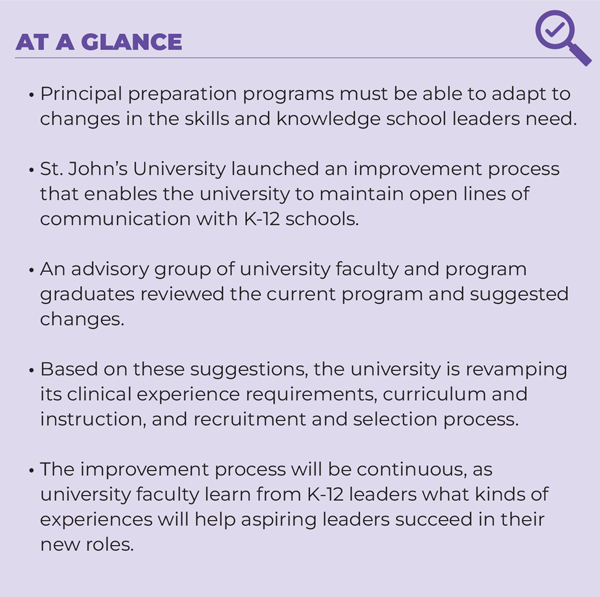
If schools of education are not able to alter their pedagogical approaches and curricula in response, the distance between principal preparation programs and the daily reality of the districts in which future principals will serve will continue to grow. For this reason, principal preparation programs need to create systems and structures for continuous improvement and information sharing with local districts. Our experience in creating these structures at St. John’s University in Queens, New York, can provide a potential framework for other programs in ensuring leaders are prepared to face the dynamic tempo of change.
Building a structure for program redevelopment
Our department initially began a process of continuous improvement and self-examination in 2021 out of a desire to update our school building leadership program. This program consists of approximately 60 students, all of whom are currently working full-time in schools. Students are accepted into the program on a rolling basis, typically take two courses per semester, and complete their course of studies in four semesters.
Our ongoing program improvement efforts were further accelerated in the past year as we embarked on accreditation work. University faculty often dislike this process, but we tried to embrace it by reframing it as an opportunity to spur work on updating areas of our principal preparation program that we knew needed addressing. We also felt the reflection and improvement required for the accreditation process was not radically different from what we were already working toward.
From our initial internal discussions, we recognized that it was important to connect with our partners in the field to uncover what new areas principals are being asked to address. In short, we needed to create a process to uncover what we don’t know.
Gathering advisers
Our first task was to create an advisory group. This group, which consisted of approximately 15 alumni and local educational leaders, came together in 2022, with scheduled meetings at least once every semester. We felt that we could better redesign our principal preparation program if we conducted that work with a networked community (Bryk et al., 2015) of not only our full-time faculty members, but also our adjuncts and program alumni currently working in the field. These practitioners represented various district types and sizes (urban and suburban) and geographic areas. Each member had knowledge and background experience that was valuable in identifying and solving problems.
We needed to create a process to uncover what we don’t know.
During advisory group meetings, current principals, assistant principals, and superintendents helped review and critique our curriculum, highlighted areas of improvement, provided feedback on potential changes, and communicated recent needs and trends within districts. We asked them questions, such as, What are the most pressing problems in your district or school? Where do you look for support to help you address these issues? What types of leadership preparation would be useful to address them? It was sometimes difficult to hear about the ways our program fell short. But the fact that these were our own program graduates, who took time out of their busy lives to discuss how we might improve, created an atmosphere of collegiality, openness, and transparency that resulted in discussions of the real challenges leaders face.
The group offered multiple suggestions to improve our curriculum. These included creating lessons on:
- Using data and monitoring progress.
- Identifying effective professional development on literacy coaching, working with English learners, and supporting students with disabilities.
- Leading conversations on diversity, equity, and inclusion (DEI) with teachers, staff members, and parents.
- Establishing systems for professional support for current leaders.
Some suggestions were direct critiques of our current program structure. For example, group members wanted more opportunities to practice leadership tasks, such as by taking part in mock teacher interviews rather than just discussing the interviewing process or by “performing” an opening day speech rather than just writing one. This process also brought up difficult-to-answer questions about balancing the need for synchronous online or in-person classes with many students’ preference for flexible, asynchronous course offerings.
Ongoing work
Our advisory group meetings have remained an invaluable way to gain insight into the current challenges principals face and how we might remain nimble in meeting these challenges. We have maintained a regular meeting schedule and have allowed time and opportunities for networking and information sharing so that these discussions benefit both us and school and district leaders. We also used the ideas that emerged during our conversations to decide what topics to include in our annual leadership symposium, which brings together superintendents and principals to network and discuss potential solutions.
In addition, we invited Chancellor Lester Young from the New York State Education Department’s Board of Regents to speak with our advisory group about systemic issues that we should be tracking. He emphasized how important it is for principal preparation programs to continue to focus on DEI issues as well as the difficulty of training and hiring teachers who were dual certified in Teaching English to Speakers of Other Languages. This discussion solidified our need to create a standing committee of faculty whose function would be to identify necessary program changes derived from the information-sharing structures and systems we were creating. This redesign committee began meeting monthly to map the standards, curriculum, courses, activities, and assessments we needed to modify our program.
More recently, a small group of faculty members received a grant from our university’s Academic Center for Equity and Inclusion (ACEI) to create a bibliography of readings, videos, books, and activities that we could embed into our principal preparation courses to enhance students’ work on DEI issues and provide professional development for our program’s faculty and adjunct instructors. The committee purchased books and accompanying resources to support aspiring administrators in addressing persistent opportunity gaps, holding discussions on racial literacy and equity, building welcoming and nurturing school climates, and dismantling education inequity.
Planning and doing
Our initial launch into our principal preparation improvement work is part of a plan-do-study-act inquiry cycle (Bryk et al., 2015) that involves creating a plan, implementing it, gathering and analyzing data, and then deciding on next steps based on the results. Our goal is to redesign our program gradually while learning from data along the way. We are currently engaged in planning and doing. We’re carrying out some changes on a small scale with the intent to collect data and study how the changes were implemented and how we might do better. Our initial program redesign areas included: 1) clinical experience (internships), 2) curriculum and instruction, 3) recruitment and selection.
Clinical experience
One of first areas for improvement the redesign committee identified was the need for authentic fieldwork experiences, an improvement also supported by research (Anderson et al., 2018; Martin et al., 2022). Our current clinical experience model used a “checklist approach” to completing required experiences. The requirements were often passive, one-shot experiences, such as shadowing or observing the principal in action. We knew we needed something more active and engaging.
To develop a strategy for the revamped clinical experience, we created a book club as a way to learn together about what an improved experience might look like and how we can better coordinate among the program and field placements. Book club members included department faculty, advisory board members, and program alumni. We read School Leader Internship by Gary Martin and co-
authors (2021), which served as a starting point for our discussions. The book suggested five stages for intern experiences:
- Assessment of self and of the school program.
- Internship preparation with crosscutting themes of reflection, exploration, and preparation.
- Internship plan development with activities tied to the Professional Standards for Education Leaders (PSEL).
- Implementation of the internship plan in collaboration with the school supervisor.
- A summative evaluation final report.
These stages will serve as the basis for our work in improving our field experiences.
Curriculum and instruction
Regarding our curriculum and instruction efforts, we began mapping out the current coursework, including course descriptions, objectives, course activities, and the alignment of each activity to the PSEL standards. From this map, we identified redundancies among different courses and a lack of content on relationships with the community and issues related to marginalized student groups. Additionally, program participants completed course activities asynchronously, outside class time, and we saw a need for more active learning and engagement, including problem-based learning, simulations, and case-based scenarios. Finally, we saw opportunities for synchronous online or face-to-face meetings, which would allow for additional group learning, hands-on activities, networking, and development of deeper connections with the university and among students.
Our first curricular change was to remove an elective course that few students enrolled in and replace it with a new course on school-community relations. This course would cover facilitating successful school-community partnerships, creating an inviting school culture, securing educator commitment to student success, and establishing collaboration and communication structures with community partners. We also identified courses where we could include lessons identifying and addressing the needs of marginalized student groups. We plan to use student surveys to collect data on whether these courses are meeting this curricular need.
We pursued instructional change by collaborating with faculty members who are responsible for individual course development to review activities within each course and align them with course descriptions, goals, and the PSEL standards. Though still a work in progress, we were able to refocus coursework on specific leadership areas in the PSEL standards and avoid overlapping the same activities in several different courses. During our regular faculty meetings, we will continue working to make sure course activities include engaging case-based scenarios and simulations rooted in current problems of practice. Feedback from student surveys as well as discussions with our advisory group will be used to determine whether we’ve fulfilled this goal.
Additionally, we began using some of the activities in the DEI materials purchased through the ACEI grant at our annual faculty retreat and monthly faculty meetings, a decision that resulted in more faculty members expressing interest in using the materials. We have also included these activities in syllabi for courses taught by adjunct faculty members who might not be a part of these regular discussions.
Recruitment and selection
Finally, our redesign process identified an area of concern with our recruitment and selection of potential candidates. Finding and recruiting high-quality candidates is one of the keys to creating an effective principal preparation program (Darling-Hammond et al., 2007; Orr, 2006), yet enrollment at schools of education remains a concern (American Association of Colleges for Teacher Education, 2022). We had no established partnerships with public school districts and/or private schools that would enable us to network with districts and communities and encourage potential school leaders to enroll.
Improving principal preparation cannot be a one-off endeavor or part of an accreditation process that only occurs every few years. It must be a constant process.
Additionally, our principal preparation program does not include a cohort model in which interested partner schools or districts could have a group of aspiring leaders enroll and move through the program together. Research has shown that the use of cohorts allows for stronger academic performance (Barnett & Muse, 1993) as well as peer and program engagement (Leithwood, Jantzi, & Collins, 1995). Our doctoral program has incorporated this model for many years, and it has been successful in supporting our students throughout their dissertation program. Our collaborative network and advisory groups will continue to discuss whether a cohort model is feasible and how and with which school districts we can propose such a partnership.
Always preparing for change
Programs that prepare future principals are varied. What works in each program depends on its specific context. And our improvement process is still in its early stages. We’re still working on standardizing our data, improving response rates for surveys, and making data more available. This will enable us to better understand the effects of the changes we are making so we can move forward in our plan-do-study-act cycle.
Although we still have a great deal of work to do, we feel that other programs can draw lessons from our experience so far. For example, our experience highlights the possible benefits of merging sometimes perfunctory accreditation conversations with program improvement efforts involving the full faculty. When looking for a time to start this work, programs can take advantage of moments like this that allow for change.
However, given the fast pace of change affecting the principalship, improving principal preparation cannot be a one-off endeavor or part of an accreditation process that only occurs every few years. It must be a constant process. University faculty who oversee leadership preparation programs and the districts and schools that hire and employ graduates of those programs must maintain continuous communication pathways. Preparation programs need to adopt structures for gathering information from current leaders and using that information to drive continual improvement so that their curricula will remain focused on the most pressing issues schools and districts face.
Our experience also shows that there is always work to be done. More recent issues have arisen since we began this redesign, like considering how we might create authentic assessments that lessen students’ ability to use artificial intelligence programs like ChatGPT to complete their assignments or addressing how principals might navigate issues related to the politicization of schools.
Though all of these are concerning developments that require our attention, they also indicate that a principal’s job is often fraught, unpredictable, and ever-changing — and it is our responsibility to design a program that will get them ready for it.
References
American Association of Colleges for Teacher Education. (2022). Colleges of education: A national portrait (2nd ed.).
Anderson, E., Winn, K.M., Young, M.D., Groth, C., Korach, S., Pounder, D., & Rorrer, A.K. (2018). Examining university leadership preparation: An analysis of program attributes and practices. Journal of Research on Leadership Education, 13 (4), 375-397.
Barnett, B.G., & Muse, I.D. (1993). Cohort groups in educational administration: Promises and challenges. Journal of School Leadership, 3 (4), 400-415.
Bryk A.S., Gomez L.M., Grunow A., & LeMahieu P.G. (2015). Learning to improve: How America’s schools can get better at getting better. Harvard Education Press.
Darling-Hammond, L., LaPointe, M., Meyerson, D., Orr, M., & Cohen, C. (2007). Preparing school leaders for a changing world: Lessons from exemplary leadership development programs. Stanford Educational Leadership Institute.
Leithwood, K., Jantzi, D., & Coffin, G. (1995). Preparing school leaders: What works. Ontario Institute for Studies in Education.
Martin, G.E., Danzig, A.B., Wright, W.F., & Flanary, R.A. (2022). School leader internship: Developing, monitoring, and evaluating your leadership experience (5th ed.). Routledge.
Orr, M. . (2006). Mapping innovation in leadership preparation in our nation’s schools of education. Phi Delta Kappan, 87 (7), 492-499.
This article appears in the December 2023/January 2024 issue of Kappan, Vol. 105, No. 4, p. 32-36.

ABOUT THE AUTHORS

James Coviello
JAMES COVIELLO is an assistant professor in the Department of Administrative and Instructional Leadership, St. John’s University, NY.

Joan I. Birringer-Haig
JOAN I. BIRRINGER-HAIG is an associate professor in the Department of Administrative and Instructional Leadership, St. John’s University, NY.

Katherine C. Aquino
KATHERINE C. AQUINO is an assistant professor in the Department of Administrative and Instructional Leadership, St. John’s University, NY.