The desire to include diverse perspectives in classroom reading can raise controversy. Preparation and trust-building can help.
Literature has the power to help students develop their own identities and open their minds to diverse perspectives (Bishop, 1990). Books in which students can see themselves are empowering (Reichmuth & Chong, 2022), and books in which students can see others foster empathy (Kuehl, 2021). Yet, many books that promote diverse ideals have been challenged, censored, or banned from school curricula and libraries. And the specter of such challenges has created a “chilling effect,” causing teachers to refrain from engaging students in literature related to salient local and global issues for fear of personal or professional repercussions and direct or indirect political pressure. Vaguely worded laws barring the teaching of “divisive concepts” have left teachers unsure of what they are allowed to teach. Many teachers fear making a mistake that will damage their livelihoods and reputations, leaving them little room for growth or learning.
Most teachers do not enter the profession to be political or countercultural, but they do want to encourage students to read relevant and engaging books. Yet, in today’s political climate, many have found themselves at the center of controversy when they assign texts that present or advance a culturally pluralistic society. Novice and seasoned teachers alike struggle with challenges to books presented in their teacher education programs as model texts for critical literacy instruction. In particular, public calls to ban or limit access to books that foster sensitivity toward diversity, equity, inclusion, and social justice place teachers in precarious positions (Coe, 2022).
Thus, it is important for teacher educators and school leaders to help teachers navigate contentious contexts while ensuring students can access texts reflecting their identities and the complexity of our world. To fail to do so risks perpetuating cycles of socialization where the experiences of some members of society are ignored and the experiences of others are exalted (Harro, 2000). Therefore, we want to provide teachers with methods for navigating challenges that inhibit their ability to share literature that validates the diversity of human experiences and fosters social responsibility and global competence.

What students learn from literature
Louise Rosenblatt’s (1993) transactional theory of reading, in which an individual reader has a distinct experience with a text, serves as a framework for understanding the social responsibility of readers. While authors have the responsibility for writing authentic texts (Fox & Short, 2003), readers are responsible for comprehending the people, cultures, and situations represented in the text. Teachers act as critical partners as students examine issues of power and privilege present in literature (Lewison et al., 2002). Giving students access to stories that address the concerns of different individuals and groups can prevent the perpetuation of injustice and help students recognize commonalities and appreciate differences.
Providing such opportunities is important because public schooling in the U.S. plays a major role in developing young people’s sense of social responsibility and their ability to contribute to the nation’s productivity, safety, and continuity. Both social responsibility and global competence require understanding of commonalities and differences between one’s own perspective and the perspectives of others. This will be important as students grow into people who engage in civic actions, global citizenship, and personal interactions.
In psychology, perspective-taking refers to awareness of the possible mental or emotional states of others (Birch et al., 2017). Perspective-taking skills are learned not only through interactions with others, but also through vicarious experiences, such as through literature (Kidd & Castano, 2013; Mar & Oatley, 2008). Upon listening to stories and answering questions about characters’ emotions, children as young as four years old have demonstrated the ability to understand others’ perspectives (Bensalah, Caillies, & Anduze, 2016). Literary portrayals of characters’ experiences, thoughts, and feelings can promote perspective-taking, especially when students are given opportunities to learn about and reflect on the characters’ historical or social circumstances (Kuehl, 2021). Classroom discussions about literature allow for perspective-taking beyond what is likely to occur when students read books on their own.
The importance of understanding others’ perspectives is evidenced in learning standards for language arts, social studies, and social emotional learning in multiple states (see Table 1 for examples). These standards reflect the understanding that exposure to diverse points of view is necessary. Perspective-taking through literature allows readers to begin to comprehend the people and situations presented in a text, which will then enable them to better understand the human experience and our world.

Understanding challenges to literature
Teachers have a responsibility to provide effective literacy instruction that will build the skills students need to be academically successful, socially responsible, and globally competent. Simply avoiding books at risk for being challenged denies students opportunities to learn essential literacy and perspective-taking skills. At the same time, parents and guardians have the right to choose what books their children read. Teachers need to be respectful of these choices.
Yet, sometimes, challenges to books are intended to prevent all students in a school or classroom from accessing a book. To know how to respond to a book challenge, the teacher needs to understand whether the challenge is coming from one parent or guardian, a coalition of parents, or a group outside the school community. Sometimes the way to respond is in the teacher’s hands; other times, it is not.
For example, a group of concerned citizens might approach the teacher, the school administration, the school district, and the local media with concerns about a book being used in class. In this scenario, the book, author, teacher, school, and school system are challenged at once. Under these circumstances, the teacher might not be involved in deciding how to address the challenge. Groups who challenge books in this way are organized and have a coordinated strategy and larger agenda in mind (López & Sleeter, 2023). Thus, to the extent possible, the school system, school, and teacher also should be organized with plans to address these challenges. Some school districts have formed committees of community members and school personnel who meet to discuss the merits of challenged books with school leaders when deciding whether a book can stay or needs to be removed.
Another scenario might involve a parent or guardian approaching the teacher or the school administration with concerns about a book being used in their child’s class. In this scenario, a conversation to better understand the objections should take place. Sometimes, an explanation about the teacher’s purpose for using the book is enough to resolve the situation. Other times, the parties may agree to a compromise. For example, the student of the concerned parents may be given a different book to read or may participate in alternative activities related to the standards and objectives.
For both scenarios, the teacher should be prepared with a rationale for choosing that specific book and with alternative texts and assignments that may be used to meet the same standards and learning objectives.
Having the conversation
Before meeting with parents or guardians to discuss a literature selection they expressed concern about, teachers need to get clarification about the concern, perhaps by email or in a brief phone call. The teacher needs to ask what the parent or guardian objects to and what specifically concerns them. This information can be helpful as the teacher considers what to say during the meeting. For example, a teacher can respond in one manner if the parent or guardian refuses to allow their child to read the book because of their belief system, and a teacher can respond in a different way if the parents or guardians simply want to discuss reservations they have about the book’s appropriateness.
Teachers need to think ahead of time about the points they want to make and how to phrase their argument for why the book is beneficial. A good practice is to compose a draft of what to say and ask a colleague to review it to ensure it communicates respect for the parent or guardian’s view. Understanding the specific objections can also help the teacher consider when, how, and where to meet with the parent or guardian. Depending on the nature of the objection, a teacher might feel confident enough to hold a meeting immediately and on their own, or they might consider including the principal in the conversation.
During the meeting, a teacher can agree where possible. For example, a teacher can note that not all books are appropriate for all children and that there is a need to limit access to some books. (After all, teachers would never suggest teaching obviously pornographic material.) The teacher might ask the parent or guardian if they would be willing to let the child read the first part of the book with the class, then discuss with their child their impressions of the book before deciding whether to let the child continue reading. A teacher can offer an alternative assignment for the student but shouldn’t feel the need to change the assignment for all students.
Anticipating and avoiding controversy
Given the rise in public challenges to books some citizen groups and lawmakers have deemed inappropriate, teachers also need to be prepared for challenges that go beyond a parent or guardian not wanting their child to read a book. Preparation and building trust are two ways to guard against controversy and respond quickly and professionally when it arises.
Preparation
Teachers prepare lessons to address specific learning standards. State learning standards offer a source of authority. When selecting books to use in the classroom, teachers should take care to outline how a selected text will help students reach the standards. For example, standards related to perspective-taking (see Table 1) can be useful when assigning books involving characters from diverse backgrounds. It’s also helpful to note that the relationship between reading literary texts and perspective-taking is one of mutual reinforcement. Reading literary texts improves perspective-taking, and perspective-taking improves reading comprehension (LaRusso et al., 2016).
There are a variety of ways to bring different perspectives into the classroom. For example, students might read books by regional authors (Kuehl & Azano, 2023). Teachers can consult book reviews and news articles; seek recommendations from community members, school librarians, and other teachers; and visit websites such as We Need Diverse Books (https://diversebooks.org) and World of Words (https://wowlit.org). Teachers can also familiarize themselves with award-winning books at their students’ age, grade, and reading levels (see the list of awards on the right). Assigning such books will not prevent all challenges. In fact, sometimes award-winning books are specifically targeted. Yet, choosing books endorsed by organizations such as the American Library Association can help legitimize a teacher’s choices and enable them to mount a stronger defense if challenged.
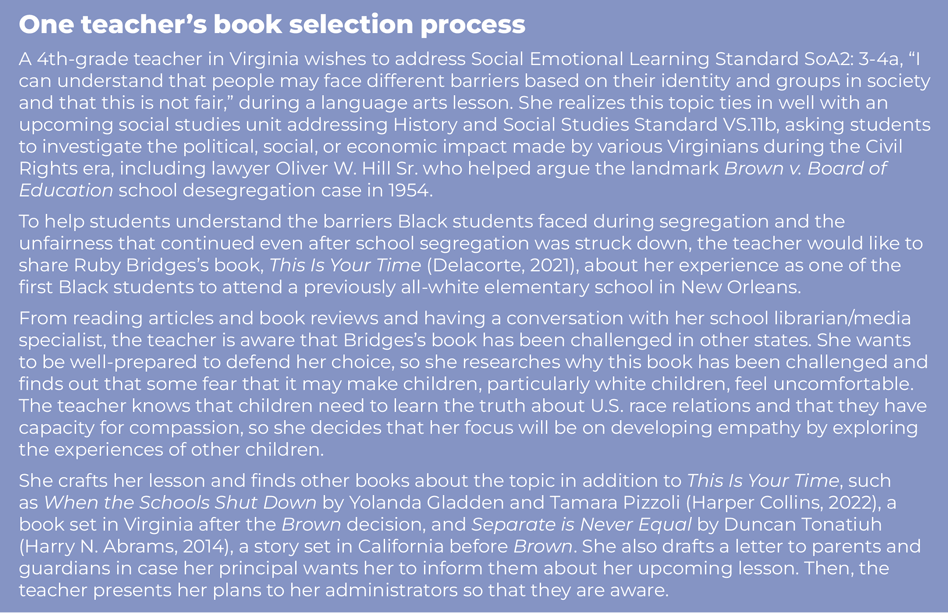
Advance preparation, with a clear rationale for a book’s use, will enable teachers to respond quickly and confidently to challenges. The story on page 42 illustrates this process in action using an example related to race. Teachers who are seeking to be inclusive in their book choices may also need to defend their choices of books related to other potentially contentious subjects (e.g., LGBTQ+ identities, sexual situations, violence).
Building trust
Teachers can also head off challenges by building trust with parents and guardians. This begins with treating all students and their families fairly, respectfully, and graciously. The goal is to have adults feel their child’s teacher has good judgment about what’s important for their child’s education even though they may sometimes disagree. Teachers can accomplish this by communicating openly and honestly about what they are teaching and why.
From the beginning of the year, it is important to make parents and guardians feel welcome to ask questions, express concerns, and offer information about their child. If school policy allows, and when possible, invite families in to help generate a spirit of connection (e.g., for a class poetry reading, to read aloud to the class). When extending these invitations, be mindful of families’ varied circumstances with regard to work schedules and availability. If it is feasible for families, however, meaningful and productive experiences in the classroom can help build more bridges than a dozen newsletters home. Still, regular written communication of a type that parents and guardians find valuable should be part of every teacher’s effort to garner support for classroom activities, including those that some parents or guardians may be reluctant or even unwilling to allow their children to participate in unless they hold the teacher’s opinion in high regard.

Encourage reading for perspective-taking
Teachers care about connecting students with quality literature that can teach them about the world and their place in it while inspiring them to become lifelong readers. To this end, teachers serve as reading role models who influence students’ reading journeys (Medina & Schumm, 2012). They want to share meaningful texts that can generate classroom conversations about identity, empathy, respect, and acceptance as well as encourage perspective-taking.
Literature textbooks provide stories that contribute to perspective-taking, but they often are limited in scope. Supplementing textbooks with high-quality trade books allows students to develop a variety of literary skills, including comprehension of others’ perspectives (William, 2022). Reading challenging (and challenged) literature can prepare students with cognitive and communication skills they will need in many situations, from interpersonal to professional (Chen & Xu, 2020). In this way, carefully selected literature helps students become socially responsible and globally competent citizens.
We respect the rights of parents and guardians, as well as the rights of students to access books (International Literacy Association, n.d.). For teachers to meet their professional responsibilities, they must select literature effective for developing their students’ awareness and understanding of themselves and others. Politically driven attempts to remove books from classrooms are not just challenging books, they are challenging teachers’ ability to share literature that validates the diversity of human experiences. Teachers need to be prepared to respond to challenges in a way that addresses legitimate questions while enabling students to continue building their understanding of the world around them.
References
Bensalah, L., Caillies, S., & Anduze, M. (2016). Links among cognitive empathy, theory of mind, and affective perspective taking by young children. The Journal of Genetic Psychology, 177 (1), 17-31.
Birch S. A., Li, V., Haddock, T., Ghrear, S. E., Brosseau-Liard, P., Baimel, A., & Whyte, M. (2017). Perspectives on perspective taking: How children think about the minds of others. Advances in Child Development and Behavior, 52, 185-226.
Bishop, R.S. (1990). Mirrors, windows, and sliding glass doors. Perspectives: Choosing and Using Books for the Classroom, 6 (3).
Chen, L. & Xu, X. (2020). How does literature affect readers’ theory of mind? Advances in Psychological Science, 28 (3), 434-442.
Coe, W.K. (2022, February 1). Maus book controversy: Four ways you can take action. The Rural Assembly.
Fox, D.L., & Short, K.G. (Eds.). (2003). Stories matter: The complexity of cultural authenticity in children’s literature. National Council of Teachers of English.
Harro, B. (2000). The cycle of socialization. In M. Adams, W.J. Blumenfeld, R. Castaneda, H.W. Hackman, M.L. Peters, & X. Zuniga (Eds.), Readings for diversity and social justice: An anthology on racism, antisemitism, sexism, heterosexism, ableism, and classism (pp. 15-21). Routledge.
International Literacy Association. (n.d.). Children’s rights to read. Statement of the International Literacy Association.
Kidd, D.C. & Castano, E. (2013). Reading literary fiction improves theory of mind. Science, 342 (6156), 377-380.
Kuehl, R. (2021). ‘We treat them like animals in a cage’: A dialogic exploration of Refugee. Reading Horizons: A Journal of Literacy and Language Arts, 60 (3), 1-23.
Kuehl, R. & Azano, A.P. (2023). Critical pedagogies of place in the language arts classroom. Reading in Virginia, XLV, 1-13.
LaRusso, M., Kim, H.Y., Selman, R., Uccelli, P., Dawson, T., Jones, S., Donovan, S., & Snow, C. (2016). Contributions of academic language, perspective taking, and complex reasoning to deep reading comprehension. Journal of Research on Educational Effectiveness, 9 (2), 201-222.
Lewison, M., Leland, C., Flint, A.S., & Möller, K.J. (2002). Dangerous discourses: Using controversial books to support engagement, diversity, and democracy. The New Advocate, 15 (3), 215-226.
López, F. & Sleeter, C.E. (2023). Critical race theory and its critics: Implications for research and teaching. Teachers College Press.
Mar, R.A. & Oatley, K. (2008). The function of fiction is the abstraction and simulation of social experience. Perspectives on Psychological Science, 3 (3), 173-192.
Medina, A.L. & Schumm, J.S. (2012). Kindling or dousing dispositions toward reading: A content analysis of the reading journeys of inservice teachers. The Journal of Reading Education, 37 (3), 21-28.
Reichmuth, H.L. & Chong, K.L. (2022). Teaching Asian American contributions to the Civil Rights Movement through children’s literature. Social Studies and the Young Learner, 35 (2), 11-18.
Rosenblatt, L. (1993). The reader, the text, the poem: The transactional theory of the literary work (New edition). Southern Illinois University Press.
William, J.M. (2022). Embedded mental states, literariness, and the mutual cross-disciplinary benefits of cognitive-literary analysis. Seminar: A Journal of Germanic Studies, 58 (1), 57-76.
This article appears in the April 2024 issue of Kappan, Vol. 105, No. 7. p. 38-43.

ABOUT THE AUTHORS

Adriana L. Medina
Adriana L. Medina is an associate professor at the University of North Carolina at Charlotte. She is a co-author of Studying a World Language: An Interactive Guidebook (Kendall Hunt, 2021).
Rachelle Kuehl
Rachelle Kuehl is a research scientist at Virginia Tech in Blacksburg.
Edwina Pendarvis
Edwina Pendarvis is a professor emerita at Marshall University, Huntington, WV.