All students can contribute to the development of knowledge. What can educators do to create an environment that empowers them to do so?
Almost everyone has spent some time in a school and has fond memories of a favorite teacher and classroom, or conversely, wants to forget a school that made them feel rejected or unseen. Those of us who spend time in schools know that adults with power, such as teachers and administrators, have a great responsibility as we shape the lives of children. Among our responsibilities is that of building equitable communities and structures that ensure powerful learning opportunities for children, especially those from marginalized communities. By achieving these goals, teachers and administrators can uphold the ideals we hope to instill in children. While such goals are easy to consider, enacting the short-term and long-term work needed to transform schools is difficult. Therefore, we hope to spark conversations about how schools can individually and collectively work to reimagine classrooms as sites of equitable learning opportunities.
Classroom communities are built on three foundational ideas. First, teachers and administrators set the tone by giving students opportunities to talk about and shape classroom practices (or by denying them those opportunities). Students pay attention to teachers and administrators’ words and actions, and they notice how adults with power respond to their ideas. Second, teachers and administrators communicate to students about what counts as preferred words and actions. How adults choose to respond to students’ statements and actions demonstrate to students whether adults value student contributions. Third, teachers and administrators send messages about the purpose of participation in classrooms. Some adults want students to give correct answers and complete predetermined practice problems, while other adults help students shape the direction of knowledge production in the classroom by encouraging and supporting students to share ideas. In all of these ways, teachers and administrators send visible and invisible messages to students about what knowledge matters, how to invoke and use knowledge, and who can share ideas and claims to knowledge.
Disrupting epistemic injustice
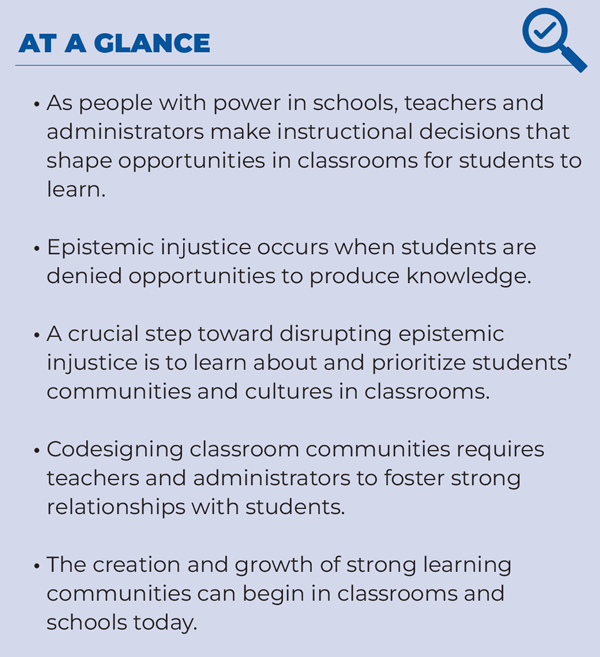
Teachers and administrators have a responsibility to create spaces and opportunities for all students to thrive. As people with power in schools, teachers and administrators make decisions — when planning, while teaching in-the-moment, and during reflection — that shape the classroom community. Given this power and authority, we must be aware of the messages we send to students. Our words and actions, especially related to how we treat students and their ideas, are foundational for creating equitable learning communities.
One way to create and grow more equitable learning communities is to consider how we might disrupt epistemic injustice. Briefly, epistemic injustice is a philosophical perspective, named by Miranda Fricker (2007), that deals with inequities associated with knowledge and knowledge production. Ian James Kidd and colleagues (2017, p. 1) provide example questions that can help educators assess the degree to which epistemic injustice exists in their school:
- Who has a voice and who doesn’t?
- Are voices interacting with equal agency and power?
- In whose terms are they communicating?
- Who is being understood and who isn’t (and at what cost)?
- Who is being believed?
- Who is even being acknowledged and engaged with?
Students can be purposefully excluded from knowledge production and practices simply because of their position in the classroom. However, this is a mistake. Disrupting epistemic injustice and giving students a role in producing knowledge is crucial for four reasons:
First, every person wants to be seen as a knower and contributor to knowledge production in some way. Students want to feel that they and their ideas matter to their peers and supportive adults. How students and their ideas are valued has immediate and long-term implications for how students see themselves and understand their place in the learning community.
Second, too often, pedagogical approaches steer our work toward deficit perspectives of students. As adults with authority and power, we must choose to see each student as an amazing human being with vast and wonderful life experiences that shape what they think and know and as valuable contributors to the knowledge-making efforts of classrooms and schools.
Third, in addition to seeing students as amazing and important people, we must establish explicit and implicit structures that enable students to feel safe and valued as contributors to a learning community. Adults who see students as knowledge-makers become better equipped to demonstrate to students that they are the core of teaching and learning in classrooms and schools.
Fourth, naming epistemic injustice as an equity issue provides us with opportunities to see areas of success, to identify challenges, and to build a community of colleagues who can develop shared language and tools to grow together.
Students, teachers, and principals have been traumatized by the pandemic in ways that may take decades to understand. Returning schools to pre-COVID framings is unethical, unjust, and unfathomable. We need to remake schools as places of caring, community, and trust. We need to create classrooms in which students are seen as humans and not inert data, in which teachers are supported to engage in continual learning with colleagues, and in which communities see schools as a partner and not a detriment to student success.
As classroom teachers and teacher educators with vast experiences disrupting epistemic injustice in different schools, we have three big ideas for reimagining schools as communities where all students are producers of knowledge. For each idea, we provide examples from Anna and Lindsay’s middle school classrooms.
Idea 1: Codesigning classroom communities
A crucial step toward disrupting epistemic injustice is to learn about and prioritize students’ communities and cultures in classrooms. For example, there has been an important push to make curricula more relevant to students’ lives. However, some teachers seek relevance by imposing it onto pre-
established curricular content. Rather than assuming we know what students should learn, we must work with students to brainstorm questions, problems, and phenomena to investigate. The creation of classroom communities in which students’ voices shape the content shows students that their ideas, voices, and values are needed.
Our most important task as teachers and administrators is to build and grow learning communities in which students’ cultural identities and community experiences provide the foundation for instruction. As adults with power, we have the responsibility to build relationships with each student, to learn about the communities in which their school exists, and to ensure that every student has opportunities to infuse their cultures and experiences into the classroom.
How Anna codesigns with students
In my classroom, we often use a “driving question board” to help guide our work. This is a visible, public space (such as a poster paper or a slide in a slideshow) where my students and I add student questions and ideas about a phenomenon. We then use the students’ ideas and questions to frame the learning path forward (i.e., “A lot of you wrote questions about __________, so we are going to spend some time today investigating that question.”).
Another way I encourage students to codesign the learning space is to give them a list of available materials, then ask them, “How can you use these materials to investigate how _____ affects ______?” We might assume students will have no idea what to do with the materials without teacher guidance, but I have consistently found that students create the same or better investigations than I may have come up with, and they are always more invested in the results. This approach often mimics authentic science as well, where an investigation’s results imply there is no relationship between two variables, and students must adjust their investigative focus. Over time, the quality of students’ driving questions improves as they learn that they will investigate these questions.
How Lindsay codesigns with students
At the end of each quarter, I send an anonymous survey to my students and give them time in class to complete it. I ask questions about the classroom culture, my teaching practice, and the learning experience. They rate each statement on a scale and have space for writing ways I can improve this unit if I were to teach it again. They also provide feedback on what I’m doing well and what I should keep the same next time. I share this feedback with my department and my administrator and use it to adjust my practice and set goals. My administration participates in a similar feedback process as well.
While I provide plenty of opportunities for students to provide feedback along the way (via exit tickets, informal check-ins, and individual conferencing), the anonymous feedback is often the most detailed and honest, and therefore the most useful for the overall learning community.
Idea 2: Building relationships
Codesigning classroom communities requires teachers and administrators to foster strong relationships with students. As people with power, when we truly hear and value student thinking, we recognize how students’ words and stories might require us to change our instructional plans and give less value to covering all the content and getting answers that directly align with a curriculum. Rather than shutting students down, we must listen, adapt our teaching, and thank students for bravely sharing ideas. By deprioritizing content memorization and recitation, we can open up opportunities for students’ ideas, lives, and communities to shape the classroom.
To build relationships with students, we must be ready to listen to and learn from students and their experiences. Therefore, we must spend time in students’ communities, learn from community members, and build strong relationships with students. Doing so also will help illuminate what disciplinary content is essential.
How Anna builds relationships
I am privileged to teach many of the same students in both 7th and 8th grade by “looping” with them over two years. I teach 7th-grade classes one year, then move up to teach those same students as 8th graders the following year. Each year, I teach five sections of either grade 7 or 8, alternating grade levels every other year. I absolutely understand the benefits of teachers being experts at a single grade level, but I think looping also can be beneficial.
First, teachers get familiar with a broader range of content which allows them to recognize when students shine in different areas. For example, maybe you see a student as “not a strong writer” based on their argumentative writing during an ecosystem unit. But when the content changes to energy transfer, forces, and motion, that same student becomes more engaged, and their writing begins to change. Because I spend multiple years with students, I have seen many students’ writing shift as they find content they like, and I can remind myself to view students as complex beings who will achieve when provided the right conditions. I enjoy letting students show me how their interests and their academic work begin to converge, especially after their second year in my class.
Teachers and administrators send visible and invisible messages to students about what knowledge matters, how to invoke and use knowledge, and who can share ideas and claims to knowledge.
Another advantage of looping is that we gain instructional time because students already know and trust you as the teacher when you begin your second year with them. For example, at the beginning of every year I have to work really hard to help my 7th-grade students learn routines (especially those involving productive talk) and build community. Because 75% of my grade 8 students had me the previous year, I do not need to focus as much on these routines at the beginning of the year. Instead, I can focus on building relationships with the handful of students I don’t already know, on further developing the skills of students whom I already know well, and on building community based on the new mix of students in my class. Of course, relationships evolve as students develop and change. With looping, we have time to build a strong foundation.
How Lindsay builds relationships
Since the pandemic, we’ve been conditioned to see other humans as a potential biological threat to our very existence — or even to see ourselves as a potential threat to our loved ones. We’ve isolated, we’ve tested, we’ve masked, and we’ve taught behind Zoom screens and plexiglass and at a 6-foot distance. Many of our students were isolated from peers and adult mentors during formative times in their social-
emotional development. How can we begin to heal from this collective trauma and connect again without fear? What does relationship-building look like in a post-COVID world?
One thing that has really shifted for me is knowing that I need to take the time to be human with my students. We may feel the need to rush to make up for lost academic content, but what about lost human connection? Building relationships and creating a safe space for students to take intellectual and emotional risks is even more relevant in a post-pandemic world. My 8th graders who graduated last year started their middle school journey isolated and online. With a lot of time and effort from everyone (teachers, families, administrators, and students), we became a very close community.
There are many ways, both small and large, that we have actively built community at my school. From our whole-school morning meeting appreciation shout-outs to instill a daily gratitude practice to our advisory-led field trips, where students use a budget with constraints to plan their own field trips, we have centered human relationships and agency in all we do. One of the cornerstones of building our community is practicing Millennium Forum, our peer-coaching circle process, in small groups of students each week. Students practice empathetic listening while supporting each other through the highs and lows of adolescent life. Teachers and administrators participate in monthly forums where educators undertake their own journey of self-development while supported by peers. Parents are also invited to participate in the forum process with other parent community members, strengthening the relationships within the community and mirroring the social-emotional work their students engage in at school.
Idea 3: Start now
The creation and growth of strong learning communities can begin in your classroom and school today. While implementing one move or one tool could be a good start, looking more broadly at the ways we treat students as human beings, how we value their ideas, and how we feature their preferred forms of communication and actions can help us begin to reimagine and change how we create opportunities for students to learn. No matter your role in a school, you have the responsibility to provide students with different and better equitable opportunities right now.
We need to create classrooms in which students are seen as humans and not inert data, in which teachers are supported to engage in continual learning with colleagues, and in which communities see schools as a partner and not a detriment to student success.
Disrupting epistemic injustice and reimagining communities in our schools and classrooms is complex, challenging, and compelling work. However, this work is important. You can start to shift what happens in your classroom and school by taking immediate and long-term actions. You can consider the words you use about students’ ideas and experiences, and you can work with students to create learning and teaching norms together. Working with colleagues, you can learn, try out, and create amazing opportunities for students. You are part of a growing community of colleagues across the U.S. and the world who are working together to disrupt epistemic injustice and reimagine classrooms and schools. Your words and actions, your evidence of success, and your stories will help shift conversations and policies in schools. You will inspire parents, community members, and policy makers to see that equitable classrooms and schools help students thrive. Most importantly, you will show students that you care deeply about their ideas, their experiences, and their importance as people.
How Anna is starting now
I often think about small and big shifts that schools can enact. A small change would be to incorporate student choice (topic of a project, independent variable of an investigation, entire investigation) so that students can shape the direction of their learning. For example, the science department at my current school is working on developing “playlists” that target specific science and engineering practices (like planning controlled investigations). We are currently creating them in a shared document on a file-sharing platform. When completed, they will include a suite of activities for students to choose, with some parameters (for example, “you must choose one activity from each of the three columns”). We are excited for students to have choices in how they study, review, and show evidence of learning.
A bigger change would be to allow students to identify how they want their world to change and think about how academic content can help facilitate that change. For example, last year, we implemented a culminating science project for grade 8 students that asked them to:
- Identify the topic areas of science that they were most passionate about.
- Identify skills they felt they were exceptionally good at or had grown a lot in to use in their project and thus demonstrate evidence of that learning.
- Identify an issue in the world (within their preferred topic area) that they felt more qualified (after completing middle school science) to try to resolve.
This project became a symposium where students shared their ideas with peers and got feedback on how realistic others thought their idea were. By allowing students to choose their problem and design a solution, we can empower them to help create the world they want to inhabit.
How Lindsay has started now
Recently, I co-taught a middle school unit on designing experiments to test hypotheses on the effects of screens on human health. As part of this exploration, our students were asked to read scientific papers on topics related to their research questions. Making sense of a journal article is difficult for adults, let alone for 6th and 7th graders. However, we showed them how to use AI, specifically ChatGPT, to summarize the various sections of a published paper (abstract, introduction, methods, etc.) at a level that a middle schooler could understand. Using this new tool, they were able to cite original research in their own introduction sections rather than relying on potentially biased news articles or other websites as sources.
By designing these opportunities for students, we are empowering them to become part of a scientific community and encouraging them to use technology as a tool for advancing their learning.
Power to know and change the world
Our aim is to empower ourselves, as teachers and administrators, to reimagine the purpose of teaching and learning and to serve as a resource for people at the middle and high school levels to initiate immediate and long-term changes to classrooms and schools. We hope all the teachers and administrators doing important daily work in schools and communities see classrooms as a place to disrupt epistemic injustice by changing how they think about disciplinary content, teaching, and students.
References
Fricker, M. (2007). Epistemic injustice: Power and the ethics of knowing. Oxford University Press.
Kidd, I.J., Medina, J., & Pohlhaus Jr., G. (2017). Introduction. In I.J. Kidd, J. Medina, & G. Pohlhaus Jr. (Eds.), Routledge handbook of epistemic injustice (pp. 1-9). Routledge.
This article appears in the March 2024 issue of Kappan, Vol. 105, No. 6, p. 33-37.

ABOUT THE AUTHORS

David Stroupe
DAVID STROUPE is an associate professor of STEM education, teacher education, and the learning sciences as well as the director of research at the Usable STEM Research and Practice Hub, University of Utah, Salt Lake City.
Lindsay Berk
LINDSAY BERK is a founding faculty member and STEM guide and adviser at the Millennium School, San Francisco, CA.

Anna Kramer
ANNA KRAMER is a science teacher at the International School Nido de Aguilas, Santiago, Chile.