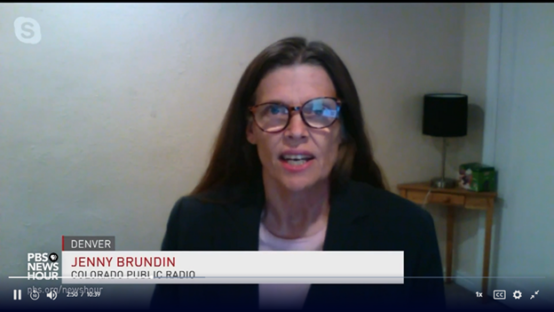
| Her stories sometimes feature long cuts from sources — extended responses that feature-format radio journalism typically doesn’t accommodate — and back-and-forths with interviewees that many radio journalists don’t have the time or inclination to include.
In combination, these two qualities — a keen eye for the unexpectedly interesting, and a mastery of radio journalism — produce work that often subverts dominant narratives in education news.
The craft of radio
How big a role should a reporter play in the story she’s telling?
Judging from her radio work, this is a question Brundin asks herself often.
A recent radio piece about the first graduating class of Denver Public Schools’ community hub program — which helps Spanish-speaking parents with childcare, English, and earning their GED — gets off to an interesting start. Its protagonist, 37-year-old Maria del Rosario, says her name and age — a fairly typical cut to kick off a profile.
But then, atypically, she’s allowed to keep talking.
She talks about her journey from Mexico, her early struggles with English, her two jobs. Almost a minute passes before Brundin resumes her narration. And even this time, it’s just for a few seconds — the mic is quickly passed back to her subject.
Brundin’s narrative style here — clarifying but not controlling — is representative of her work elsewhere. She lets sources speak at length, which is uncommon in a 4- to 5-minute public radio feature. As Brundin fades into the background, her pieces become not about what she’s learned in her reporting, but about what her sources can teach us.
The result in this case is a more fully human look at the sort of district-community program that is extremely difficult to talk about without repeating vague comms-approved talking points.
In most of Brundin’s radio pieces, you can expect to hear a lot from her sources.
You can expect to hear a lot from her sources.
One story profiles a classroom of fifth-graders designing methods for ridding honeybees of disease-carrying varroa mites. Long and well-arranged pieces of audio illuminate the students’ sophisticated thinking as they continually revise their designs.
One group builds a “bee car wash” that involves funneling the bees through a tube of bristles that can scrape the mites into a container of lavender and thyme — “a freaky mixture that mites hate,” one student explains.
In a story about a naturalization ceremony for 48 kids ages 3-14 in Denver, children have the first and final word. In another about a skateboarding program at an elementary school in Longmont, kids talk thoughtfully about learning the new sport.
Brundin has one 9-year-old describe his progress:
“On the mini ramp, I kept saying ‘I can’t do it, I can’t do it, it’s not possible,’” he says at first.
Then he nails a trick: “I was so excited, I felt that feeling. The fire was burning inside me. I was like, ‘let’s go!’”
Finally, he reflects: “It’s changed me to be a little patient-er. I’m still not patient. But I’m a little better.”
One of The Grade’s priorities is encouraging education journalists to give more voice to students and parents; Brundin’s work accomplishes this.
This is politically important, documenting the opinions of those served by public schools. But in Brundin’s case, it also makes the work more engaging — frankly, more entertaining. It makes her stuff worth a listen.
Documenting the opinions of those served by public schools makes the work more engaging.
Choice of subject matter
The pieces highlighted in the previous sections aren’t your typical education stories. The story about the naturalization ceremony, it could be argued, isn’t about education at all.
This is another of Brundin’s virtues: Her work widens the scope of the education beat, encompassing stories that are often ignored by education reporters but shed light on the education system.
Though the citizenship story doesn’t mention education, the implication is obvious. These children are part of Denver’s future. They are served by Denver’s public schools. Their opinions about things like American history and school safety matter.
Asked by Brundin if there’s anything he doesn’t understand about the U.S., 13-year-old Eyoas from Ethiopia gives a thoughtful response:
Eyoas: Some people say the USA is kinda bad, like there’s some things wrong with it.
Brundin: He says he’s learned about the US’s violent and unjust history, but in his opinion, so far, in the short time he’s been here…
Eyoas: I’ve never seen, like, so many good things happen in one continent, really.
For another recent story, Brundin spoke with vendors at a cafeteria-food convention about keeping up with a new generation of hungry consumers at the outset of a new program providing free meals to all students in the state.
The piece could have easily been a dud. There’s no drama inherent in children’s dietary preferences, and a convention is a potential minefield of unsatisfying corporate messaging.
But in Brundin’s telling, the convention isn’t about the conventioneers, but the kids they serve.
We learn from one district’s nutrition director that kids “want a greener solution” and won’t tolerate plastic packaging. We learn how the large Muslim populations in Denver, Aurora, and Greeley are steering those districts away from pork and other non-halal products.
As in the citizenship story, we come away having learned about an area (the packaged foods industry) that intersects with public schools in ways we might not have imagined.
When I listen to stories like this, I wonder: What exactly are the limits of the education beat?
When I listen to stories like this, I wonder: What exactly are the limits of the education beat?
|