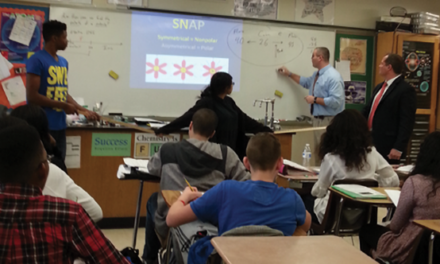
A New Jersey high school created a dual-enrollment program for multilingual learners that encourages them to attend college and become teachers.
Linguistic and cultural diversity of public schools is growing. Students who are multilingual learners (MLs) represented 10.3% of public school enrollment in 2021, an increase of approximately half a million students since 2010 (National Center for Education Statistics [NCES], 2023b). Schools face challenges in educating MLs. Consider ML graduation rates: In 2016, nationwide, 67% of MLs graduate on time, as opposed to 85% of non-MLs (U.S. Department of Education, n.d.). Of those MLs who do graduate, only 12% earn a bachelor’s degree within eight years of graduation, compared to 32% of non-MLs (Núñez et al., 2016).
Many influences impact the academic achievement of multilingual learners. One factor could be the makeup of the teacher workforce as compared to the student population. Between 2010 and 2021, the percentage of public school students who were white decreased from 52% to 45%, marking the first time that non-white students were the majority. Meanwhile, the population of Hispanic students increased from 23% to 28% (NCES, 2023c). At the same time, 80% of public school teachers are white, while only 9% are Hispanic. Similarly, 15% of students but only 6% of teachers identify as Black (NCES, 2023a).
The city of Vineland, New Jersey, reflects the trend of changing student demographics that contrasts with a largely white, female, English-speaking teaching workforce. Vineland is in Cumberland County, the poorest county in the state. Statewide, 41% of residents over 25 have earned at least a bachelor’s degree, while only 17% of Cumberland County residents over 25 can say the same (U.S. Census Bureau, 2021).
Vineland Public Schools has an enrollment of 10,287 students, 10.5% of whom are MLs. The district bucked the national trend in graduation rates, with similar graduation rates for MLs and non-MLs. However, administrators and teachers noted that many MLs who had the potential to be successful in college shied away from attending because they worried about the language demands of higher education.
Vineland High School has an enrollment of 2,780 students in 9th through 12th grade, and 7.9% are classified as MLs. The school’s successful bilingual education program has been designated as a Model Program by the New Jersey Department of Education. The Model Program initiative was designed to highlight English as a second language (ESL) and bilingual programs across New Jersey that engage in innovative practices and whose students are demonstrating required levels of academic achievement. Depending on their home language and English screener scores, Vineland students still learning English are either placed in the ESL-only program, where they receive their core subject classes in English with the support of two daily periods of ESL, or in the bilingual program, where they receive core instruction in Spanish and receive two daily periods of ESL. Students may transfer from bilingual to ESL as their English proficiency grows. However, it is not uncommon for students who arrive in high school to finish their high school career in the bilingual program.
Students in the bilingual program typically arrived in the U.S. in middle or high school. This program meets students where they are academically and linguistically and helps them succeed at high levels. But it was hard to see those students’ college dreams cut short because they were still learning English. Given the economic challenges of the city, as well as the continuous challenge of staffing a bilingual program with qualified teachers, Vineland administrators and teachers knew something had to be done.
A solution: Bilingual education path
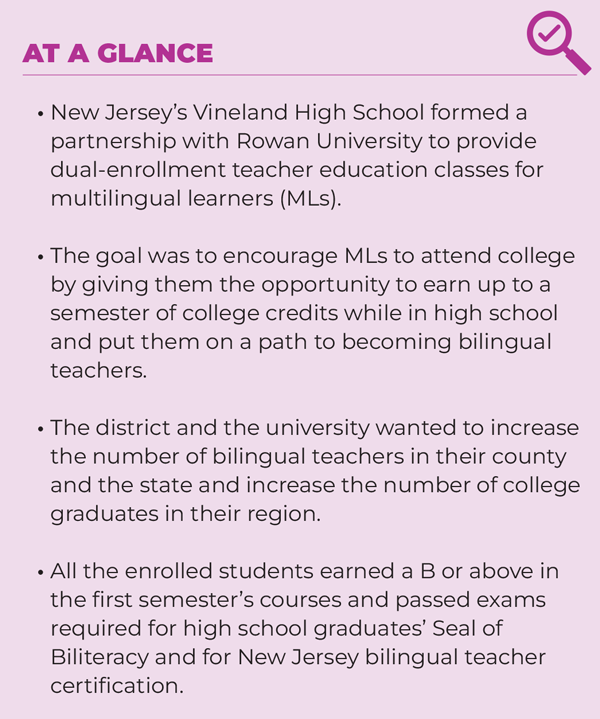
The district partnered with the Rowan University College of Education in Glassboro, New Jersey, to create a dual-enrollment program specifically designed for students in Vineland’s bilingual program. Many dual-enrollment programs exist across the country, and several allow students to take university coursework in Spanish. However, this program introduces Spanish-speaking students to education as a viable profession through courses in their native language that are required for a teaching degree with a specialization in bilingual education. The program has twin goals of providing a pathway to a college degree for recently arrived Spanish-speaking students and producing future bilingual education teachers. Eligibility for these dual-enrollment courses is a high level of proficiency in Spanish, with priority going to 11th-and 12th-grade students. The three dual-enrollment classes are electives in students’ high school schedules. Because the program was initially funded through Title III, students in the program were required to be current MLs. Future goals of the program include seeking out funding that will allow the district to open the program to any student who wishes to enroll.
Dual enrollment is a powerful tool for fueling high school and college completion. It allows students to save time and money, all while helping them develop an identity as a college student (U.S. Department of Education, 2022). Dual-enrollment programs have strong positive effects on high school achievement and completion, college enrollment, and college credit accumulation (What Works Clearinghouse, n.d.).
Although these programs are common in high schools, the benefits are not distributed equally among populations. Dual-enrollment programs are less common at schools that serve students with fewer economic opportunities and students of color. When these programs are available, historically underrepresented students participate at lower rates, even though the positive effects are strongest in underrepresented groups (U.S. Department of Education, 2022).
At the university level, this program has the potential to increase not only overall enrollment, but also enrollment of underrepresented postsecondary students. Like many universities, Rowan has established diversity, equity, and inclusion (DEI) goals. One of those goals is to offer a pathway to bilingual and other underrepresented students into postsecondary education. Furthermore, Rowan has a high ratio of first-
generation postsecondary students and therefore has institutional structures to support these students’ academic success.
Making it a reality
The program started in spring 2023 at Vineland High School with a Rowan core class for first-year students that focuses on critical reading and writing skills. A retired high school bilingual teacher served as an adjunct instructor for the class, teaching it at the high school within the students’ schedule of classes. District administrators and high school guidance counselors made students aware of the class through in-person announcements, emails, and recommendations from ESL and bilingual teachers and guidance counselors. An initial cohort of 27 students voluntarily registered. The students ranged from 9th to 12th grade, though the majority were juniors and seniors. All were in ESL or bilingual support classes in addition to their general education classes; some were recently arrived, and others had been in the bilingual program for two to four years.
Shortly after beginning the dual-enrollment class, seven students dropped because of a lack of readiness or a reluctance to commit to the rigorous expectations of the class. The remaining 20 students successfully completed this course, which is the first in a three-course sequence the program will offer to Vineland students. The second course will focus on immigrant students in U.S. schools (a required course for the ESL/bilingual teaching endorsement program) and the history of U.S. education (a required course for all education majors).
Dual-enrollment programs are less common at schools that serve students with fewer economic opportunities and students of color. When these programs are available, historically underrepresented students participate at lower rates.
As with all bilingual courses at the school, students received readings in both languages and chose the language in which they wanted to read or express themselves. Students said they felt challenged by the material but energized by the relevance of the readings, the freedom to discuss topics of high interest with their peers in their own language, and the rapid improvement they saw in their own writing abilities, both in Spanish and English. One student described the pride he felt in hearing his grandfather compliment his written letters home.
The semester culminated with a trip to the university for a campus tour and a visit to the college of education. The students met the dean, who is an immigrant from Haiti; several professors; and bilingual college staff. Students reported that the program helped them to see themselves as college students and to understand that they had the potential to work successfully toward a college degree.
The program not only helps students realize their potential in meeting the demands of higher education, but also is designed to save time and money. All dual-enrollment coursework that the students take at the high school is paid for by the district, thus reducing the cost of a college degree. The courses being offered at the high school are required courses in teacher education programs at Rowan, giving students a head start on their degrees. Students can earn a total of nine college credits before they graduate from high school. This provides these students with a substantial incentive to apply to Rowan and seriously consider a teacher education degree.
In addition, students in the dual-enrollment bilingual teacher education program may take the Oral Proficiency Interview (OPI) and the Writing Proficiency Test (WPT) instead of the Standards Transparency and Mastery Platform (STAMP) for Seal of Biliteracy testing as they graduate high school. Vineland is one of a growing number of districts offering their students the Seal of Biliteracy on their high school transcripts, affording students official documentation of their language proficiency for college or employment applications. Most Vineland High School Seal of Biliteracy students take the STAMP test, a much simpler, computer-based assessment to obtain the Seal of Biliteracy. Both the STAMP and the OPI/WPT tests are on the New Jersey Department of Education list of approved language exams for the Seal of Biliteracy, but only the OPI and WPT are valid for teacher certification. If students score an Advanced Low or higher on the OPI and WPT tests, they will complete the language proficiency requirement for state ESL and bilingual certification, and avoid this financial barrier later in their college career.
Results and future prospects
Many of these students will be first-generation college graduates, and the teaching profession represents a degree of stability that they find highly desirable. By graduating students from high school with almost a semester of college already completed, the program greatly increases the chances of them finishing a degree program (Villareal, 2017) and becoming certified teachers. We hope to raise the percentage of local residents with college degrees, increase the median income of the city and county, and provide young people with a clear pathway to the middle class, all while providing the community with the teachers it needs to ensure that our future English learners can receive the best we have to offer.
Both district and the university officials were pleased when, at the end of the semester, all the students who had remained in the program earned at least a B in the course. Moreover, all of them passed the OPI and WPT exams in Spanish at the level New Jersey requires for bilingual teacher certification. These students plan to take the other two courses in the dual-
enrollment sequence in the current school year. The goal of the program is to get them into courses in their specialization as quickly as possible.
A new cohort of 20 students has been recruited to start the program this school year. Interestingly, although the course was designed for Spanish speakers, a number of Ukrainian and Haitian Creole-speaking students asked if they could take the course as well. After consulting with the university and the instructor, we said yes. Our class this fall is a mix of students translanguaging in English, Spanish, Haitian Creole, and Ukrainian, learning together how to become teachers and support each other to become successful in two languages.
References
National Center for Educational Statistics. (2023a). Condition of Education: Characteristics of public school teachers. U.S. Department of Education.
National Center for Educational Statistics. (2023b). Condition of Education: English learners in public schools. U.S. Department of Education.
National Center for Educational Statistics. (2023c, April). Condition of Education: Racial/ethnic enrollment in public schools. U.S. Department of Education.
Núñez, A.M., Ríos-Aguilar, C., Kanno, Y., & Flores, S. (2016). English learners and their transition to secondary education. In M.B. Paulson (Ed.), Higher education: Handbook of theory and research (pp. 41-90). Springer.
U.S. Census Bureau. (n.d.). Quick facts. U.S. Department of Commerce. www.census.gov/quickfacts.
U.S. Department of Education. (2016). Academic performance and outcomes for English learners.
U.S. Department of Education. (2022, September). The power of dual enrollment: The equitable expansion of college access and success: Ed Homeroom.
Villareal, M.U. (2017). The effects of dual credit on postsecondary outcomes [Policy Brief]. University of Texas at Austin, Education Research Center.
What Works Clearinghouse. (n.d.). Evidence snapshot: Dual enrollment programs.
This article appears in the October 2023 issue of Kappan, Vol. 105, No. 2, p. 26-28.

ABOUT THE AUTHORS

JoAnne Negrin
JOANNE NEGRIN is supervisor of multilingual learning at Vineland Public Schools, Vineland, NJ.
Catherine Michener
CATHERINE MICHENER is an associate professor in the College of Education, Rowan University, Glassboro, NJ.
Brooke Hoffman
BROOKE HOFFMAN is a lecturer in the College of Education, Rowan University, Glassboro, NJ.