An organization that promotes civics education used a student government model to teach students concepts of democracy and also showed the adults that students could be useful partners in school governance.
The Rendell Center for Civics and Civic Engagement is engaged in a bold experiment to create democracies in elementary schools to increase youth’s civic literacy and civic engagement. Our goal is to cultivate the next generation of active citizens. Our approach is to do so by helping K-8 schools build civic curriculum and youth-adult governance structures so students learn and practice the knowledge and skills of effective citizenship. What follows is the story of and lessons from the center’s yearlong involvement to build a youth-adult school governance system and schoolwide civic literacy curriculum at the K-8 Edwin Stanton School in Philadelphia, Pa.
The premise of the Rendell Center’s approach is that civic learning needs to be schoolwide and experimental: Students learn civic knowledge and skills in classroom settings and apply their learning in a youth-adult, decision-making structure. This approach calls for challenging educators’ assumptions about young people’s leadership abilities and for redesigning decision-making structures and processes. One important hurdle is that the current era of accountability sidelines civics and history instruction in many elementary schools in favor of numeracy and literacy lessons in order to prepare students for high-stakes testing (Rentner et al., 2006). Thus, establishing a schoolwide civic curriculum requires educator buy-in and integration of established pedagogical practices and instructional coaching.
Building civic learning into organizations not focused on civics instruction requires multiple levels of school change that are deep and wide. A new governance system would need to be designed and implemented — one that values youth-adult leadership practices as a form of civic learning. Civic curriculum and instructional practices would need to be modeled and thoughtfully integrated into already established pedagogical practices. Our approach was informed by research on sustaining education change. Cynthia Coburn (2003) argues that sustainability requires scaling up specific changes within a school by spreading underlying beliefs, norms, and principles of the reform and shifting the ownership of reform from a few actors to many. In other words, more than the authors would need to believe civic instruction and youth-adult leadership are central school practices and have the knowledge and skills to engage students in civic learning.
Curricular spread
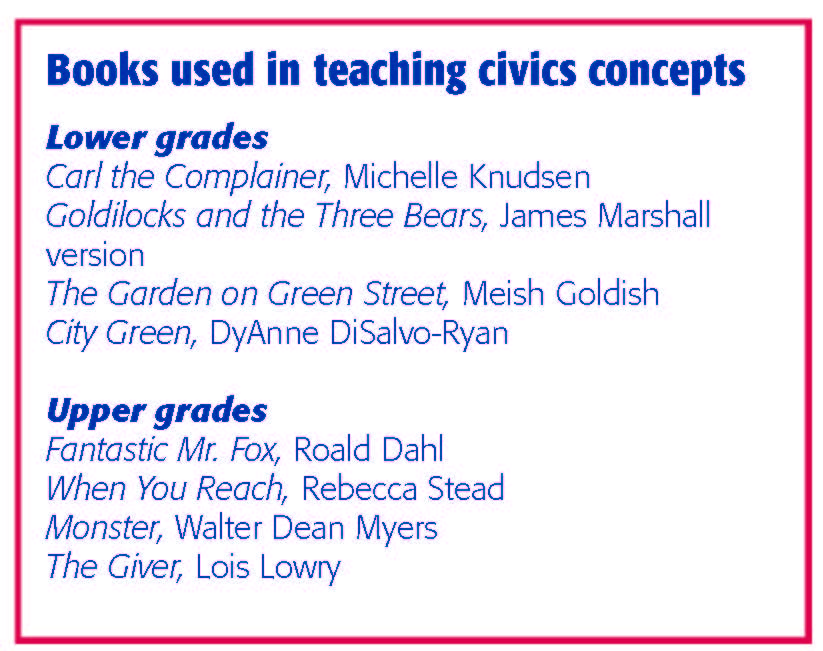
Using common language and instructional practices across grades was essential for scaling up civic learning at Stanton. K-4 students participated in literacy lessons and then connected their discussions to concepts unpacked in the Rendell Center’s We the Civics Kids materials. Then, students in grades 1 through 7 participated in a literature-inspired mock trial, bringing classroom learning of civic concepts to a broader context and facilitating a wider spread of the principles, beliefs, and norms of democracy throughout the school.
The main conduit for civic literacy instruction in the K-4 classrooms was using age-appropriate nonfiction, historic fiction, and fiction books and connecting classroom discussions to civic themes and concepts in the We the Civics Kids materials. Those materials emphasize eight lessons:
- Community building;
- Rules;
- Choices and voices;
- American identity;
- Leadership;
- Rights and responsibilities;
- Conflict and compromise; and
- Youth activism.
For example, during a read-aloud and class discussion of Carl the Complainer by Michelle Knudsen, students learned about the importance of becoming active, involved change agents in their classrooms, schools, homes, and communities. Carl did not get the change he wanted until he realized that he needed to use his responsible voice to address the change, as opposed to complaining about it. Working on a literature-based mock trial based on the James Marshall version of Goldilocks and the Three Bears, a 3rd-grade class identified the roles and responsibilities of the people in a courtroom. Serving as bailiff, attorney, or jury member, students demonstrated an increased ability to develop opinions and support them with what they learned preparing and arguing their trial.
A deeper understanding
After the Rendell team’s lessons were piloted, teachers began to integrate civics literacy into their own classroom literature and across all disciplines. Fourth-grade teacher Joan Carter-Williams, for example, was able to connect civic engagement with the stories in the classroom anthology that had an environmental theme. Giving students a deeper knowledge of what they can do for their environment helped them to better realize the importance of the community garden they already had established. Supporting the conversation were pieces of literature such as The Garden on Green Street by Meish Goldish and City Green by DyAnne DiSalvo-Ryan. (Green Street is about a neighborhood that unites to create a community garden on an empty lot; City Green, also a picture book, highlights urban renewal and community action.) For some, integrating civics into established curriculum happened naturally. For others, it took time to gain a deeper knowledge of the myriad ways the change promoted by We the Civics Kids enhances instruction and raises student performance.
Building civic literacy into classroom and schoolwide instructional practices and developing a youth-adult governance model is a unique approach to civic learning and school improvement in elementary schools.
By midyear, Stanton K-4 educators were well on their way to building a community of knowledgeable and engaged young citizens. To continue this spread, Stanton staff and students learned about America’s judicial system by writing and arguing a literature-based mock trial. This experience took students into the gray area of democratic deliberation by creating a space where each student could form and support his or her own opinion about an ethically unclear dilemma, a frequent feature of democratic societies. To introduce mock trial, the Rendell team presented a professional development seminar that took Stanton’s educators through the steps of writing their own case. The culminating activity was for participants to prepare and argue the case of “The State v. Goldie Locks,” which highlights the issue of criminal trespass. Modeling and then mentoring the mock trial process and then allowing educators to decide the level to which each of their classes should participate proved to be the best way to spread and shift civic learning.
In the last marking period of school, students in 1st through 7th grades participated to varying degrees in the mock trial. The 1st and 3rd grades, in collaboration with the Rendell team, chose the James Marshall version of Goldilocks and the Three Bears on which to base their trials. Upper grades worked with teacher-selected fiction that included Fantastic Mr. Fox by Roald Dahl in 4th grade, When You Reach Me by Rebecca Stead in 6th grade, Monster by Walter Dean Myers in 7th grade, and The Giver by Lois Lowry in the 8th grade.
This constructivist approach to curriculum and cross-class collaborations provided students an opportunity to deepen their understanding of the judicial system.
Each piece of literature illustrated an ethically challenging conflict. For example, Mr. Fox’s family was starving. In order to feed them, Mr. Fox stole food from the farmers. Thus, the jury had to decide if Mr. Fox should be found guilty of stealing, given testimony from witnesses on both sides of the argument. In Monster, the challenge was to determine if defendant Steve Harmon was simply in the wrong place at the wrong time or whether he had made the wrong decision to get connected with the neighborhood hoodlums. For this trial, 7th graders explored the idea of the extent to which a person is judged by the company he or she keeps.
Some classes wrote and tried a case based on their book’s main tension; others participated as jurors. This constructivist approach to curriculum and cross-class collaborations provided students an opportunity to deepen their understanding of the judicial system. The result is that it spread the beliefs, principles, and norms of democracy to many members of the school. Students not only learned civics, they had some agency over curriculum.
Spreading governance
The National Center for Learning and Civic Engagement’s recent report, State Civic Education Policy Framework (Baumann, Millard, & Hamdorf, 2014), calls on policy makers and educators to improve civic learning by cultivating participatory institutional cultures in schools. One strategy is to leverage students as assets for school change, which the Campaign for the Civic Mission of Schools (2011) also concludes is an effective strategy for increasing civic learning. In other words, students learn civics and increase their belief in the efficacy of democracy when they engage in school decision-making processes that affect them daily.
Still, the lack of youth-adult leadership structures in schools, combined with educators’ belief about young people’s abilities to participate in school decisions, creates real hurdles. Often adults do not view young people as mature or knowledgeable enough to handle sophisticated school problems (Costello et al., 1997). These beliefs often translate into school structures that place students on the fringes of school change processes rather than as central stakeholders where important decisions are made. The Rendell Center approaches the idea of students becoming assets for school change.
We used our first in-service session with the entire staff and administration to recognize unproductive beliefs and norms and illustrate how young people’s perspectives are vital when revising ineffective policies and practices. We presented a real case study highlighting the importance of youth-adult leadership (Brasof, 2011). In that case, a nearby high school experienced many students roaming the building during lunchtime, eventually leading to one student spraining an arm during a game of tag. Simulating a task force, participants had to determine a policy to address this situation. Having facilitated this simulation in many settings and understanding student voice research, it was no surprise that most participants blamed the students. Their suggestions for policy solutions reflected the belief that to control students, the school should punish them for not being in the cafeteria and increase enforcement by assigning more educators to lunch duty. Stanton teachers’ solutions mirrored those of educators at that nearby school, which exacerbated, rather than solved the problem. If educators had asked why students were behaving as they did, they would have discovered that students found the school’s food disgusting and instead spent their lunch money at local eateries after school. Forcing hungry and unoccupied students to stay in the cafeteria created more management problems. Using their youth-adult governance structure, students at the school eventually designed an out-to-lunch policy that resulted in a more orderly lunchtime experience and a happier school community. Such outcomes helped challenge participants’ deeper beliefs about young people and about how unilateral leadership practices inhibit school leaders’ ability to collect information vital for effective decision making.
After reviewing the underlying principles, beliefs, and norms of youth-adult leadership, the entire staff developed a list of rights and responsibilities as a means of triggering the beginnings of a schoolwide civic culture.
After reviewing the underlying principles, beliefs, and norms of youth-adult leadership, the entire staff developed a list of rights and responsibilities as a means of triggering the beginnings of a schoolwide civic culture. This document translated concepts such as due process and freedom of speech into classroom norms. For example, the document outlined the belief that each student has the “right to due process . . . (and to) listen and be heard,” following up with a list of responsibilities (norms) to ensure these rights (principles) are upheld, including requirements that students “listen and accept consequences” and “[speak] one at time and express my opinions . . . listen to others respectfully and without judgment.” This instructional activity was an important starting point because civic concepts became a means to foster youth-adult dialogue about policies and practices across the school.
In the lower grades
As lower-grade teachers worked on civic literacy curriculum and instructional practices, 5th- through 8th-grade teachers collaborated during in-services and after-school sessions to write the school’s constitution and supporting civics curriculum. In contrast to most student councils, which tend to be social planning committees with very little power, the language of Stanton’s governing document integrated the same constitutional principles and processes that shaped the federal constitution — separation of powers, checks and balances, federalism, and individual rights — resulting in a three-branch government where youth and adults share power to create, implement, and review school policies and practices.
Once upper-grade educators had created a working draft, it was necessary to present the work to the rest of the school and have students and educators study its language and constitutional concepts. It was imperative that both curricular and governance restructuring activities happen in concert so educators could see how school leadership practices and civic curriculum are integrated (Brasof, 2015). Upper-grade teachers taught students, teachers, administration, and staff how to read their newly written constitution and discussed possible changes. Their efforts led to a successful ratification vote.
Stanton now had a youth-adult governance structure that staff and students were excited to begin using, said government adviser and 6th-grade teacher Anne Olvera. Highly competitive executive branch elections demonstrated the excitement about this. Students running for student body president, vice president, treasurer, and secretary did not promise vending machines or shorter school days as one might expect. Instead, students wanted to address real school issues. As a 7th-grade presidential candidate said in her speech, “This school has helped me mature into an intelligent individual. Stanton will be known as a great school across Philadelphia that supports its students in and out of school.”
Articulating students’ role in school improvement and the importance of democratic participation to the educator and student audience, one candidate for vice president said, “We play a big role in the school; we want to help make school more efficient.” Students illustrated that their perspectives and solutions for school changes should be taken seriously and that spread was occurring. These are some ideas articulated in electioneering speeches:
- Improve lunch procedures and have older students sit with younger, more disruptive students;
- Raise funds for more field trips (in the wake of major budget cuts over the past five years);
- Build community across students, teachers, and parents;
- Reform uniform policy;
- Establish a peer mediation program;
- Start a student-led tutoring club to help struggling students; and
- Develop extracurricular sports.
Student and teacher views
Rickey, a charismatic 6th grader running for president, received huge cheers when advocating for a “better balance between standardized tests and celebrating community.” Rickey won the presidency. After House of Students elections were held, students wrote their first bill — Fun Day. Their intention: Build a greater sense of community throughout the school. The bill’s executive summary said that, “if students work together to create a positive day for our school, we can show how well we cooperate and work together to impact our community.”
Fun Day Bill (HS-01) specifically focused on community building and scaling up civic learning in the school. This policy was more than a social outlet for students. School government advisers Anne Olvera and Nicole Monsalud wanted their first bill to be something the school community could rally around. In it, all teachers and members of government were assigned responsibilities for ensuring Fun Day was a collective endeavor, reinforcing the spread and shift.
“Teachers felt like their voices were heard too,” said Olvera, recounting the Staff Senate session. “The discussion triggered new ideas and buy-in. As a result, they voted for it.”
The bill passed both houses unanimously and was signed into law by the principal and student body president. The school community also came together to make this end-of-year event a success. The parent community donated over 500 gifts, and 10 volunteers helped run the event. Student representatives helped every teacher and their classes come up with and manage a game. School treasurer and 7th grader Tayjonna said:
Everybody really knew what to do and was able to contribute. We got to be kids and have a break from academics. A lot of parents volunteered, which helped the community become more aware of our school. Lots of the teachers told me how great Fun Day was and that they couldn’t wait to go next year.
Monsalud agreed, giving a teacher’s perspective:
Teachers really came through. Even when the weather forced us to shorten the event, ruining teachers’ lunch period, no one complained and everyone remained flexible. Everyone seemed to really enjoy working together. It was mission accomplished. We got to celebrate our community.
A community around school government activity had emerged. Olvera, Monsalud, and Tayjonna began thinking of ways to improve the event and to look at other serious school issues that their government might consider tackling next year, including resource distribution, scheduling, and dress code. Just as important, Fun Day shifted ownership of youth-adult leadership to many members of the school’s community and spread the underlying beliefs, principles, and norms set forth in their newly written constitution. “Not everyone was really sure how government was going to work at first,” Tayjonna said. “Now, after Fun Day, people understand government better; they want to join and help out.”
Review and reflection
Building civic literacy into classroom and schoolwide instructional practices and developing a youth-adult governance model is a unique approach to civic learning and school improvement in elementary schools. As a leading initiative in civic education, the Campaign for the Civic Mission of Schools (2011) stresses the importance of connecting school governance, curriculum, and extracurricular activities to civic learning, making school a space where the aims of building a better society through democratic principles and processes can be realized. Furthermore, the efficacy of youth-adult leadership for improving school is thoroughly documented (Brasof, 2015). Yet establishing such forms of civic learning in today’s education policy climate presents many challenges. Addressing gaps in instructors’ skills and structural and cultural inhibitors is necessary. Principal support is central to initiating and sustaining these kinds of school changes.
Spread and shift can occur when the principal shares the authority and the responsibility with the school community (Hartley, 2010). Stanton principal Stacey Burnley was instrumental in scaling up civic learning within the school. Burnley ensured civic learning was a priority for the school in part by espousing its virtues in shaping the school’s culture and climate. Such actions encouraged new leaders to take on the responsibility for engaging in school change work. Burnley also authorized upper school teachers and the Rendell team to redesign the school’s governance structure knowing that more members of the school community would have formal say on how polices and practices are designed, implemented, and reviewed. Furthermore, Burnley leveraged the power of the principalship so civics had a prominent place in school change work. Burnley carved out time for professional development and space in the school’s program of studies for cross-grade and interdisciplinary collaborations.
Building democracies in elementary schools is possible and holds the potential to increase civic learning and improve other school policies and practices. Stanton’s approach to civic education presents a promising new model of civic learning and school leadership — one in which youth-adult leadership activity has the potential to create a community focused on school challenges and simultaneously build the capacity of youth to be active citizens.
References
Baumann, P., Millard, M., & Hamdorf, L. (2014). State civic education policy framework. Denver, CO: Education Commission of the States and National Center for Learning and Civic Engagement.
Brasof, M. (2011, October). Student input improves behavior, fosters leadership. Phi Delta Kappan, 93 (2), 20-24.
Brasof, M. (2015). Student voice and school governance: Distributing leadership to youth and adults. New York, NY: Routledge.
Campaign for the Civic Mission of Schools. (2011). The guardians of democracy. Philadelphia, PA: University of Pennsylvania, Leonore Annenberg Institute for Civics of the Annenberg Public Policy Center. www.civicmissionofschools.org
Coburn, C.E. (2003). Rethinking scale: Moving behind numbers to deep and lasting change. Educational Researcher, 32 (6), 3-12.
Costello, J., Toles, M., Spielberger, J., & Wynn, J. (1997). History, ideology, and structure shape the organizations that shape youth. Youth Development: Issues, Challenges, and Directions, 185-232.
Hartley, D. (2010). The management of education and the social theory of the firm: From distributed leadership to collaborative community. Journal of Educational Administration and History, 42 (4), 345-361.
Rentner, D.S., Scott, C., Kober, N., Chudowsky, N., Chudowsky, V., Joftus, S., & Zabala, D. (2006). From the capital to the classroom: Year 4 of the No Child Left Behind Act. Washington, DC: Center for Education Policy. www.cep-dc.org/displayDocument.cfm?DocumentID=301
Citation: Brasof, M. & Spector, A. (2016). Teach students about civics through schoolwide governance. Phi Delta Kappan, 97 (7), 63-68.
ABOUT THE AUTHORS

Marc Brasof
MARC BRASOF is an assistant professor of education at Arcadia University, Glenside, Pa.
Anne Spector
ANNE SPECTOR is director of curriculum at the Rendell Center for Civics and Civic Engagement, Philadelphia, Pa.