Schoolwide mental health programs include all students, task staff with a wide range of responsibilities in a comprehensive plan, and include community input and support.
The verdict is in: School-based mental health programs reduce behavior problems, improve school climate, and increase academic achievement. This should not be a surprise: Teachers tell us that the biggest obstacles to student achievement and to their own ability to teach are students’ emotional and behavioral problems (Johnson & Duffet, 2003). It’s time to abandon the idea that we can separate a student’s academic performance from his or her emotional and behavioral performance: Academic and social-emotional learning are mutually reinforcing sides of the same coin. Schools with well-developed schoolwide programs of emotional and behavioral support, especially those embedded in a multitiered system of support (MTSS), demonstrate the best outcomes.
Whatever happened to Jacob?
Between 12% and 20% of American students have a diagnosable mental health disorder, and many others suffer quietly with subclinical symptoms. Jacob is a typical case. I worked with Jacob when he was in 8th grade. He was quiet, didn’t seem to have many friends, and pretty much kept to the fringes of school life. As the year went by, teachers did not take much notice of him; he had a reputation for being unmotivated, was rarely prepared for class, and was just passing his lower-level classes. He didn’t seem to care. His few friends were known to have a variety of problems. Some thought drugs might be involved, but Jacob never got into any real trouble.
Academic and social-emotional learning are mutually reinforcing sides of the same coin.
It was his mother who first came to me with a concern. She said that she and her husband had divorced when Jacob was in 6th grade and that he had difficulty transitioning to the social demands of middle school. His parents tried to provide the support they thought he needed, and they always thought his difficulties were a passing phase. But as his difficulties in school continued, Jacob began to feel more depressed. He had recently begun talking about killing himself and had just been caught shoplifting downtown. I agreed to meet him and quickly saw that he was depressed and needed intensive intervention right away. What really surprised me, though, was his record: Jacob had been a conscientious, well-liked student in elementary school, and had even been tested with an IQ in the very superior range. I worked with him in counseling for the rest of the year, consulted with his mother periodically and connected her with a community-based counseling center, worked with teachers in trying to re-engage him in school, and arranged other supports. He improved, but progress was slow; a lot of damage already had been done.
Schoolwide mental health programs
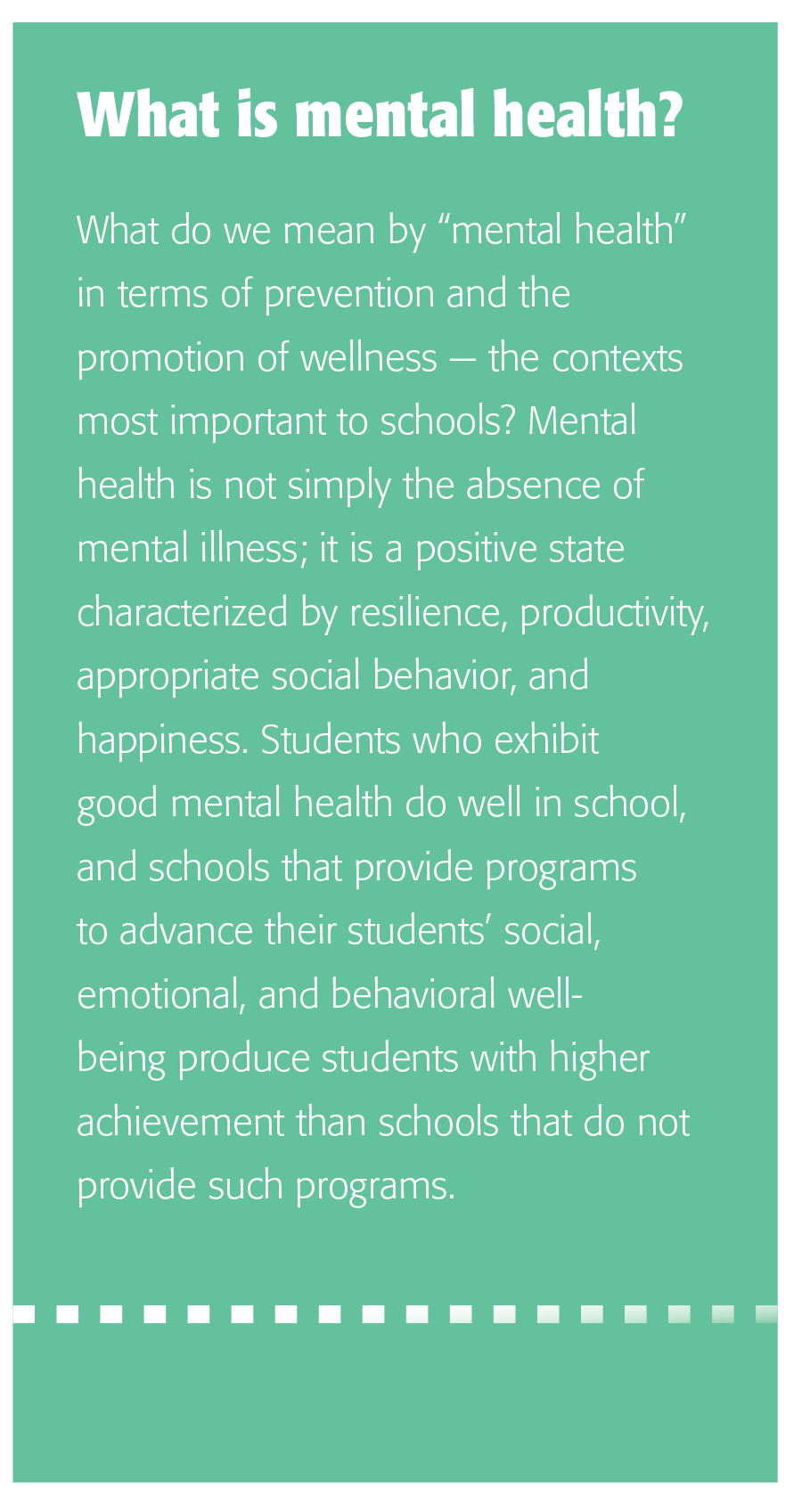
The consensus among school mental health professionals — psychologists, counselors, social workers, and nurses — is that the most efficient and effective framework for organizing mental health services in schools is through a multitiered system of support. This framework typically features three increasingly intense tiers of evidence-based intervention, providing a continuum of care for all students, not simply those identified as having a disability. Tier 1 universal interventions are designed for all students, whether they’re experiencing problems or not; Tier 2 targeted interventions are designed for students at risk for developing emotional or behavioral problems; and Tier 3 intensive interventions are designed for students at very high risk for or already experiencing a significant mental health problem.
Jacob clearly needed Tier 3 intensive intervention. But how did he go so long without help? Part of the answer is that his school did not have a well-organized approach to teaching students how to stay mentally healthy and how to cope with problems before they begin to dominate their lives. Many schools have well-developed programs for children who are at high risk or already experiencing emotional and behavioral problems, including special education, individual counseling, behavioral assessment and intervention, case management, and wrap-around services in collaboration with community providers. However, unless schools also have well-developed Tier 1 and Tier 2 programs, Tier 3 programs are prone to being overwhelmed by increasing case-loads, which can lead to a decline in their ability to provide high-quality services. The only way out of this bind is to dramatically improve the prevention and mental health promotion programs delivered universally to all students.
Fortunately, many Tier 1 universal mental health programs have been designed for use by school personnel. According to the Collaborative for Academic, Social, and Emotional Learning (CASEL), social-emotional learning programs are specifically designed to teach students:
- Self-awareness of their strengths and weaknesses;
- Self-management and responsible decision making;
- Empathy, teamwork, and conflict resolution; and
- Emotional and behavioral self-control.
These programs typically focus on building resilience within students and creating protective schools. The most effective programs focus on both of these areas in a comprehensive package integrated with all other aspects of the school’s program. The What Works Clearinghouse (http://ies.ed.gov/ncee/wwc/) and CASEL (www.casel.org/) are excellent sources of information about these programs.
Other Tier 1 interventions supporting student mental health include staff development and parent education, improving home-school collaboration, and schoolwide efforts to improve school climate. In addition to such efforts, schools also are turning to other Tier 1 interventions designed to improve students’ mental health, including mindfulness, meditation, and physical activities.
Schools need a well-organized approach to teaching students how to stay mentally healthy and how to cope with problems before they begin to dominate their lives.
Designing schoolwide programs
We know how to design and implement curricula for every academic subject. We may not have the same experience designing school mental health curricula, but the principles are exactly the same. Every mental health curriculum should incorporate the following characteristics:
- The purpose of the program should be clear. Goals target specific social, emotional, and behavioral skills and emphasize positive relationships.
- The curriculum should have a theoretical, research, and evidence base supporting its use with students similar to those in your school.
- The curriculum should be culturally sensitive, and parents should participate in its planning and introduction.
- Skills should be presented consistently (across classrooms and grades) in a sequenced, coordinated, and developmentally appropriate way.
- The curriculum should be seen as equal in importance to other subjects and sufficient time and resources devoted to teaching it.
- Staff should be well-trained and program outcomes evaluated (Durlak et al., 2011; Nation et al., 2003).
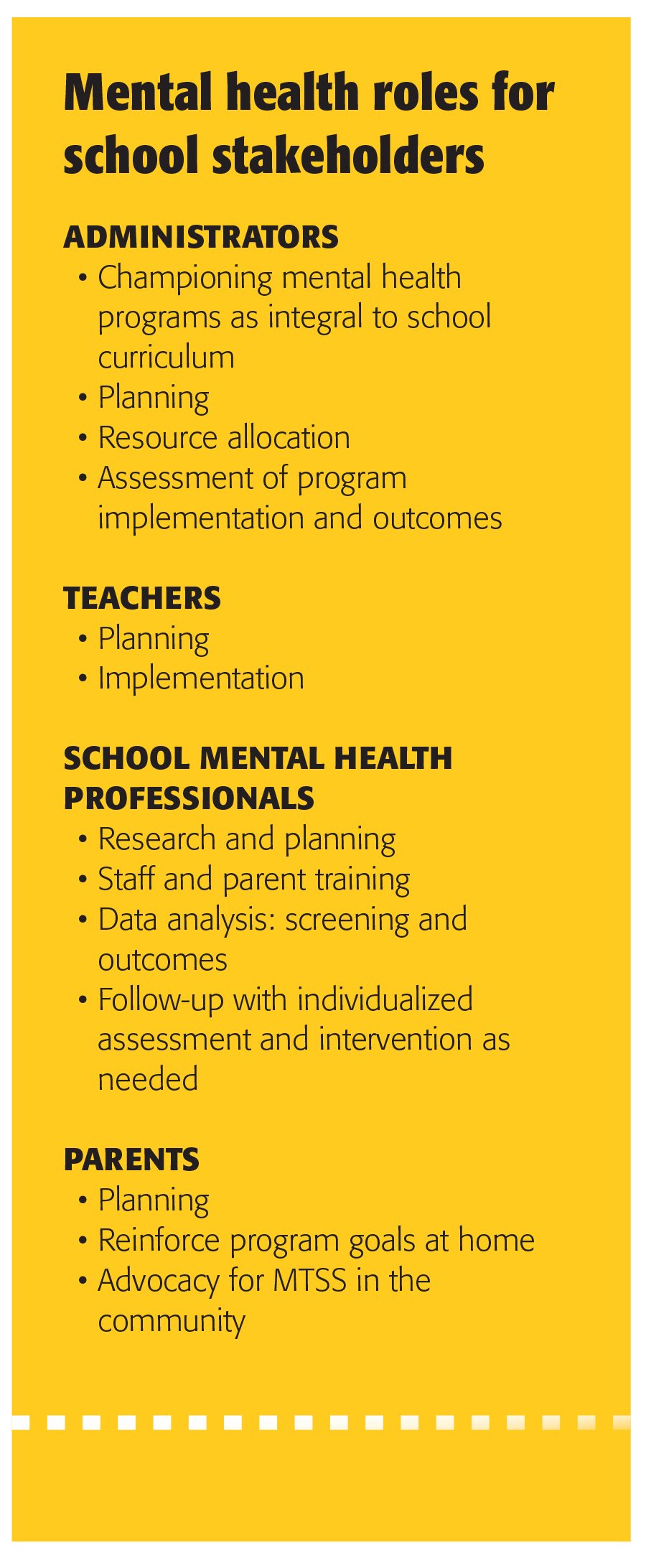
Schoolwide mental health programs are most effective when all staff members are involved in delivering them at one level or another. Full involvement of staff also makes programs more sustainable as individual staff members turn over from year to year.
A mental health framework
An MTSS framework typically employs universal screening of all students to help identify those who may require follow-up or need more intensive intervention. Monitoring their progress ensures that students respond to the intervention and that student response data are used to make education decisions. Schools now organize their instructional systems through an MTSS in the form of a response-to-intervention (RTI) framework. The same organizational structures developed for academic RTI can be adapted or used for the emotional-behavioral framework. In schools that already use an RTI framework for academic issues, the learning curve for adding an emotional and behavioral component is very short.
All schools screen students for emotional and behavioral problems, usually by means of referrals from teachers who typically spot a student they believe may be at risk and refer that student to the appropriate mental health professional. Some schools also screen through the systematic monitoring of office discipline referrals and similar measures. Screening for emotional and behavioral problems is considered best practice and, within an MTSS framework, is similar to the RTI benchmarking process.
Teacher referrals and office disciplinary referrals are best at finding students with certain kinds of conduct or behavioral problems. They are not adequate for finding students with less obvious problems such as anxiety or depression. Teachers are not well-trained on how to spot mental health problems and are more likely to refer students who are actively disrupting classrooms than those who are suffering quietly and doing nothing. The best approach to screening all students for emotional and behavioral problems is through systematic use of procedures and instruments designed for that purpose. Whether used for academic or emotional-behavioral problems, screening is not done to diagnose or label students but to find students who need interventions or are not responding to interventions and need more intensive support.
Many screening procedures and instruments are available for school use. Screening procedures are an effective way to collect valid data about all students in a short time, while removing subjective opinions of teachers. Most assess factors that place students at risk or protect them from emotional and behavioral problems. The National Center on Safe Supportive Learning Environments provides a variety of resources for measuring school climate, including a compendium of surveys and assessments that can be part of a whole-school screening process (see http://safesupportivelearning.ed.gov/topic-research/school-climate-measurement). Other examples of screening programs appropriate for school use are:
- BASC-2 Behavioral and Emotional Screening Scale (www.pearsonclinical.com);
- Search Institute (www.search-institute.org);
- Social-Emotional Assets and Resilience Scales (http://strongkids.uoregon.edu/SEARS.html);
- SOS Signs of Suicide Prevention Program (www.mentalhealthscreening.org); and
- Systematic Screening for Behavior Disorders (http://store.cambiumlearning.com).
Multicultural considerations
For a variety of socioeconomic reasons, a disproportionate number of African-American, Native Alaskan, and Native American students are identified as emotionally disturbed under IDEA (Individuals with Disabilities Education Improvement Act) as compared to other groups of students. An MTSS can be an important mechanism for reducing this over-identification. Universal screening, evidence-based prevention programs, and early intervention can reduce the chances of prematurely referring these students for comprehensive evaluation, thereby avoiding some of the bias associated with such procedures. Since everyone in the school participates in these programs, the stigma commonly associated with receiving such services is dramatically reduced.
Even with a well-developed MTSS, a high level of cultural competency will always be required of educators. For example, while screening can help identify students who need early intervention before they are identified as emotionally disturbed, the nuances of the psychological questions used in these screenings may not be fully understood by culturally and linguistically diverse individuals, even with the help of translators. In addition, cultural groups conceptualize mental health in different ways, and some families feel great shame or otherwise stigmatized when told that their child may have a mental health problem. Often compounding the problem may be a misunderstanding or distrust of the school system in such matters. School mental health professionals may need to expand and customize the screening for these individuals. Certain student behaviors or responses may need to be examined through a culturally sensitive lens. Observing a student’s behavior in the classroom can help determine what contextual factors might contribute to the behavior and how that behavior differs from other students with a similar background. This information, shared transparently and supportively with parents, might improve home-school collaboration in this area.
Reviewing schoolwide screening data can identify disproportionate identification in the school and design ways to reduce it. Schools must actively determine whether interventions were evidence-based, appropriate for the student, and carried out correctly before advancing a student to a more intensive level of service. Given these complexities, professional development activities for everyone on staff is usually needed.
Jacob within an MTSS
I wish Jacob’s school had had a multitiered system of support. Under an MTSS, from the moment he entered middle school, he would have participated in a Tier 1 universal social-emotional learning program, where students learned such skills as how to cope with adversity, solve problems, and communicate feelings. Education programs for parents and staff might have prompted someone to bring him to my attention much earlier. In any event, he would have been flagged at the first universal screening for emotional and behavioral problems. School staff would have followed up immediately and inquired about responses that indicated family concerns and depression. He would have been referred to a Tier 2 psychoeducational group for students whose families were divorcing and would have been followed much more closely. If Jacob’s social, emotional, and academic performance had not shown quick improvement, he would have been referred to me for ongoing counseling regarding his feelings of depression about his parents’ divorce. His parents would be brought in to discuss how they could help Jacob cope with the family situation. Jacob would not have been allowed to go down a road of quiet suffering, loss of friends, declining grades, and bad company for close to three years. Because of this early intervention, he might never have come to my attention: The trajectory of his life through the rest of his school career and into adulthood might have been very different from what this highly intelligent young man actually experienced. Jacob did all right: He finished high school in a lackluster way and went on to employment in the community. I don’t know what happened to him after that, but I do know is that this intellectually gifted young man came nowhere close to reaching his potential, and both he and society suffered the loss. And I also know that this loss was preventable.
A rare opportunity
It is not often that a group of interventions comes along that has an extensive evidence base demonstrating its ability to improve outcomes simultaneously in behavioral and academic domains across all grades in urban, rural, and suburban schools. Adding an MTSS to a school’s model of service delivery and bolstering universal screening and programming for emotional and behavioral issues has the potential to prevent mental illness and improve school climate and academic performance in schools all across the country. The fact that programs organized in this way are readily available, relatively inexpensive, and designed to be implemented by school personnel puts them at the top of the list of priorities for school improvement.
References
Durlak, J.A., Weissberg, R.P., Dymnicki, A.B., Taylor, R.D., & Schellinger, K.B. (2011). The impact of enhancing students’ social and emotional learning: A meta-analysis of school-based universal interventions. Child Development, 82 (1), 405-432.
Johnson, J. & Duffet, A. (2003). Where we are now: 12 things you need to know about public opinion and public schools — A digest of a decade of survey research. New York, NY: Public Agenda. www.publicagenda.org/files/where_we_are_now.pdf
Nation, M., Crusto, C., Wandersman, A., Kumpfer, K.L., Seybolt, D., Morrisey-Kane, E., & Davino, K. (2003). What works in prevention: Principles of effective prevention programs. American Psychologist, 58, 449-456.
Citation: Desrochers, J.E. (2014). The best mental health programs start with all students. Phi Delta Kappan, 96 (4), 34-39.
ABOUT THE AUTHOR

John E. Desrochers
JOHN E. DESROCHERS is a school psychologist in Westport, Conn.