In this week’s newsletter: State test scores are telling an uneven story of pandemic recovery. A star reporter describes how he reported on a short-staffed school and a just-arrived Filipina teacher. Science of reading-based literacy programs are taking off. Community colleges are training teachers. And a Chalkbeat reporter wears (literally) her pride in her job.
TEST SCORE TROUBLE
The big story of the week, according to us
State test results are trickling in and — no surprise — they aren’t great. The lowest scores appear to be correlated with the chronic problem of low attendance. About 1 in 3 students were chronically absent last year, according to Attendance Works. But the picture isn’t dire across the board, particularly for higher income students. And there are some interesting surprises, like in Oregon, where white students didn’t fare better than students of color.
🔊 Student absenteeism skyrocketed in the pandemic as test scores plunged (Washington Post)
🔊 HISD’s math test scores are lower than pre-pandemic levels. Here’s how it aims to change that. (Houston Chronicle)
🔊 Newark public school students score low on math state tests, higher in reading (Chalkbeat Newark)
🔊 N.Y.C. Children Held Ground in Reading, but Lagged in Math, Tests Show (New York Times)
🔊 Latest MCAS results show uneven academic recovery statewide (WBUR; see also Boston Globe, Boston Herald, GBH, Commonwealth)
🔊 Oregon students’ reading, writing and math skills plummeted amid pandemic (Oregonian; see also OPB)
🔊 Fewer than half of Wisconsin students were proficient in math, language (Milwaukee Journal Sentinel)
Other big stories this week: With two years left to spend the final — and largest — chunk of ESSER funds, schools are creating programs and hiring new staff, but they’re getting wary of what will happen when the funding runs out. Advocates and parents continue their plea to the White House to revive the universal free meal program as kids rack up school lunch debt and families go hungry. Also, Los Angeles public schools were hacked, and some schools in Florida and elsewhere are still closed in the aftermath of Hurricane Ian.
INADEQUATE EXPECTATIONS
The best education journalism of the week, according to us
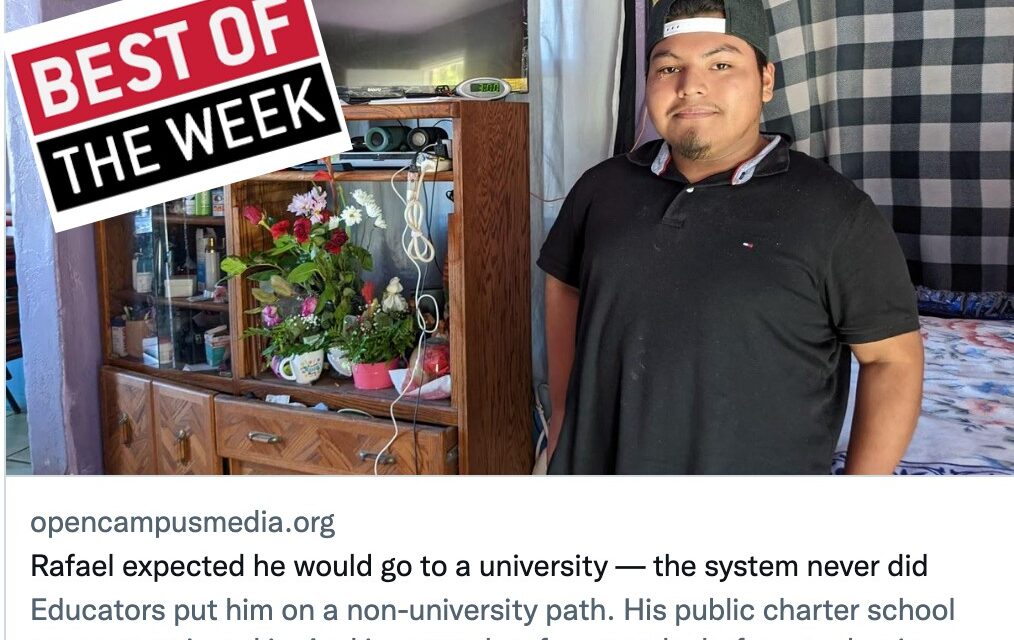
🏆 BEST: The best story of the week is Rafael expected he would go to a university — the system never did by Nick Fouriezos for Open Campus and EdSource. What makes this piece so good is that it focuses on a vulnerable student in a school system that seems set up to fail him.The student, Rafael Lopez-Librado, lives in a rural area outside of Fresno, comes from Indigenous immigrant roots, has a disability, and attends a school that seems to care little about his high hopes and dreams. His guidance counselor instructed him to write “welding” in the box for what he wants to study, even though he didn’t know what that was. “This is a story about one student’s high expectations for himself, and the people who didn’t share them,” writes Fouriezos.
🏆 RUNNER-UP: This week’s runner-up is When your disability gets you sent home from school by Meredith Kolodner and Annie Ma in the Hechinger Report and AP. While data and statistics can be great reporting and storytelling tools, often the stories that are hardest to get — and most impressive — are those that reveal what the statistics don’t. In this story, Kolodner and Ma investigate an off-the-books kind of suspension that disproportionately impacts students with disabilities, but often flies under the radar. Over a few months of reporting, Kolodner and Ma interviewed 20 families in 10 states who described repeatedly being called during the school day to pick up their children for behaviors stemming from their disabilities. While not recorded as suspensions, these calls have much the same impact on students and families. This is an issue I wish more reporters would look into, especially as schools struggle to deal with “disruptive” behaviors in the wake of the pandemic.
BONUS STORIES:
🏆 ‘Careless’ Child Abuse Reports Devastate Thousands (The 74)
🏆 Oakland Parents Want a Seat at the Table (KQED)
🏆 A Baltimore high school football team learns from loss (Baltimore Beat)
🏆 Sexual misconduct top reason KY teachers lose license (Herald Leader)
🏆 Idaho kids harmed when restrained, secluded in schools (Idaho Statesman)
🏆 Since 2016, nearly 1 out of 5 students have left (Fort Worth Report)
ELI SASLOW’S REPORTING SECRETS
New commentary from The Grade
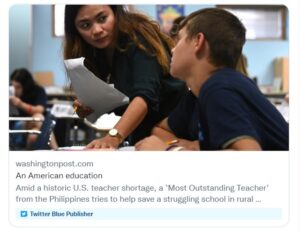
Above: Eli Saslow’s much-discussed new story about an immigrant teacher and an Arizona school.
Eli Saslow’s latest Washington Post story is an impressively detailed and beautifully written depiction of desperate administrators, hopeful and hard-working teachers, and understandably mistrustful students who’ve seen too many teachers come and go.
In a new interview about the piece, Saslow describes how he found the school and picked the teacher he focused on, and how he gathered the details that make the story so compelling and necessarily raw.
“To write stories that are honest and true that means I’m writing some things that will hurt a little bit.”
Follow @alexanderrusso for thought-provoking commentary on education journalism all day, every day.
ADVANCES IN LITERACY
Promising innovations & signs of progress
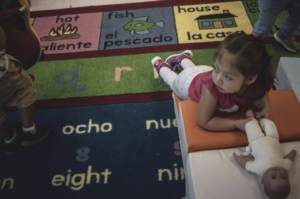
💡 (Above) A bilingual preschool in Memphis is working with an under-served immigrant population to improve literacy in the community, starting in early childhood. (Chalkbeat Tennessee)
💡 A handful of job training programs have proven that they work in advancing low-income workers to the middle class. (New York Times)
💡 Schools in California and Connecticut are cautiously embracing the science of reading in the hopes of improving literacy rates. (EdSource, New Haven Independent)
💡 While stories about teacher shortages persist, new teachers in Colorado are excited to start, and some states like Washington are looking to community colleges for a new supply of instructors. (Colorado Sun, Hechinger Report)
Read more about the importance of including promising innovations and preliminary successes.

PEOPLE & JOBS
Who’s doing what, going where
Above, clockwise from top left: Signal Cleveland has hired Amy Morona to cover higher education and Paul Rochford to cover K-12. And Oregonian Report for America fellows Rose Wong and Sami Edge got a shoutout from the paper for their great work on early childhood and higher education.
🔥 Impact: Mere hours after The 74 published an incredible investigation into a student surveillance company accused of LGBTQ bias, the Trevor Project refunded a $25,000 donation from the company. Kudos!
🔥 Media appearances: St. Louis Public Radio’s Marissanne Lewis-Thompson was on NPR’s Morning Edition last weekend talking with host Ayesha Rascoe about her podcast about Black families who’ve opted to homeschool their kids. WFYI’s Lee Gaines was on WAMU’s 1A talking talk about issues around sex education in Indiana and the rest of the country.
🔥 Fellowships: The newest class of Citizens and Scholars higher education journalism fellows was announced yesterday! Congrats to the New Hampshire Union Leader’s Josie Albertson-Grove, the National Memo’s Chandra Bozelko, Buffalo Business First’s Lian Bunny, The New Bedford Light’s Colin Hogan, Marketplace’s Stephanie Hughes, the Detroit Free Press’ David Jesse, CNHI’s Janelle Stecklein, USA Today’s Nirvi Shah, and freelancers Chanté Griffin and Cassie Chew.
🔥 Job openings: Bethesda Beat is hiring an education reporter to replace Caitlynn Peetz, who left for Education Week. The Hechinger Report is looking for an audience engagement editor. The Connecticut Mirror is looking for an education reporter. And so is WAMU. Check previous versions of the newsletter for more jobs that may still be open.
PODCASTS & RESOURCES
What’s happening and new research
Above: Stay tuned for the Oct. 13 release of the trailer for APM Reports’ new podcast Sold a Story, about why schools haven’t been teaching kids to read. Sign up here for email notifications.
⏰ Podcasts: WNYC’s The Brian Lehrer Show came out with a three-part series on culture wars at school, exploring the role of LGBTQ student needs in a New Jersey election, how American history curriculum has become a wedge issue for voters, and how schools are factoring into the politics surrounding the New York governor’s race. On Slate’s One Year podcast (1986), staff writer Joel Anderson looked at how Jim Crow-era leadership in a Mississippi town allegedly used public school funds for the local segregation academy — and what the Black folks did about it.
⏰ Resources: Non-parents are much more critical of schools than parents, according to new polling results from Morning Consult. An end to DACA would dramatically affect undocumented teachers, according to a story from The 19th. Looking for a fun way to explain math terms? Feel free to republish this narrative infographic, in which a fictional local journalist figures out the best way to explain how town administrators plan to spend a sudden windfall. (H/T The Journalist’s Resource.)
⏰ If you’re a reporter in Massachusetts, check out the Boston Schools Fund analysis of the MCAS scores. Want to find climate angles in your education reporting? Climate Central released a report on the threat of rising sea levels, with implications for K-12 schools (due to decreased property valuation and funding for education). It’s worth a read.
THE KICKER
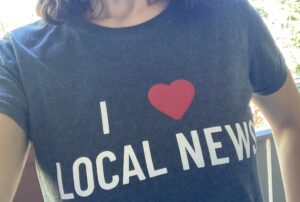
“Yes, the absent-minded woman seen crossing Rogers Park/Edgewater in this shirt — courtesy of @chalkbeat — is me. And I have never worn a truer statement on an article of clothing.” — Chalkbeat Chicago reporter Mila Koumpilova
That’s all, folks. Thanks for reading!
Reply to this email to send us questions, comments or tips. Know someone else who should be reading Best of the Week? Send them this link to sign up.
Using Feedly or FlipBoard or any other kind of news reader? You can subscribe to The Grade’s “feed” by plugging in this web address: http://www.kappanonline.org/category/the-grade/feed/.
Read more about The Grade here. You can read all the back issues of The Grade’s newsletter, Best of the Week, here.
By Alexander Russo with additional writing from Colleen Connolly.
ABOUT THE AUTHOR
Alexander Russo
Alexander Russo is founder and editor of The Grade, an award-winning effort to help improve media coverage of education issues. He’s also a Spencer Education Journalism Fellowship winner and a book author. You can reach him at @alexanderrusso.
Visit their website at: https://the-grade.org/