In this week’s newsletter: Two amazing new stories about homeless students and one kid’s harrowing pandemic experience. What really happened in last week’s midterms? How mainstream media downplayed the displacement of 100,000 Black educators. Three top law schools are quitting the US News & World Report rankings. And a new multimedia project is out on the impact of white women who helped perpetuate oppression in education.
MIDTERM LESSONS
The big story of the week, according to us
This week’s big story is the impact of last week’s elections on education. Close readers already know that the media-fueled “red wave” didn’t pan out — and that pre-midterm education coverage tended to amplify right-wing school board successes. What we’re learning since then is what probably should have been obvious from the start: Right-wing school board candidates generally did well in Republican-controlled states like Florida, but fared poorly in purple and blue parts of the country like Michigan and California. School choice is no longer the taboo it once was for many Democrats. And opposition to diversity, gender, and COVID safety measures was no guarantee of success for school board candidates — regardless what part of the country they’re in. Here’s what reporters and analysts are saying:
🔊 Extreme Candidates and Positions Came Back to Bite in Midterms (New York Times)
🔊 ‘Too hyperbolic’? School board parental rights push falters (AP)
🔊 School choice motivated midterm voters in superintendent races. (USA Today)
🔊 How will fights about race and suburban schools change education politics? (Chalkbeat)
🔊 Parents rights school board campaigns lost most Michigan races (Bridge Michigan)
🔊 California school board races don’t see red wave (EdSource)
🔊 Despite GOP gains, Austin-area voters rejected conservative school board candidates (Texas Tribune) See also KUT Austin
🔊 Conservatives sweep races for seats on Kansas State Board of Education (KCUR)
🔊 Youngkin’s signature red vest didn’t deliver big wins for GOP nominees (Washington Post)
🔊 Pandemic Politics Produced Mixed Results in Local School Board Races (Voice of San Diego)
According to Ballotpedia, school board election winners were pretty evenly divided among those who supported and opposed school diversity, gender, and COVID safety positions.
Other big stories this week include two superintendents fired right after the midterms, changes to social studies curriculum in Virginia and Colorado, the FBI’s revelation that most of the threats against HBCUs came from one person (a minor), and yet another school shooting, this time at the University of Virginia. Oh, and three top law schools have now quit the US News rankings.
📌 Scheduling note: We’re taking next week off for Thanksgiving, so we’ll see you after the holiday! 📌
INVISIBLE STUDENTS
The best education journalism of the week, according to us
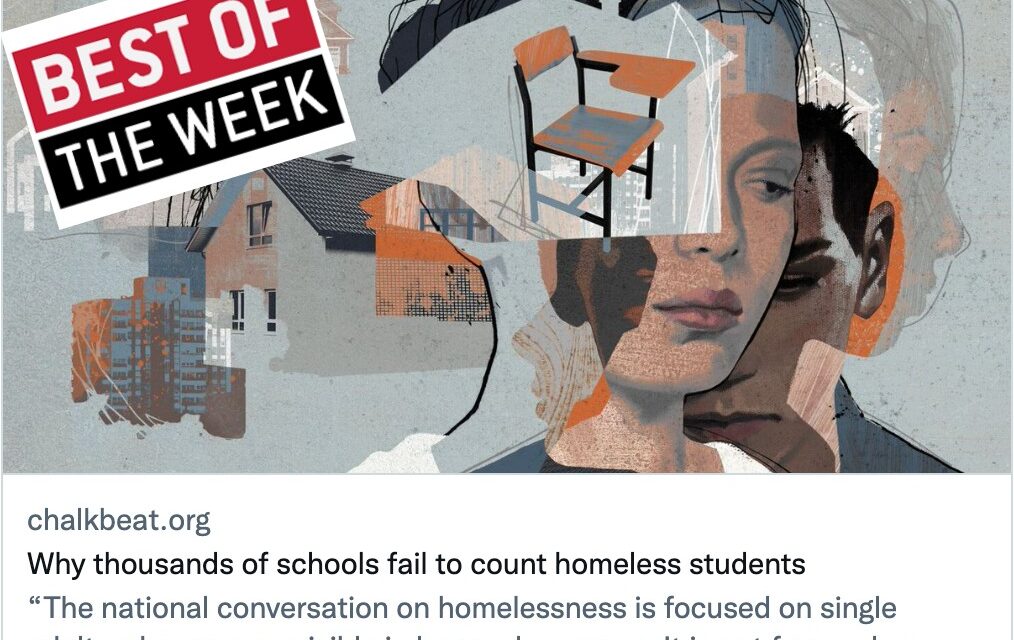
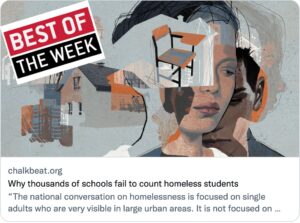
🏆 BEST: The best story of the week is Hidden toll: Thousands of schools fail to count homeless students by Amy DiPierro and Corey Mitchell from the Center for Public Integrity. Produced along with Chalkbeat, the Seattle Times, Street Sense, and WAMU, the team analyzed district-level federal education data and found that around 300,000 homeless students entitled to certain rights and benefits have gone without them — despite a 1987 federal law that DiPierro and Mitchell found is rarely enforced. One major factor: Districts have failed to identify students as homeless. Among the many consequences is lost access to transportation for students who move out of the district, leading to more missed class time, dropouts, and school instability. This is an incredibly data heavy story, but a very important one. As one source said, homeless students are a “largely invisible population.” Kudos to the whole team for dogged reporting on this topic. If you want to know more about how they did it, see their white paper on the topic.
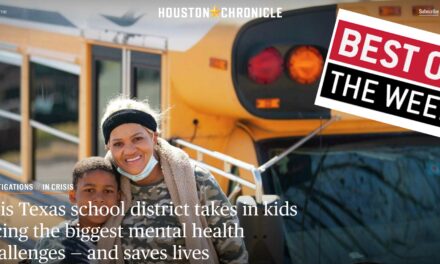
🏆 RUNNER-UP: This week’s runner-up is Linda Jacobson’s heartbreaking Virtual nightmare: One student’s journey through the pandemic in The 74. Jacobson shares intimate details of Jason Finuliar’s downward spiral, from a high-achieving and highly sociable student to a depressed teen who lost all motivation for his classes and extracurricular activities, eventually landing in a mental health facility. “I felt so worthless,” Jason said. “I had no clue when things were going to go back to normal.” We’ve seen some other great stories on how the isolation of virtual learning impacted kids — I’m thinking of ProPublica’s stunning 2021 story about the cost of the pandemic on teens — but I wish we would see even more. While many kids have bounced back — and some including Jason’s sister weren’t so negatively affected by remote learning — many had experiences like Jason’s that are likely to have an impact on the rest of their lives. Let’s not forget.
BONUS:
🏆 Handcuffs in Hallways: Hundreds of elementary students arrested at U.S. schools (CBS News)
🏆 NYC’s Black schools chief isn’t sure racial integration is the answer (Washington Post)
🏆 In Uvalde, a Community Struggles for Reform Amid Grief (The Trace)
🏆 D.C. school enrollment hits 15-year high, mayor says (Washington Post)
🏆 ‘Just-right’ books: Does leveled reading hurt the weakest readers? (EdSource)
🏆 How math became an object of the culture wars (New Yorker)
🏆 42% Of Students “Chronically Absent” (New Haven Independent)
A note on last week’s runner-up: Thanks to a sharp-eyed reader for pointing out that Gothamist’s story about a struggling NYC high school failed to note that the school changed its admission process in 2022.
WHITE MEDIA, MIDTERM COVERAGE
New commentary from The Grade
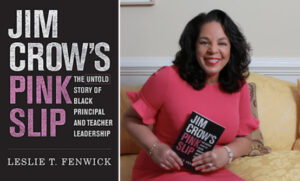
When an estimated 100,000 Black educators were displaced from their jobs in the aftermath of the Brown decision, the mainstream media failed to cover that part of the story adequately, according to Howard University’s Leslie T. Fenwick. “Desegregation was a national issue that drew national media coverage,” writes Fenwick in a new piece for The Grade, “but the elimination of Black principals and teachers was not assigned the same urgency.” It’s a chilling reminder of the effects of racial bias in journalism, which I’d argue remains a major problem today. We keep missing big stories unfolding right under our noses.
Also: In the run-up to last week’s midterms, readers of education news might well have expected to see conservative school board takeovers taking place across the nation. This isn’t the first time that education coverage has misled readers with amplified fears and advocate-based speculation. But I’m still hopeful that reporters and editors will reconsider this approach.
“Education reporters: if you haven’t read this yet, consider reading it today.” That’s APM Reports’ Emily Hanford recommending our recent piece about coverage of reading research. Like Hanford says, journalists have two jobs: to hold others accountable and to model accountability for their own work.
A CLOSE LOOK AT READING CURRICULUM
Promising innovations & signs of progress
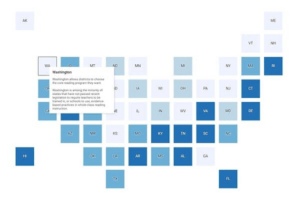
Above: Check out this new interactive map on state reading laws, courtesy of Christopher Peak and Emily Hanford. Lots of changes in some states.
💡 After seeing her peers make inappropriate jokes following the murders of George Floyd and Breonna Taylor, a Pennsylvania teen started a poetry and art competition to empower young people to express themselves in healthy ways. (WHYY)
💡 Some school districts across the country are experimenting with play-based learning to increase literacy, close achievement gaps, and improve motor skills. (Hechinger Report)
💡 A New Haven-based nonprofit is offering scholarships to high schoolers to learn how to code. (Connecticut Public Radio)
💡 First graders in Connecticut are learning how to deal with upsetting feelings — many of them the consequence of the pandemic — with puppets that teach them to “shake out the yuck.” (NPR)
Big thanks to the Solutions Journalism Network for including Kate Rix’s recent piece in their newsletter!
Follow me at @alexanderrusso for thought-provoking commentary all day, every day.
PEOPLE, JOBS
Who’s doing what, going where
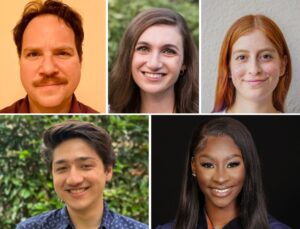
Above, clockwise from top left: Job-changers Jack Stripling, Cayla Bamberger, Valeria Olivares, Aziah Siid, and Julian Shen-Berro.
🔥 Career moves: Jack Stripling, formerly of the Chronicle of Higher Education, is joining the Washington Post’s education team as an investigative reporter covering higher ed. NY Post education reporter Cayla Bamberger is leaving the paper, but she says she’ll still be covering NYC education in her next gig. (She’s the second local NYC newspaper ed reporter to leave, following Michael Elson-Rooney’s recent departure from the New York Daily News for Chalkbeat New York, noted Leonie Haimson.) Valeria Olivares is now the Dallas Morning News Ed Lab’s engagement reporter, following a stint as a fellow. Aziah Siid has joined Word In Black as an education reporter. (They also have an education newsletter you should check out!) Julian Shen-Berro, formerly of Politico NY, is joining Chalkbeat’s national team for a few months.
🔥 Also, in case you missed it, former Wall Street Journal education reporter Leslie Brody is now at the charter network Uncommon Schools, and former WNYC education editor Patricia Willens is now a senior editor the New York Times’ The Daily.
🔥 Job openings: Education Week is hiring an assistant managing editor for policy and politics. The Salt Lake Tribune is hiring a K-12 education reporter. If you’re interested in critiquing the media (like us), Nieman Lab is hiring a staff writer. Check previous editions of this newsletter for more jobs that may still be open.
PODCASTS, RESOURCES
What’s happening and new research
Above: Be sure to check out “Jane Crow: Then and Now,” a multimedia production from Ed Post about the role of white women in perpetuating systems of oppression that have led to today’s educational inequalities. If it reminds you of This American Life’s “Nice White Parents” from two years ago, you’re not alone.
⏰ Podcasts: The latest episode of APM Reports’ Sold a Story is out, featuring Emily Hanford and her team trying to get answers about why a textbook publisher still uses some debunked reading practices. The New York Times’ The Daily featured not one but two episodes on education this week: one with Sarah Mervosh on NAEP scores and remote learning and the Sunday Read featuring Samantha Shapiro’s amazing story on homeless students in rural America. For more on election-related education issues, WBUR Here & Now asked whether school board races are swinging to the right and Bloomberg’s Bedrock, USA discusses why school boards had the toughest races. Lastly, Chalkbeat New York’s Alex Zimmerman was on P.S. Weekly to talk about changes to the NYC school admissions process.
⏰ New ventures: The Minneapolis outlet Southwest Voices is launching an education news portal about Minneapolis Public Schools. Signal Cleveland officially launched this week and will help fill in a much-noted gap in education coverage in the city. And check out Democracy and Education, a resource from former education reporter Karin Chenoweth for school board candidates who want to protect democracy.
⏰ Resources & research: If you’re writing about school “culture war” issues, consider checking your language. Gabe Schneider of The Objective makes a compelling case not to use the term, which “works to frame a horrific challenge to Black Americans’ continued existence as up for debate.” And new research summarized in The Conversation shows that math teachers in virtual classes tend to view girls and Black students as less capable.
⏰ Deadlines: The EWA awards are open! I think there should be a write-in category, but there’s a ton of good education journalism that warrants celebration. Deadline is Jan. 9.
THE KICKER
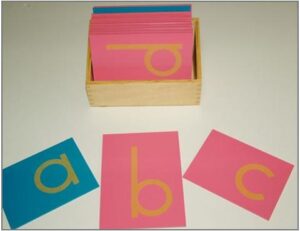
How did you (or your kids) learn to read? I remember tracing sandpaper letters and sounding out words and before I knew it I was reading. But maybe your experience was different?
That’s all, folks. Thanks for reading!
Reply to this email to send us questions, comments or tips. Know someone else who should be reading Best of the Week? Send them this link to sign up.
Using Feedly or FlipBoard or any other kind of news reader? You can subscribe to The Grade’s “feed” by plugging in this web address: http://www.kappanonline.org/category/the-grade/feed/.
Read more about The Grade here. You can read all the back issues of The Grade’s newsletter, Best of the Week, here.
By Alexander Russo with additional writing from Colleen Connolly.
ABOUT THE AUTHOR
Alexander Russo
Alexander Russo is founder and editor of The Grade, an award-winning effort to help improve media coverage of education issues. He’s also a Spencer Education Journalism Fellowship winner and a book author. You can reach him at @alexanderrusso.
Visit their website at: https://the-grade.org/