In this week’s newsletter: Kids aren’t showing up consistently to school — or showing up at all. One district in Texas has figured out a way to address the student mental health crisis without state funding. A job change forced a veteran reporter to rethink her whole approach to reporting. And NPR’s Elissa Nadworny shares how education reporting has helped her Ukraine coverage.
CHRONIC ABSENTEEISM
The big story of the week, according to us:
The big story of the week is chronic absenteeism. Two years since the start of the pandemic, nearly all schools are back in session — in person, mask-optional. But kids still aren’t showing up consistently. Chronic absenteeism in NYC public schools hits an alarming 40%. For students, intermittent attendance can derail academic learning and change educational outcomes. For district schools, attendance problems combined with enrollment drops create a devastating one-two punch:
🔊 Where Are All the Kids? 4 Things to Know About the Current Absenteeism Crisis (EdWeek)
🔊 As chronic absenteeism skyrockets amid reopenings, how can states and districts reengage students? (K-12 Dive)
🔊 With half of students chronically absent, Akron schools look to state program for help (Akron Beacon Journal)
🔊 Chronic absenteeism plagued N.J. schools during pandemic (Philly Inquirer)
🔊 JCPS seeing high rates of ‘chronic absenteeism,’ some students missing nearly 20 days (WLKY Louisville)
🔊 More Baton Rouge kids aren’t showing up for school, raising alarm: ‘How can it be that bad?’ (The Advocate)
🔊 Nearly 1 in 3 BPS students was chronically absent last year, state says (Boston Herald)
Other big stories this week: California released alarmingly low enrollment numbers (LA Times, Mercury News, CalMatters, Sacramento Bee, EdSource, Orange County Register). Meanwhile, schools are struggling to address learning loss, identify the most disadvantaged kids, and upgrade facilities with federal COVID funding (US News, Detroit News, AP, OPB). And homeschooling isn’t going away even with schools back open (Associated Press).

RE-THINKING THE ED BEAT
New commentary from The Grade
Veteran education reporter Linda Jacobson (above, middle right) has been doing some great national reporting and writing these past two years for The 74, where she’s been challenged to change the way she reports and writes her stories.
One key shift was towards focusing on parents and students:
“I’ve always talked to parents, students, and teachers in my reporting,” she writes. “But rarely did parents drive most of the reporting — because it wasn’t an expectation.”
Another key shift was de-emphasizing processes and policy, replacing it with concrete information about school-level experiences.
You can read it here: How I rediscovered reporting during the pandemic.

A MENTAL HEALTH SOLUTION
The best education journalism of the week, plus a runner-up and some bonus stories.
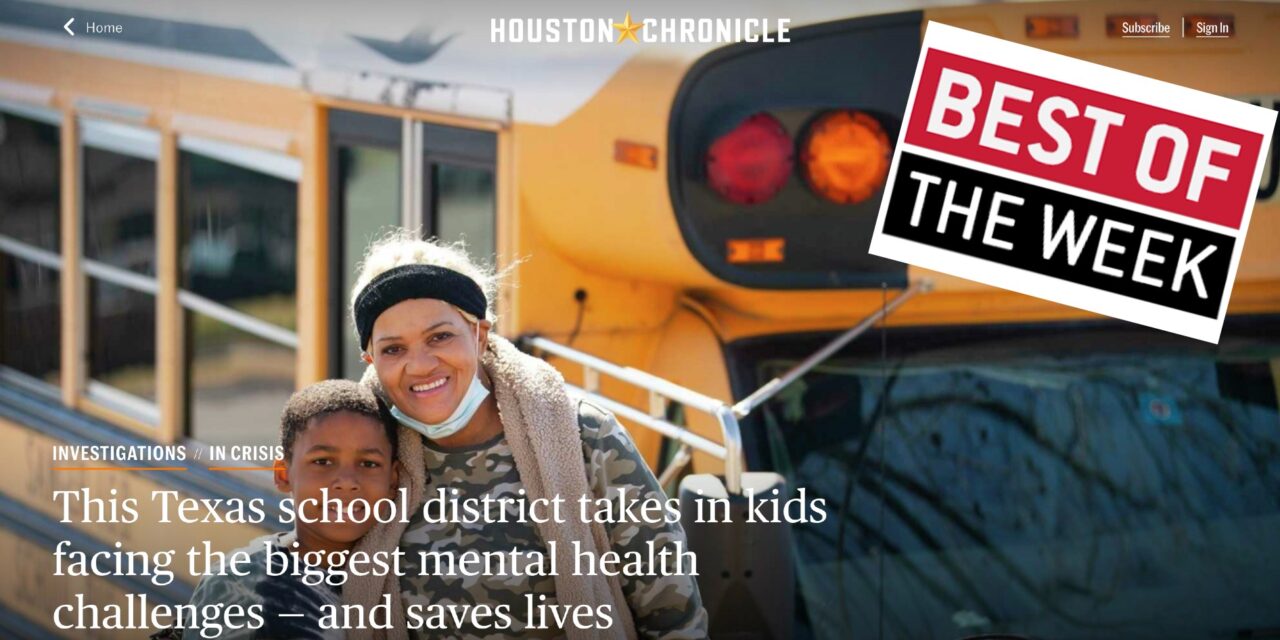
🏆 BEST: The best story of the week is In Crisis: This Texas school district saves lives of mentally ill kids by Alex Stuckey and Stephanie Lamm in the Houston Chronicle. Last week, we shared several stories about the so-called second pandemic of student mental health crises, a challenge that many school districts seem unable to meet. However, this story provides an example of a district that has found a way. Sanger ISD’s Challenge Program works to identify the root causes of behavior problems and goes from there, and it has found ways to pay for extra staff without state resources. Students are responding. Parents are seeing the results. It’s a great example of solutions journalism and a rare success story that I’d love to see reported more often. This is brave, important, and uplifting investigative journalism you don’t see often enough. And it seems like readers want more of it too: “This is the most encouraging, optimistic reporting, not just on education but on innovative mental health services as an essential aspect of public education in Texas I’ve seen in a long time.”
🏆 RUNNER-UP: This week’s runner-up is Inside the exodus from Bay Area neighborhood schools by Kayla Jimenez and Harriet Blair Rowan in the Mercury News. While several outlets across California covered the new state report showing steep declines in enrollment (see above), Jimenez and Rowan took the time and reported a much deeper story on what’s driving those numbers and where the “missing” students have gone. Some have stopped going to school, but Jimenez and Rowan found that often they’ve simply changed schools. One parent switched her kids to a charter school. Another family chose homeschooling. Lots of news outlets tell this kind of story from the district perspective. This is one of the few I can recall that tells it from the perspective of the parents and children. They, not the district, are the focal point.
BONUS:
🏆 A One-Woman Rescue Squad for Homeless Students in Rural Texas (The New York Times)
🏆 Why a Denver high school opened honors classes to all students despite pushback from parents (Denver Post)
🏆 What Chicago schools got right about parent outreach amid the pandemic (Chalkbeat Chicago)
🏆 Tennessee passed a law to restrict teaching about race. A year later, it’s barely been used (Wall Street Journal)
🏆 Tying shoes, opening bottles: Pandemic kids lack basic life skills (Washington Post)
🏆 Michigan schools were promised COVID aid. Then came the restrictions (Detroit News)

MEDIA TIDBITS
Thought-provoking commentary on the latest coverage.
Above: Recent Detroit News story about one district’s apparent overreaction against parent protests.
📰 COVERING SCHOOL DISTRICTS’ RESPONSE TO PROTESTS: We know that some districts have faced intense protests and loud threats against board members, as well as recall efforts. We know some districts have been inundated with FOIA requests. So would it be reasonable at this point for a mainstream national news outlet to report on how districts are responding to these challenges? Yes, it would. And in at least a few cases, the district responses have been nearly as intense as the protests. According to the Detroit News’ How Rochester schools targeted parents critical of COVID-19 policies, Rochester schools called at least two parents’ employers and sent the police to one parent’s house. In other situations, districts have collected dossiers on protesters and tracked their activities. A few parent protesters have been fired, doxxed, and attacked online. In a healthier news environment, I’d expect that heavy-handed school district tactics against parents expressing their concerns would garner a greater measure of national attention.
📰 HOW TWITTER COULD HELP EDUCATION NEWS: NYT head Dean Baquet is telling his journalists to cool it with Twitter, and one of his main rationales for telling reporters to stay away is the tendency to engage in criticism of colleagues and competitors. “I do not like it when somebody at The New York Times criticizes somebody at The Washington Post,” said Baquet in a recent interview. “It makes me uncomfortable when people do that.” (And he’s not alone. Longtime education journalist Greg Toppo describes it as a fool’s errand to try to engage in constructive criticism on Twitter, a platform he describes as “a forum for unchecked media-bashing.”)
However, I don’t see journalists criticizing each other’s work on Twitter as a major problem, at least, not among education journalists. There’s a growing amount of Twitter-based media criticism from advocates, educators, and civilians. A few education journalists call out problems that they see in stories or narratives, catching factual errors or possible bias. But that’s about it. While totally understandable, journalists leaving the debate over education coverage to others seems like a short-sighted way to go. Twitter could be a constructive place where journalists engage in discussion among each other about their work.
📰 NEW ERA FOR EDUCATION JOURNALISM: Last weeks’ exciting job announcements — Chrissie Thompson to AP and Sarah Garland to the New York Times — create big openings at the newsrooms they’re leaving. So does the fast-approaching search for a new EWA head now that Caroline Hendrie has announced her departure. Crossed fingers these organizations will consider talented people from all fields and backgrounds, bringing new voices into education journalism. They might be established education reporters who are interested in taking on new leadership challenges, or journalists from outside the education beat with strong ideas about how to rethink education coverage. Or, they could even be non-journalists, like EdNC’s Mebane Rash, who take a fresh look at newsgathering and information distribution, free from the traditions and the established culture of journalism. We need a new generation of leaders in education journalism.
Looking for media commentary and analysis all day, every day? Follow me at @alexanderrusso.

PEOPLE, JOBS, AWARDS
Who’s doing what, going where.
Above, clockwise from top left: NPR’s Anya Kamenetz, NBC News’ Mike Hixenbaugh and Antonia Hylton, and Epicenter NYC’s S. Mitra Kalita are among the many journalists honored for their education-related coverage recently.
🔥 It’s awards season, and these education journalists are winning! Congrats to NPR’s Anya Kamenetz, who won the American Educational Research Association’s Excellence in Media Reporting on Education Research Award. NBC News’ Mike Hixenbaugh and Antonia Hylton were nominated for a Peabody for their “Southlake” podcast. Former education reporter and Spencer fellow S. Mitra Kalita won the News Media Association’s 2022 News Leader of the Year Award. The association also honored the Center for Public Integrity’s Corey Mitchell and his colleagues for their story on criminalizing kids and Nashville Public Radio’s Meribah Knight and ProPublica’s Ken Armstrong for their report on Black children being jailed for a nonexistent crime. And among the finalists for the Deadline Club Awards are the Chalkbeat NY team for their coverage of remote learning, Colin Lecher and Maddy Varner of The Markup for their story on how NYC’s school algorithms reinforce segregation, NBC News’ Erin Einhorn and colleagues for their story on a segregation wall in Detroit, and NBC News’ Hixenbaugh and Hylton (again) for the “Southlake” podcast.
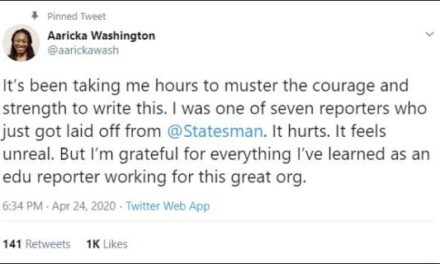
🔥 Comings and goings: EdWeek deputy managing editor Emma Patti Harris is leaving the outlet to join the new Baltimore Banner as the director of visual and immersive experience. We hear the Banner will soon announce its education team too, joining veteran reporter Liz Bowie, formerly of the Baltimore Sun. Congrats to former Houston Public Media education reporter Laura Isensee, who celebrated her first year freelancing with a fascinating thread about the highs and lows of the experience. And the Austin American-Statesman’s María Méndez published her last two stories for the paper before she moves on to the Texas Tribune, where she’ll be an engagement reporter.
🔥 Job openings: USA Today is looking for an education editor to replace Chrissie Thompson, and they’re still hiring a K-12 enterprise reporter to replace Erin Richards. The Dallas Morning News is hiring a reporter for their Education Lab. Chalkbeat Chicago is hiring a bureau chief. There are also job openings at Honolulu Civil Beat, the Austin American-Statesman, and the LA Times. Check previous editions of the newsletter for other listings that may still be open.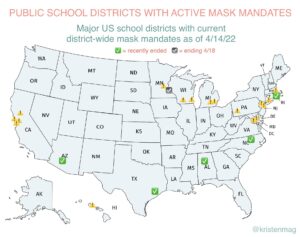
EVENTS
Above: A helpful DIY map (and Twitter thread) showing which districts are operating under mask mandates. See other resources below.
⏰ New initiative: Amanda Ripley, author of “High Conflict,” is partnering with the Solutions Journalism Network to launch a new program to help journalists produce more nuanced and helpful coverage. Want to be a part of it? Apply to their Complicating the Narratives Fellowship. To learn more, tune into their next event on April 21 on how to do this kind of journalism. And if you haven’t already, read our columns featuring Ripley’s views on complicating the narrative and the regrettable rise of “conflict” journalism.
⏰ Resources: The Cato Institute is tracking “public schooling battles” over curriculum, sexuality, gender equity, freedom of expression and more. FutureEd is tracking parent-rights bills across the country and also has a report out on the new power of parents in public education, written by Greg Toppo, Jo Napolitano, and Thomas Toch. And Burbio is tracking enrollment changes, broadly finding decreases in city districts and increases in rural areas, the suburbs, and towns.
⏰ ICYMI: NPR’s Anya Kamenetz spoke about focusing on “relationships and shared experiences as part of our collective post-traumatic growth” at the CAIS National Leaders Conference. And Vox’s Rachel Cohen spoke on a panel about equitable schools and equitable neighborhoods at the YIMBYtown housing conference.
THE KICKER
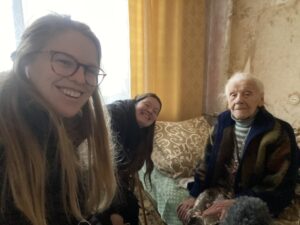
Above left: NPR’s Elissa Nadworny has (temporarily) gone from education reporter to war correspondent. Watch her talk about how education reporting has been a great help here. Find some of her widely-admired coverage here.
That’s all, folks. Thanks for reading!
Reply to this email to send us questions, comments or tips. Know someone else who should be reading Best of the Week? Send them this link to sign up.
Using Feedly or FlipBoard or any other kind of news reader? You can subscribe to The Grade’s “feed” by plugging in this web address: http://www.kappanonline.org/category/the-grade/feed/.
Read more about The Grade here. You can read all the back issues of The Grade’s newsletter, Best of the Week, here.
By Alexander Russo with additional writing from Colleen Connolly.
ABOUT THE AUTHOR

Alexander Russo
Alexander Russo is founder and editor of The Grade, an award-winning effort to help improve media coverage of education issues. He’s also a Spencer Education Journalism Fellowship winner and a book author. You can reach him at @alexanderrusso.
Visit their website at: https://the-grade.org/